Thailand has started deploying a canine virus-detecting squad in hopes of quickly identifying people with COVID-19 as the country faces a surge in cases, with clusters at construction sites, crowded slum communities and large markets.
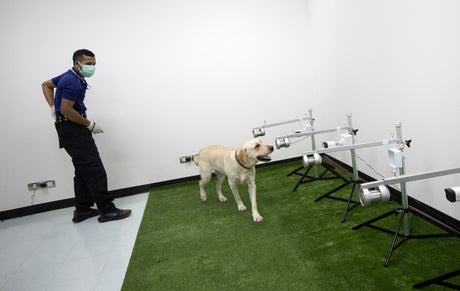
Angel Bobby and Bravo are among six Labrador Retrievers that have been trained by researchers at the veterinary faculty of Bangkok’s Chulalongkorn University to sniff out a unique odor that people with COVID-19 produce in their sweat, the researchers say.
Since May 10, the three have tested more than 1,000 samples from college staff, students and people outside the university.
The results so far are impressive. After a few seconds of sniffing sweat samples placed in metal containers, the dogs can tell which people have COVID-19 infections. If there’s no trace of infection, the dog will walk pass the sample. If it is positive, it will sit in front of it.
Prof. Kaywalee Chatdarong, head of the research team, said she was aware that other countries have been using dogs to identify coronavirus infections, including Finland, the United Arab Emirates, Germany and India but that she had no idea if it would work in Thailand because of the country's spicy and flavorful cuisine.
Suwanna Thanaboonsombat, a volunteer who collects samples to bring to the lab, said the canine testers add a big element of convenience because they can check samples from people who can't go out to be tested.
“People can simply put cotton balls underneath their armpits to collect sweat samples and send them to the lab. And the result is quite accurate,” Suwanna said.
The researchers plan to send the canine team out to communities suspected of being new COVID-19 hotspots. The dogs will work inside a mobile unit, while the collecting team can comb through the community collecting samples.
According to the U.S. Centers for Disease Control and Prevention, dogs are among a small number of pets that can become infected with the coronavirus, mostly after close contact with people with COVID-19. It says the risk of animals spreading the virus to people is considered low.
The Thai researchers said that as a safety precaution, they designed the sample containers so that the dogs’ noses do not contact the samples. They also believe the receptors on cells in dogs' respiratory tracts are not a welcoming environment for the coronavirus to attack.
Kaywalee said that while dogs can provide a fast and cheap testing alternative, they do have limitations.
“5 p.m. is their dinner time. When it’s around 4:50, they will start to be distracted. So, you can’t really have them work anymore. And we can’t have them working after dinner either because they need a nap. They are living animals and we do have to take their needs and emotions into consideration,” she said.
“But for me, they are heroes and heroines.”