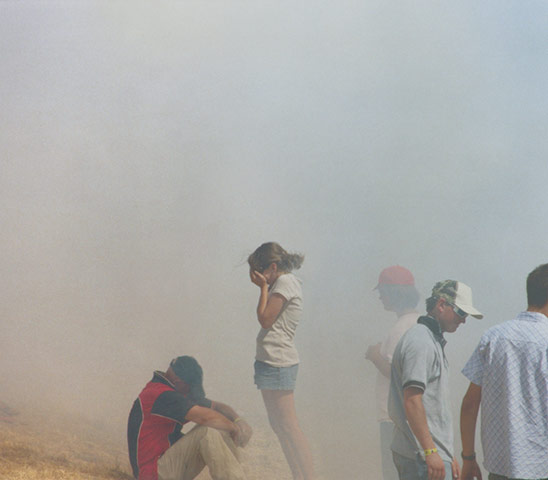
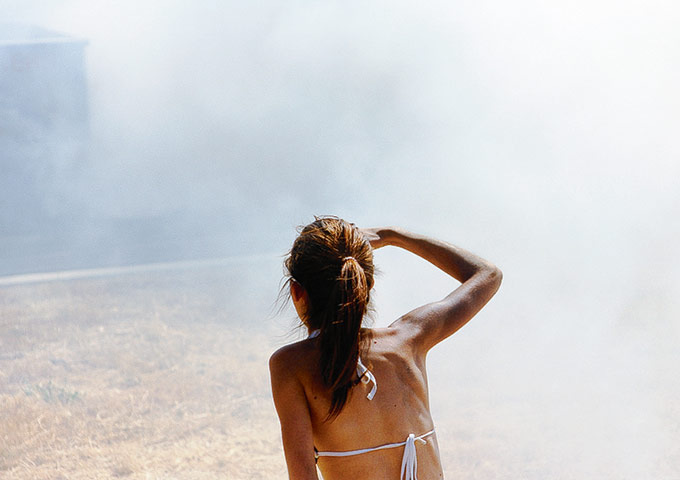
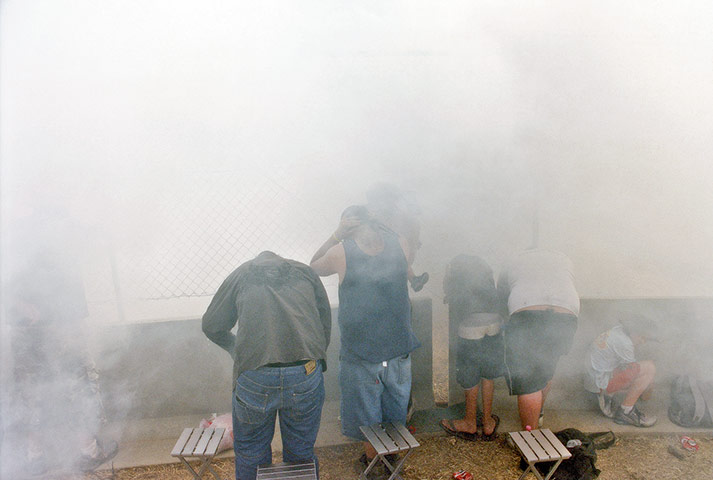
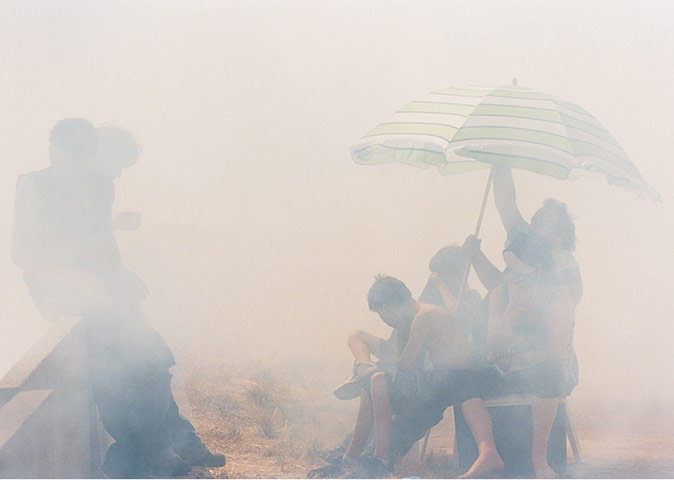
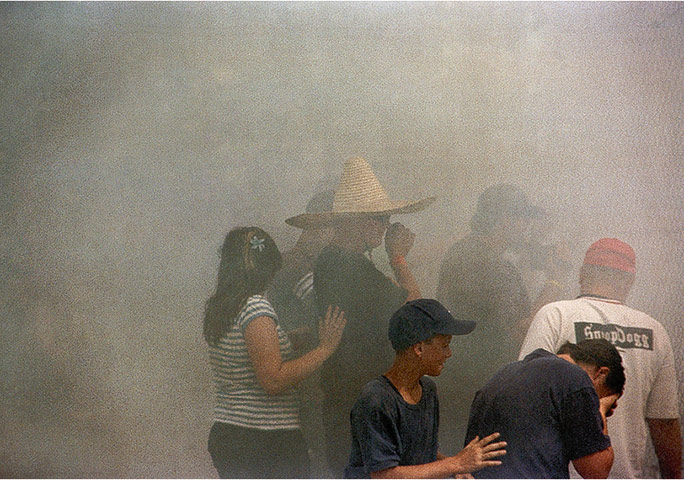
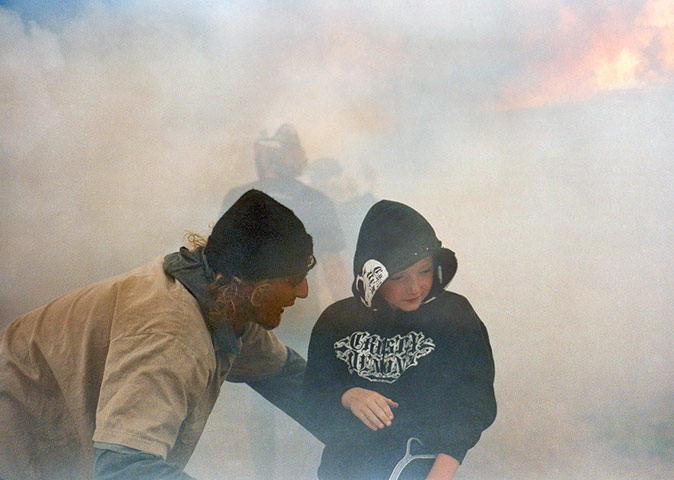
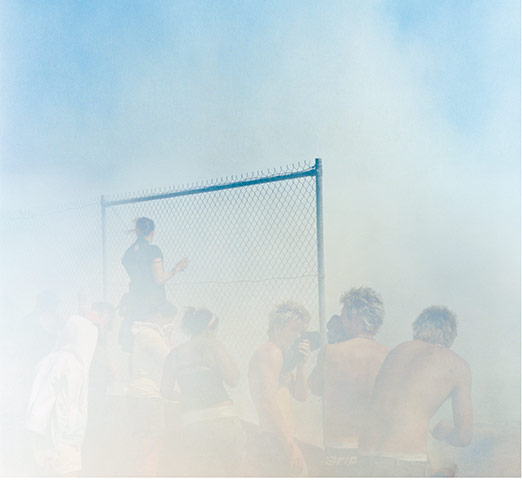
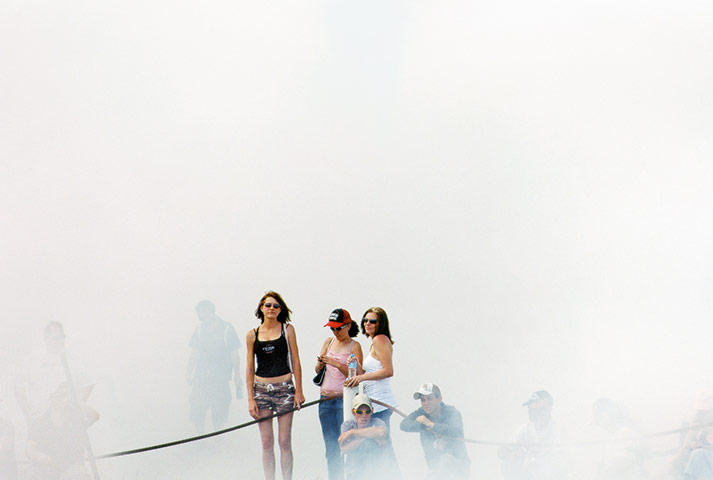
The first question you ask yourself about Michael Corridore’s photographs – “What is going on?” – is one that they refuse to answer. In this series of images, the figures are ghostly, partially resolved into the background or even, occasionally, the foreground. It’s not at all clear why they are where they are. Everything that is visible seems incongruous: a woman struggles to open up a beach umbrella in what looks like a war zone. Is she making a day of it? Why? Photograph: Michael CorridoreEven some of the subjects seem to wonder what’s happening as they peer into the void, looking for clues. Their expressions – when you can see them, that is – are ambiguous, but a lot of the body language seems to speak of shell-shock, or of grief: faces buried in hands, heads hanging in dejection. Are they victims? Refugees? Traumatised bystanders? It’s pretty clear that they’re either watching something horrible, or running away from something horrible, or both. Photograph: Michael CorridoreThe images become even more compelling when you find out they were taken at a sporting event, or at least a sort of one: the Springnats Car Festival, held annually in Shepparton, Victoria, in Australia. The faded figures are spectators at a burnout competition, a slightly esoteric drag racing spin-off in which contestants lock their brakes and spin their rear wheels until smoke billows from the undercarriage and the tyres explode, producing cheers from the assembled crowd, along with a thick haze of oil, dust and burnt rubber. The title of Corridore’s series, Angry Black Snake, stems from the moment when an engine blows up during a burnout performance, sending radiator hoses rocketing skyward through the smoke. If it doesn’t sound like much fun to watch, well, it doesn’t look like much fun to watch, either. Photograph: Michael Corridore
Initially drawn to the car festival subculture as a subject, Corridore began to explore the more abstract compositions brought about by a convergence of figure, landscape and atmosphere. He says he was “looking for fiction in real situations”, and calls the images “unreliable documentary”. “They don’t tell the right stories,” he says. “They don’t give up information.” Photograph: Michael CorridoreViewers are purposefully given room for misinterpretation, space to read as much, or as little, into the scene as they wish. “A lot of people do think it’s some sort of tragedy,” Corridore says. “Something apocalyptic, like a brush fire. But a lot of people think I’ve invented them completely.” Photograph: Michael CorridoreIn fact, none of the scenes is staged, though waiting around to catch them required a tremendous amount of patience, and several successive visits to the festival over the years. The variables of whim, wind and smoke made it difficult to plan anything. “These moments are very short,” Corridore says. “They last only a few seconds.” Photograph: Michael CorridoreAnd the environment is as difficult to work in as you might imagine – the acrid smoke burns the throat, the noise is deafening and the oily air coats spectators and photographer alike in a blue-black soot. “It’s quite draining,” Corridore says. “It looks like you work in a coal mine at the end of the day.” Photograph: Michael CorridoreYet despite this, Corridore insists that the people who attend these burnout competitions are having a good time. “They pay a lot of money to go to these events,” he says. “It’s like a family thing.” Even so, you can see from the covered faces and turned heads that this sort of fun can be a little bit unforgiving. “Yeah, it does sting,” Corridore says. “Some people love it. Some people who come aren’t really aware of what they’re getting into.” Photograph: Michael Corridore
Sign up to read this article
Read news from 100’s of titles, curated specifically for you.