Just one person around here looks shiftier than me. I would put her in her 20s. She’s standing in the colonnade with a yellow pouch of tobacco, peering out into the main square and taking pains not to be seen from it. But I’ve seen her. That bright ski coat is a problem. Yes, she admits. She’s seen the signs. No, she won’t talk to the Guardian about them. She’s off to smoke this cigarette somewhere else anyway.
It was here in Bristol 459 years ago – maybe right here, actually, since we’re so near the docks – that the first person was recorded smoking tobacco in England. He was a sailor, one of the drug’s first importers, you might guess, seen “emitting smoke from his nostrils”. Now the city has taken the lead – a slender lead – in bringing the long, sad chapter that he started to a close.
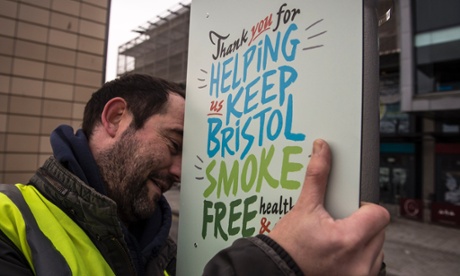
There is no official ban on smoking in Millennium or Anchor Square. At this stage, it is just official tutting. Nevertheless, it is the first time that British smokers have been told not to light up in an outdoor public space (if you set aside special zones such as playgrounds, hospitals or picnic areas). “Thank you for helping us keep Bristol smoke free, healthy and clean,” the signs say on every lamp-post, their blue and green letters looking really delighted. Evidently, passive aggression poses a lower public health risk than passive smoking.
Although, in truth, the smoke itself is not the issue. Outdoors, the effects on health of an occasional wisp is far below anything you could measure confidently. “These city-centre squares are often full of children playing, and this pilot will provide a smoke-free environment for kids and their families to enjoy,” says Fiona Andrews, director of Smokefree South West, which put up the signs. But smokers were doing nothing to impinge on families’ enjoyment, besides making a slight smell and leaving bits of litter. The real battle is psychological. When smoking is made less visible, it is also made less convenient and less normal, with the result that fewer people start smoking, and more stop. The signs have been declared an experiment, with more to follow elsewhere if they are considered a success – which presumably means not much grumbling.

This is a symbolic moment for Bristol, and for Britain, but there can’t be many who are surprised by it. Cigarette advertising was banned in 2003. Smoking in pubs and other workplaces was banned, after a battle, in 2007, when the smoking age was also raised from 16 to 18. Cigarette vending machines were banned in 2011. The display of cigarettes in large shops was banned in 2012, and will be extended to small shops in April. Tax on cigarettes has risen progressively, including a big rise in 2012. Labour plan to tax tobacco companies directly, too. Smoking in cars with children in them will be banned from 1 October. More legislation to mandate plain packaging for cigarettes is on its way this spring.
The government says it has no plans to ban smoking in public places, but the pressure to do so is present and growing. Last October, Lord Darzi published a report recommending that Boris Johnson use his powers to ban it in Parliament Square and Trafalgar Square, and in London’s royal parks, and expressed the hope that borough councils would do the same in the spaces they control. The mayor said he’d consider the measures if they could be proven to save lives, while Tessa Jowell, who hopes to be Labour’s candidate against him at the next election, has promised to introduce them. If a ban does come, it will only be following in the footsteps of New York, Hong Kong, much of Canada and many other places. According to 2013 figures, 18.7% of British adults smoke. Cancer Research UK wants to get that below 5%, and Scotland has committed itself to do so by 2034. Surely no smoker still suspects that a plot exists to marginalise their habit. It exists in plain sight.
So how do they feel about it in Millennium and Anchor Square? Charles Watkins, 31, is a graphic designer. He puts his tobacco pouch away as I draw near. Have I shamed him out of it? “Kind of a little bit, yeah. I don’t usually smoke during lunch. It’s one of those naughty days,” he says. So what does he think about the new signs? “It kind of makes me want to vomit up my soul.” After more questioning, it becomes clear that he means the typography rather than the words. They just make him “a bit sad”. He sounds wistful for the old days, but not like he wants them back.
Chris Colburn, also 31, is a guest at a hotel nearby. He’s standing just outside the smoke-free zone, but is clearly visible next to it – as is the large chrome ashtray that his hotel provides. He understands the signs, he says, but hopes things don’t become unreasonable. “I hide my smoking from my children. But if you’re outside, where else are you supposed to go? Have they allocated anywhere?” He is an asbestos consultant, and admits that this probably makes cigarettes seem rather tame.
Jamie Goodwin, 30, a web entrepreneur, often smokes here on his way to the gym – “ironically” – but is perfectly phlegmatic about the new regime. “I don’t really feel that much either way about it,” he says. “To be honest, I’m happy not to smoke in the square if that’s for the best.”
Clearly these smokers cannot stand for smokers everywhere. Still, it is striking that none of them really objects to the restriction or disputes the basic anti-smoking message. All, in any case, plan to quit eventually. Smokers now, you feel, are used to being pariahs.
But that does not mean that they are all resigned to it. Forest – that is the Freedom Organisation for the Right to Enjoy Smoking Tobacco – are a pressure group funded mainly by the tobacco industry. They insist that they speak independently, but it is not clear how many smokers’ views they really represent. Simon Clark, the director of Forest, and not himself a smoker, considers Bristol’s smoke-free zones “illiberal and unwarranted”. In his view the authorities are stealthily “trying to get to prohibition via a series of steps”.
When you talk to people who work in tobacco control, however, this does not sound like what they’re up to. Between 2006 and 2010, Professor Linda Bauld served as the government’s scientific adviser on tobacco control and chaired the National Institute for Clinical Excellence’s guidance on tobacco harm reduction.“The smokers I work with in my studies,” she says, “always say: ‘Why doesn’t the government just ban them?’” The simple answer is that it would be nearly impossible to get the legislation through, and then completely impossible to enforce it.
Bauld would like to see some new approaches, but she’d like to see them arrive faster – not stealthily. In fact, the slow decline in smoking seems to have accelerated since the pub ban of 2007 – and, just recently, accelerated further. After 2007, the proportion of British adults who smoked fell by about half a percentage point a year. Now it is more like a whole point each year. What is more, the decline is happening at each end – with smokers giving up and new ones not replacing the dead ones fast enough. Even so, Bauld says she is “increasingly frustrated … One percentage point a year is not enough.”
Some examples of what might be coming: besides new rules on plain packaging, financial incentives, especially with pregnant women, might play an important role. A study that Bauld conducted with Professor David Tappin, published in the BMJ last month, found that pregnant smokers who received £400 of shopping vouchers in return for using the NHS quitting service were more than twice as likely to give up than those who were offered the quitting service on its own.
There’s also the recent arrival of vaping, or e-cigarettes, which now have more than two million users in the UK, whatever the debate about their value as quitting aids. One way or another, committed smokers need to know that they are heading towards a life on the margin of the fringe.
This poses a question that needs answering. As the TV chef Antony Worrall Thompson puts it on the Forest website, “Why should the anti-smoking lobby dictate our lifestyle at the expense of our well-known culture of tolerance?” Well, tolerance is fine, but it has limits. Most people would agree that we should not proudly “tolerate” someone’s decision to jump off Beachy Head. We should try to talk them out of it.
Many people carry baggage on this subject, so in case you’re wondering, I’ll quickly unpack mine. I smoked my last cigarette in a flat in Camberwell in 2002, in the bath in fact, when I was 26. I’d been a regular smoker since about 14. It’s hard to be exact because it was such hard work to get the habit going. Starting smoking wasn’t cool. What was cool was to be a smoker, hopelessly. Addiction was something that we bragged about once we got there, being a little ruined ahead of time. I gave up just once, and now I never miss it.
So are smokers making a free choice worth respecting? Was I? There are some good reasons to say no. Roughly two thirds of smokers start as children at a time when the law wouldn’t consider you competent to borrow money or vote, let alone embark on a life-endangering addiction. It’s also clearly the case that single most important factor determining whether somebody will take it up is whether the people around them do. A child with two smokers for parents is three times more likely than average to follow them.
Smoking is addiction. Survey data from the UK the US consistently shows that around 70% of smokers want to stop, and that in any given year about 40% try. Are these people making a free choice to smoke? Or are cigarettes themselves what restricts their freedom? Might they not be freer, after a little while, if cigarettes were made too difficult to bother with?
There is also a strong but often overlooked correlation between smoking and mental health problems – most likely not because smoking causes them, but because of its pharmacological effects, or the mental strain of giving up. “It’s a huge issue for us,” Bauld says. “In inpatient psychiatric units you’ll find that between 70% and 90% of the patients are smokers. That’s just the reality. It’s really high.” It may also often be that people with mental health issues find the stress of nicotine withdrawal especially difficult.
Finally, smokers do not only harm themselves. So it is not only their lifestyle that needs to be considered. In the case of passive smoking, the science is stark. Each year around 9,500 admissions to British hospitals are children with health problems caused by it. The World Health Organisation estimates that around 600,000 people die each year because other people smoke, and five million smokers die every year – ultimately – because they copied other people. “Basically we need adult smokers to stop,” Bauld says. “I’ve spent 15 years doing research in this area, and I’ve never met a smoker who wants their child to start smoking. Never, ever, ever.” Children might be optimistic, but grandchildren look a decent bet.
In the meantime, pariah status has its uses. In Bristol, 20-year-old Bethan is reluctant to give her name in case her dad finds out she smokes. She’s not a local, and she’s mortified to find what she and her cigarette have wandered into. “It’s bad for my health, it’s bad for everyone else’s health, it makes sense for it not to be here,” she says. “Actually, I’m going to put this out.”
The worst places on Earth to be a smoker
Bhutan Perhaps the strictest anti-smoking laws in the world. Tobacco was banned in 2004; anyone smoking in a restricted area gets three years in jail. In 2011 a monk received the same sentence for smuggling in $2.50 worth of chewing tobacco.
Serbia Found to have the highest smoking rate in the world by the World Lung Foundation: 2,924 cigarettes per person per year, or about 8 a day. A strict set of anti-smoking rules put in place in 2010 were, perhaps unsurprisingly, highly unpopular.
Isle of Man On top of the UK smoking ban, the Isle of Man has a smoke-free prison, where new inmates are presented with nicotine patches and told to give up. But a 2011 report found that prisoners were boiling up the patches to make a crude tobacco.
California The city of Belmont has perhaps the strictest anti-smoking legislation in America. Thanks to the lobbying efforts of a group of retirees, cigarettes are banned even in private apartments in multi-story blocks.
Costa Rica Enforces strict anti-smoking laws, with no cigarettes allowed in public parks or on university campuses. There is, however, one remarkable -anomaly: the minimum smoking age is a precocious 10.