A friend of mine in Chiang Mai recently lamented the double standards regarding the way in which the government and society has responded to the haze problem in the North.
"Why do people only care about the haze in Bangkok, but not in Chiang Mai and the northern provinces? Why is the government only active in solving problems in Bangkok but not here?" she asked me in exasperation.
I totally sympathise with her and the residents of towns and villages in the North for their plight being ignored.
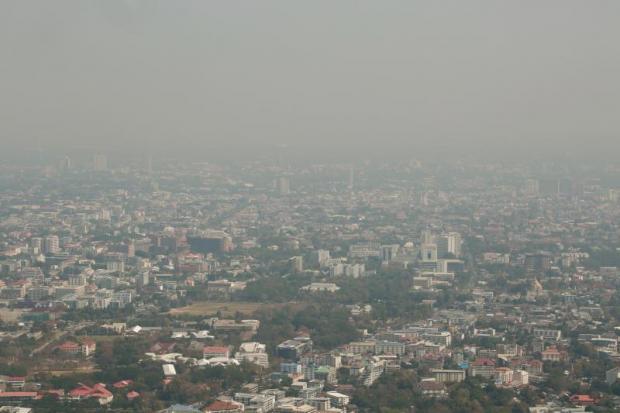
Since February, PM2.5 levels in the North have soared beyond healthy limits. The sky in Chiang Mai has been shrouded in thick mist, blocking the view of the iconic Doi Suthep.
As a result of their suffering, residents in Chiang Mai have started to get tough with the government, such as key environmentalists like Dr Rungsrit Kanjanavanit, a cardiologist and lecturer at the Faculty of Medicine at Chiang Mai University. Dr Rungsrit adopted a sarcastic tone when he recently announced Chiang Mai was an environmental disaster zone.
Last week, residents started gathering signatures to remove provincial governor Supachai Eiamsuwan from office, accusing him of not doing enough to solve the problem. Local people feel as if they have been left to battle the hazardous haze on their own. All they can see is officials resorting to passive measures such as using water cannons to tackle the dust, making artificial rain, or distributing face masks.
Needless to say, these methods are not sufficient to cope with the magnitude of the problem.
What seems apparent is that the problem of haze in the North is more complicated than what residents in Bangkok have had to face.
Haze has been a seasonal problem in the North for over a decade. It usually appears between January and April, with a peak in March as the extremely dry conditions increase the magnitude and number of fires.
The cause of haze in the North boils down to forest fires and open burning of farmland to prepare for the next harvest of mass crops such as maize. Things are made worse by the topography of the region which makes haze linger for longer.
The problem is also compounded by trans-boundary haze coming from Laos and Myanmar. Farmers in neighbouring countries also embrace monoculture. For instance, farmers in Laos and Myanmar prefer to plant corn while those in Cambodia opt for sugar cane.
In terms of forest fires, there should be a new national body with authority to arrest wrongdoers. It should have an adequate budget to invest in sophisticated equipment and the necessary manpower to handle forest fires in different areas.
Indeed, the Pollution Control Department (PCD) did a marvellous job in bringing down haze levels in 2017-2018. The secret of its success came from a clear policy and stringent law enforcement.
The Ministry of Natural Resource and Environment and the military combined forces to track down, monitor and prevent farmers from starting fires. The authorities also used a satellite system to monitor fire hotspots which helped in curbing forest fires.
However, the system was changed this year as the central government shifted power to the provincial governors. This means that provinces with smaller farming areas and efficient governors can easily tackle this problem.
However, to make efficient haze control a reality, the country needs a central body to assist provincial governors and local administration to do their work.
At the same time, we can use economic measures to encourage farmers and companies to help combat haze. With regard to this, Thailand can learn from Singapore.
The Asean region has long suffered from trans-boundary haze caused by open burning from palm oil plantations in Indonesia. The scale of the impact is severe. In 2015, the impact of haze to the economy and health of residents of Singapore was registered at US$515 million (16.6 billion baht), according to the Singapore Institute of International Affairs (SIIA), a think-tank on national policy.
Most people believed Singapore could not do much, but the city-state proved that an economic mechanism can work wonders in dealing with air pollution even if the source is located in another country. Without any oil-palm plantations of its own, Singapore plays a big role in the downstream trading and financing of the palm oil trading industry. Temasek Holdings, the state investment fund, as well as major Singapore banks DBS, UOB and OCBC are also involved in palm oil investments.
In fact, the city-state has set a goal of becoming a hub for a sustainable supply chain for agricultural products.
It started campaigning among consumers so it could force those in the business to use only palm oil products from green suppliers.
The Singaporean government also worked with the United Nations Environment Program to draft guidelines for local banks in financing the palm oil business.
Through market and financial mechanisms it is possible for society to deal with open burning in the farming sector which is a major source of haze.
In Thailand, it's time society helped create a market that favour companies that buy sugar and corn from sustainable supply chains. Economic institutions and government can impose laws and policies forcing companies to invest and purchase products from farms that do not use open burning; while consumers should be more willing to pay a premium for greener products.
Without these measures, at the end of the day, we will increasingly see water cannons, face masks and artificial rain while our lungs become even more blackened.
Anchalee Kongrut is an assistant news editor of the Bangkok Post.