The industry has been debating convergence for a quarter of a century. Were we going to watch TV on computers, or surf the web on TVs?
Fast forward to 2013 and we are converged. We have the luxury of watching television wherever and however we want, in HD or 3D, via the internet on our computers, one of our many handheld devices or our smart TVs. This has had a big impact on how we view, what we view and when we view. One thing that has not changed is content is still king, because consumers are smart, too, and know what they want and where to get it.
So is this going to be the year that the commissioning battle between traditional broadcasters and internet broadcasters really kicks off? There is an awful lot riding on this – politicians are anticipating all delivery by the net, and a £2.5bn spend on smart TVs. Electronics manufacturers have unveiled yet another generation of ultra-high definition sets at the Consumer Electronics Show in Las Vegas while most of the last generation is still sitting in the shops, if the shop has not already gone bust in these austere times. Major players such as Apple, Google, YouTube, even the supermarkets with such services as Tesco's Blinkbox, are all banking on it.
Netflix has earmarked $3.7bn (£2.4bn) for exclusive content over the next five years, gambling on Forrester Research's forecast that by 2016 more than half of all TV content will be delivered via the internet and on-demand, with the PC and web-enabled television set having to concede some ground to mobile phones, games consoles and tablets. This time last year, Amazon's LoveFilm was where you went for movies, and Netflix for your online "box sets" of TV series. Now Warner Bros says it is developing original programming for both and they are making high-profile investments, such as NBCUniversal's deal with LoveFilm for hundreds of hours of classic US TV shows and a Disney deal for Netflix which chief content officer Ted Sarandos described as a "game changer".
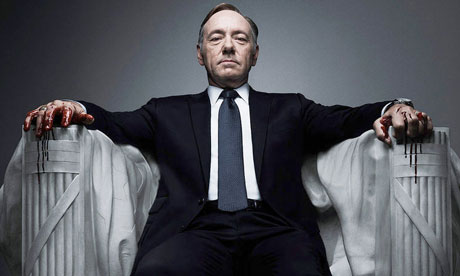
Creative scheduling of Kevin Spacey and David Fincher's complete 13-part remake of House of Cards globally on one day (which goes live online today), the new series of Arrested Development and exclusive windows on such shows as Lillyhammer, as well as optioning a couple of books, has given Netflix a high profile and some credence as a production investor. This week the company launched a $400m bond offer, more than half of it to refinance debt, but, according to chief finance officer David Wells, it could also help finance future original series if House of Cards is a hit with subscribers.
All this investment in content should be good news for the creators and producers on the endless round of funding their next commission. More buyers in the market, more opportunities to sell and if you are lucky enough to have a programme format or drama that the competing commissioning parties want, then the price you demand could include a "bounty commission".
Producers just want to get their programme made and have always veered towards the traditional broadcasters as their first port of call, for the kudos of having the programme screened on a major channel. So should producers now rethink this strategy to include Netflix, LoveFilm or Hulu – does it make sense to look for a longer-term relationship with one of the new players?
Netflix launched in the UK with no intention of setting up a commissioning team, or even a UK office, to launch their assault on our traditional broadcasters, among which we now have to include Sky with its £600m investment in "home-grown programming" by next year – it's time to get over the fact they were the new player on the block a mere 25 years ago. This is a huge commitment – ITV invests £1bn on content each year across the channels and itv.com.
The traditional broadcasters have long anticipated all this, and established very sophisticated streaming and catch-up TV platforms and multiple channels all with their +1 options, as well as investing in live event based TV – must-watch-now-rather-than-later and supported by spinoffs and interactive versions. A former head of entertainment at ITV once said to me: "If I commission a programme for Saturday night and it delivers less than 9 million I am a failure, yet if I commissioned a programme for Channel 4 and it delivered 5 million I would be a success".
We should never underestimate the pressures on the individual commissioners or the role they play in shaping our TV viewing. To really compete in the commissioning ring, the new players need to establish teams and structures here that understand their audience and build long-term relationships with the key producers and talent. It's not just about deep pockets.
Knowing your market matters even more and the broadcasters are upping their game with increased content spends which, along with the appetite for such international acquisitions as The Killing and Borgen on some of the secondary channels, has inspired a new rush of high-quality commissioned drama for the mainstream.
Many years ago ITV put five dramas into research and the one that came out bottom was 'Cracker'. Had the head of drama not fought for this wonderful crime series, it would never have come to our screens. The drama that came out on top in the research was automatically commissioned, against the advice of the commissioner. It ran for one short series and was never heard of again.
Take heed, new players – you cannot commission by algorithms. It takes extremely talented people with a gut feel and years of experience. Keeping their focus on a very clever "acquisition" strategy and using their expertise and insight on data to market and create new global audiences second, third or fourth time around for programmes, is the way for the new players to get in the game. In return the traditional broadcasters should not engage in a commissioning battle just for the sake of winning (perhaps never making the project), and concentrate on new commissions with deficit financing from internet broadcasters. That way the industry benefits, the consumer benefits and it should be a win-win for all the key players.
Consumers just want what they want and will find it wherever it is – I recently heard someone say "they just devour a la carte". Hopefully the battle for their money will not end up burying some potentially great new productions just to outbid a competitor and satisfy shareholders and egos. Let's be smart about smart TV, because the audience definitely is.
Debbie Mason is an expert in digital and broadcast media, who runs the consultancy Mason Media Matrix.
Get more articles like this sent direct to your inbox by signing up for free membership to the Guardian Media Network – this content is brought to you by Guardian Professional.