
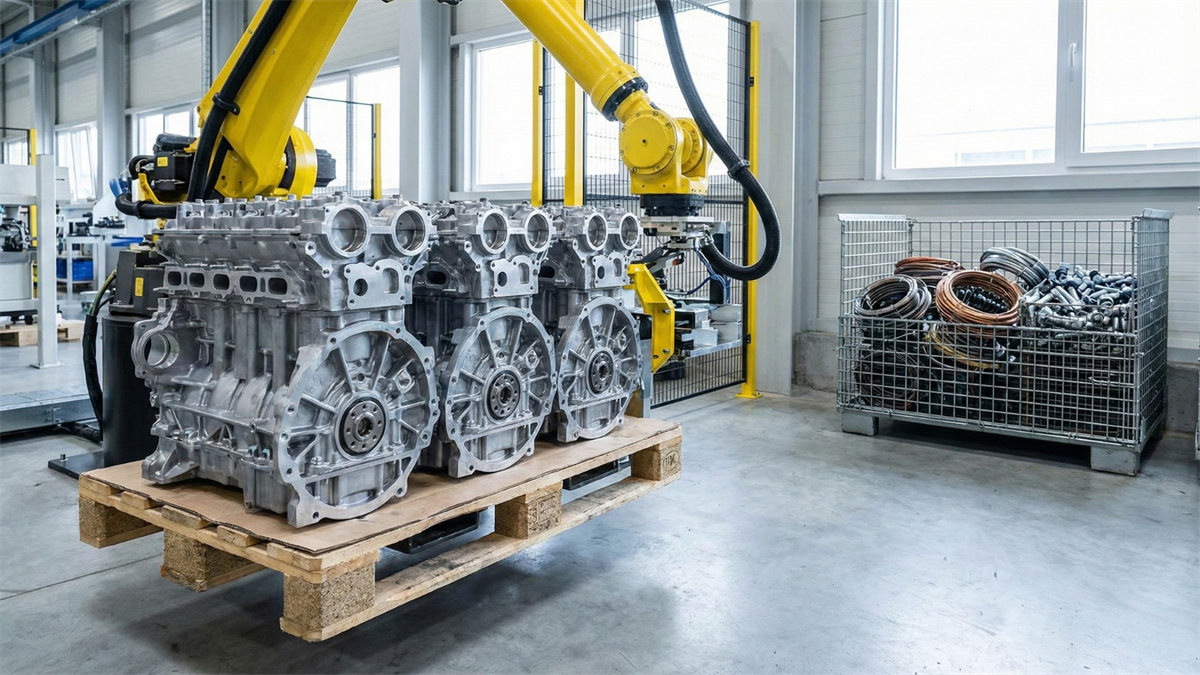
The automotive industry is currently navigating a period of intense volatility that has left many investors on the sidelines. Major car manufacturers, known as Original Equipment Manufacturers (OEMs), are locked in a capital-intensive battle for market share. Headlines are dominated by aggressive price cuts, shrinking profit margins, and a high-stakes race to develop electric and autonomous technologies. For the average investor, trying to predict which car brand will emerge victorious and which might face bankruptcy is a risky gamble.
However, there is an alternative investment strategy that bypasses this uncertainty: the picks and shovels approach. Instead of betting on which logo will be on the hood of the next bestseller, investors can focus on the companies that build the essential infrastructure for all of them.
Tier 1 suppliers, such as Magna International (NYSE: MGA) and Autoliv (NYSE: ALV), provide the critical backbone of the modern vehicle. Whether the future is electric, hybrid, or gas-powered, these companies get paid. Recent market data suggests these two suppliers are not just surviving the current turbulence; they are thriving. By decoupling themselves from the risks plaguing individual car brands, Magna and Autoliv offer a compelling mix of deep value, steady income, and disciplined growth that is hard to find elsewhere in the automotive sector.
Undervalued and Cash-Rich: The Numbers Don't Lie
When comparing these suppliers to the broader electric vehicle (EV) sector, the valuation gap is striking. Pure-play EV stocks often trade at high multiples based on future growth promises. In contrast, Magna and Autoliv offer grounded metrics that appeal to value-oriented investors looking for safety in a high-interest-rate environment.
Bargain Valuations with Built-In Yield
Current market data highlights Magna International trading at a forward price-to-earnings ratio (P/E) of just 8.84. Similarly, Autoliv trades at a trailing P/E of approximately 12.5. These figures suggest that both stocks are priced significantly lower than many of their technology-focused peers, offering an attractive entry point for long-term holders.
Beyond value, these companies provide an income safety net through dividends and share buybacks, acting as a buffer against market volatility:
- Magna International: Offers a dividend yield of 3.74%. The company also recently approved a new share buyback program authorizing the repurchase of up to 10% of its public float, signaling management's belief that the stock is undervalued.
- Autoliv: Provides a dividend yield of 2.87%. The company has been aggressive in returning capital to shareholders, repurchasing $100 million in shares during the third quarter alone while maintaining a healthy leverage ratio of 1.3x.
Cutting Costs to Boost Cash Flow
High dividends are only sustainable if a company generates cash. Magna and Autoliv have demonstrated remarkable operational discipline to fund these returns. In their recent third-quarter reports, both companies lowered their capital expenditure guidance for 2025, pivoting from expansion to efficiency.
Magna, for instance, reduced its projected spending to approximately $1.5 billion during its third quarter of 2025. This operational tightening directly boosted free cash flow, which jumped by nearly $400 million year-over-year. Similarly, Autoliv is targeting an operating cash flow of roughly $1.2 billion for the full year, as reported in its third-quarter 2025 earnings report. By prioritizing efficiency over reckless spending, these suppliers are converting revenue directly into shareholder value.
The Brand Agnostic Growth Engine
While Western automakers worry about losing market share to new competitors, Magna and Autoliv have positioned themselves as neutral arms dealers. They are winning business in the critical Chinese market by supplying the latest winners of the auto industry, proving that their growth is not tied to the success of legacy brands.
Magna’s Strategic Pivot: Assembling the Future
Magna International possesses a unique advantage: it is the only supplier globally capable of assembling complete vehicles for other companies. This capability has turned a potential threat, the rise of Chinese EV exports, into a significant revenue stream.
Magna recently secured a contract to assemble electric vehicles for XPENG (NYSE: XPEV), a major Chinese automaker, at its facility in Graz, Austria. This deal is a masterstroke in strategy.
It proves that Magna can pivot its existing European assets to serve whoever creates the most demand, regardless of their country of origin.
Furthermore, Magna raised its full-year 2025 sales outlook to $41.1 billion to $42.1 billion, underpinned by these strategic wins.
Autoliv’s Market Share Dominance
Autoliv’s competitive moat is built on a simple reality: safety is mandatory. Every car needs seatbelts and airbags, regardless of whether it runs on batteries or gasoline.
As the global leader in automotive safety with over 40% market share, Autoliv is uniquely positioned to capture growth across the board.
Recent third-quarter data underscores this strength. While many global brands faced declining sales volumes in China, Autoliv’s sales to domestic Chinese automakers surged by 23%.
This confirms that Autoliv can continue to grow its revenue even if Western brands lose market share in the world’s largest auto market.
Resilience in the Face of Disruption
Investors are rightfully concerned about trade tensions and supply chain disruptions. However, the data suggest that Magna and Autoliv are managing these risks far better than the market gives them credit for.
Trade barriers and tariffs are a reality of the current geopolitical landscape. Yet, both companies have proven they have the pricing power to pass these costs along to their customers.
- Autoliv: Successfully recovered approximately 75% of tariff-related costs from its customers in the third quarter, preserving its profit margins.
- Magna: Management projects that unrecovered tariffs will have a negligible impact on margins, less than 10 basis points, throughout 2025. This indicates that mitigation strategies are already effectively in place.
Supply Chain Resilience and Diversification
Both companies are also taking active steps to secure their supply chains against future shocks. Autoliv recently struck a deal with Kolon Industries to build a new airbag cushion plant in Vietnam. This strategic move diversifies their manufacturing footprint, lowers costs, and bypasses potential geopolitical choke points in other regions.
Furthermore, investors have noted potential headwinds from semiconductor shortages at supplier Nexperia and from aluminum disruptions at Novelis. While these are valid concerns for the fourth quarter, Magna’s raised guidance implies that these risks are known, quantifiable, and already baked into their financial outlook. This transparency significantly limits the potential for negative surprises.
The Value Investor’s Entry Point
The automotive industry is in transition, and transitions create volatility. However, for investors willing to look past the headlines of price wars and brand rivalries, the path forward is clear. While OEMs offer speculation and high cash burn, Magna International and Autoliv offer foundational value and operational discipline.
These companies provide exposure to the same high-growth trends, electrification and the booming Chinese market, but with significantly less risk. With raised full-year guidance, rising cash flows, and strong dividend yields, Magna and Autoliv represent a stable, data-backed entry point into the future of mobility. For those tired of the roller coaster ride of EV stocks, these suppliers offer a much smoother journey.
Where Should You Invest $1,000 Right Now?
Before you make your next trade, you'll want to hear this.
MarketBeat keeps track of Wall Street's top-rated and best performing research analysts and the stocks they recommend to their clients on a daily basis.
Our team has identified the five stocks that top analysts are quietly whispering to their clients to buy now before the broader market catches on... and none of the big name stocks were on the list.
They believe these five stocks are the five best companies for investors to buy now...
The article "Smart Money Is Buying Auto Suppliers, Not Car Brands" first appeared on MarketBeat.