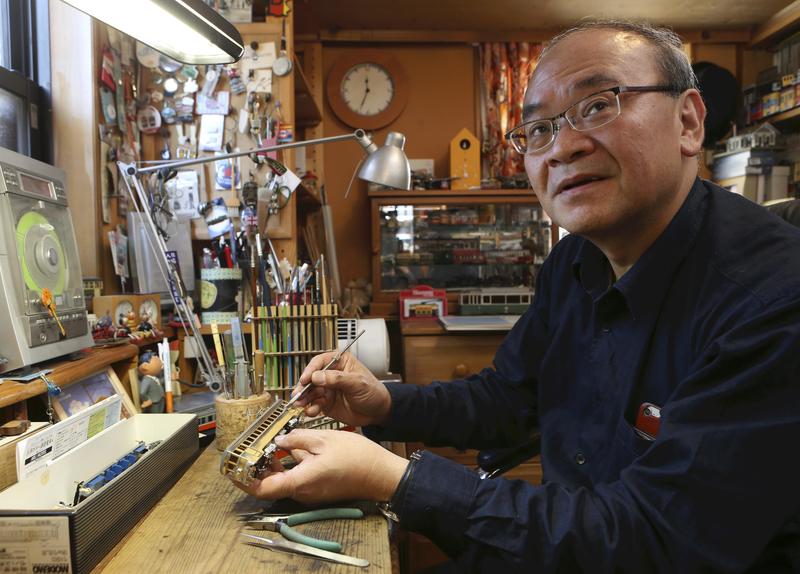
Model railroads fascinate children and adults alike. Professional model railroad artisan Yoichi Miyashita makes dioramas with realistic model trains running through nostalgic townscapes, mixing a world of imagination and reality.
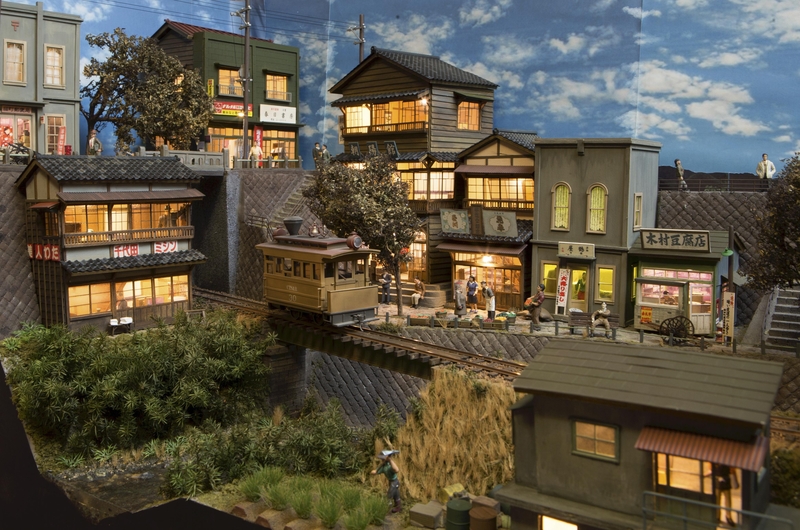
One of his dioramas re-creates a scene of a retro train as it runs across an iron bridge over a river at dusk as electric lights flicker on at shops and inns along the riverside.
Miyashita said he spent about a year making the diorama after being inspired by an essay called "Nekomachi Kiko" (cat town travelogue) written by manga artist Yoshiharu Tsuge. In the essay, Tsuge writes about good old Japanese towns he has seen.
"I created a wonderous world by combining the townscape I remember with the streets described in the essay," Miyashita said.
For his model railroads, Miyashita mainly uses the HO gauge, with a 16.5-millimeter-wide track, which is predominant in Western countries where homes are spacious. Track gauges are different depending on the scale of the model trains. In Japan, the 9-millimeter N guage is popular as a diorama can be made over a space the size of one tatami mat.
N gauge model trains, buildings, mountains and other scenery are readily available in the Japanese market so that even beginners can create dioramas using ready-made products. With relatively few ready-made products for the HO gauge, Miyashita has been making most of the items, with the exception of the tracks, wheels and other such parts.
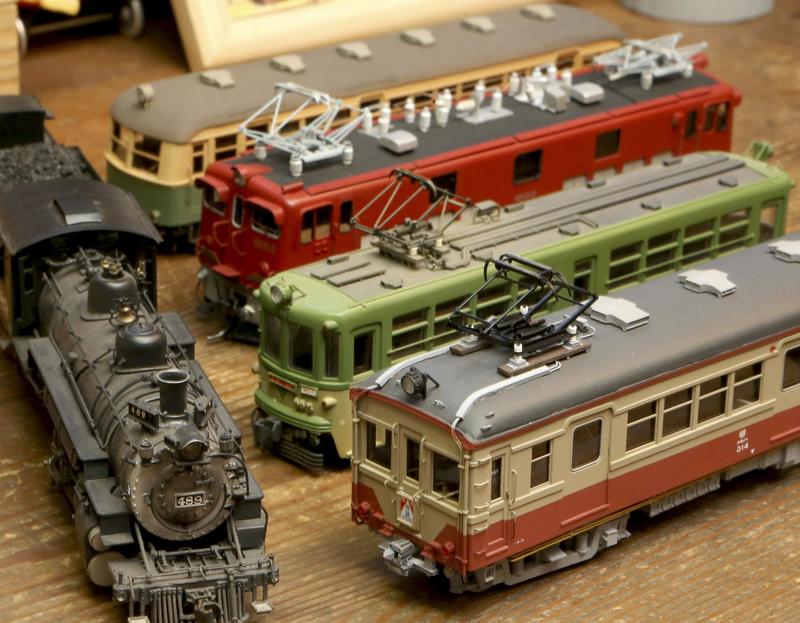
First, Miyashita creates the land that serves as the base for the models while imagining the scenery. He uses a clay-like modeling compound atop heat insulating materials to create hills and valleys.
"Actual towns develop in accordance with the shape of the land," he said. "If you make models in the same way, they will become more realistic."
Blueprints for the trains are drawn based on information and photographs seen in specialty magazines. Based on these drawings, he cuts out wood, paper and other materials, and assembles them to create a model.
As for the buildings, simply reproducing them in a smaller size will not make them look realistic. For example, to create the illusion of looking up at a building from below, he makes the height of the first floor of a three-story building taller than the second and third floors. This makes the model look natural, as if you were looking up at the entire building.
The trick to painting is to enhance the contrast between colors, using sharper colors than those of actual trains or buildings.
"Emphasizing contrast makes them look more authentic," Miyashita said. He also recommends adding some dirty spots as another technique to boost the models' authenticity.
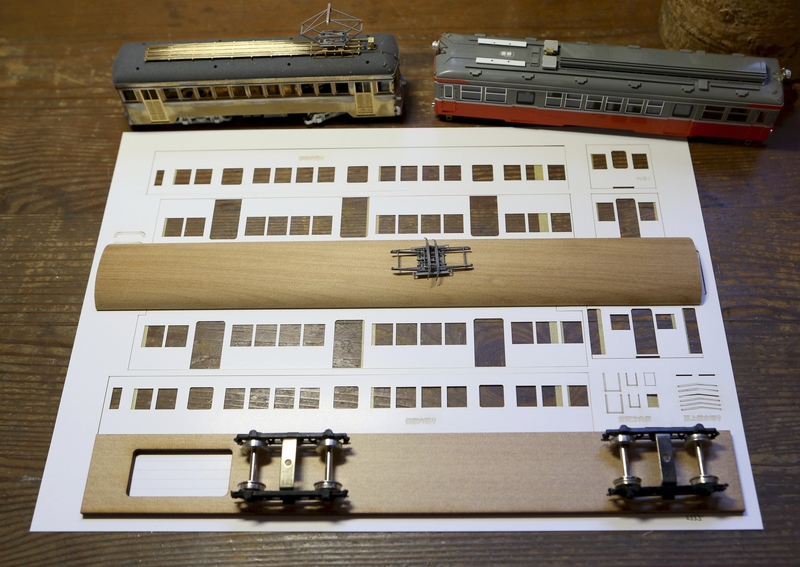
More than 40 years have passed since Miyashita became obsessed with model trains in his junior high school days.
In his study, materials such as specialty magazines and photo books neatly line one of the walls while soldering irons, tweezers, brushes and paint are organized by type. When he begins working on a new model, he said he stays indoors for almost the whole day.
"I want to make them even more realistic," Miyashita said. "I have yet to make the perfect model."
Journeying ever deeper into the world of model railroads, he continues on wherever the tracks take him.
Profile
Miyashita was born in Osaka Prefecture in 1961. In his third year of junior high school, his work was published in a model railroad magazine for the first time. His life's work is reproducing the scenery of railways in the Chubu region, and writes serial articles about making models for a magazine. An exhibition of his work is scheduled to be held from March 28 to April 12 at Gallery Sakatsu in Toshima Ward, Tokyo.
Hara Model Railway Museum
About 1,000 model railroad sets from around the world are exhibited at the Hara Model Railway Museum in Yokohama. The museum was established by Nobutaro Hara, a well-known model railroad maker and collector.
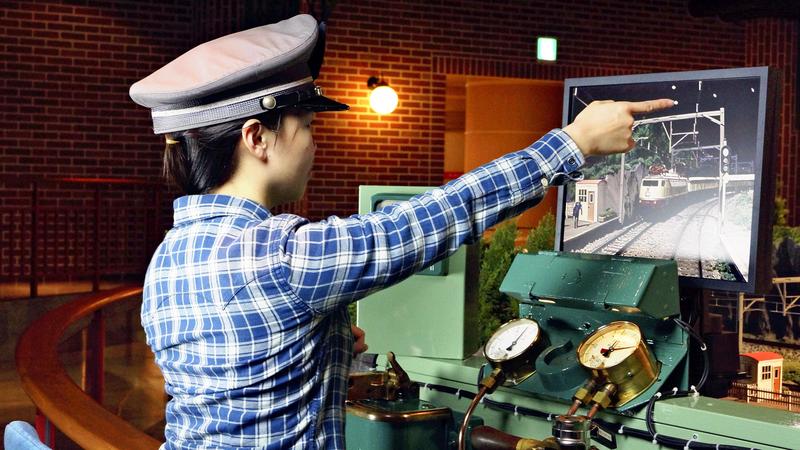
The must-see attraction is a 30-meter by 10-meter diorama called Ichiban Tetumo Park. This diorama uses one of the world's largest model railroads, the 1 gauge with a track width of 45 millimeters. The realistic steam locomotives, trains and other models running through a townscape make for a spectacular view.
Next to the diorama is a driver's platform that visitors can interact with to allow them to experience operating a model train that has a camera on the locomotive.
Read more from The Japan News at https://japannews.yomiuri.co.jp/