Small theaters for Japanese storytelling entertainment have been popping up in Tokyo and elsewhere for the past few years, backed by the increasing popularity of rakugo and other traditional storytelling performances. These theaters, called "mini yose," accommodate only a few dozen guests at a time. Their primary purpose is to provide opportunities for the increasing number of young professionals in the field.
Data shows that the combined number of professional rakugo comic storytellers mainly in Tokyo and Osaka is nearing the 1,000 mark. Kodan, the art of story recitation, has been attracting more newcomers in recent years, motivated by performer Kanda Matsunojo, who has rapidly risen to stardom. Rokyoku musical recitation is also accepting more and more new apprentices.
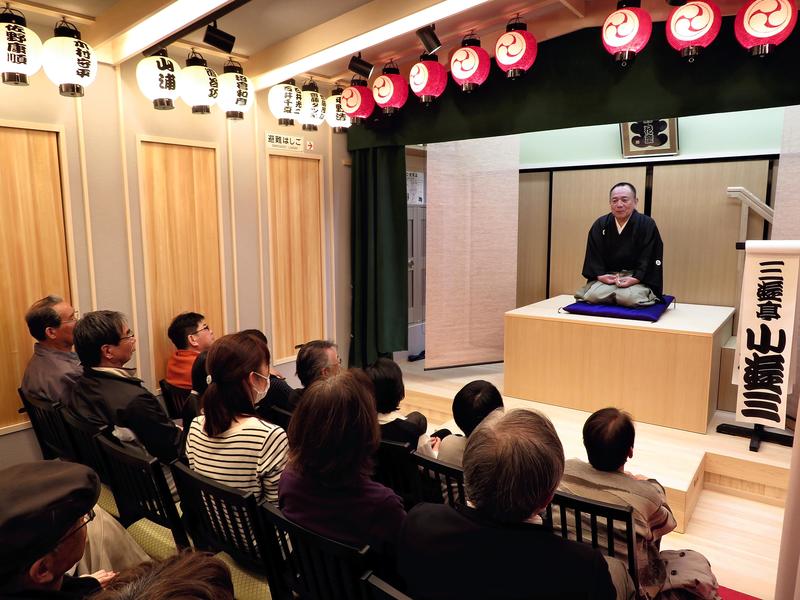
Rakugo Engei Nipporikan is a mini yose theater that opened in April near the entrance of the Yanaka Ginza shopping street in Tokyo. The shopping street is popular for its retro atmosphere.
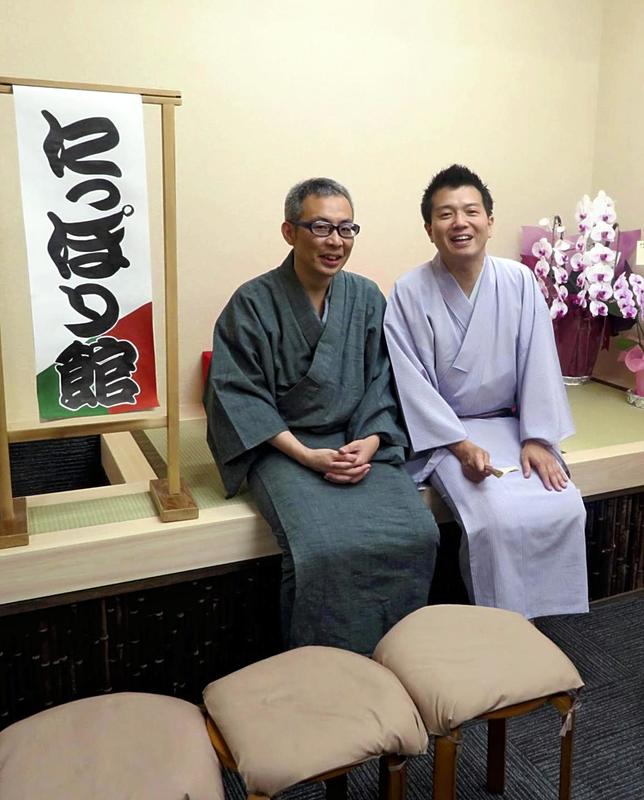
The theater is jointly operated by Hayashiya Takehei, 42, and Sanyutei Mankitsu, 40. Both have already become shin-uchi, the highest rank in the rakugo hierarchy, but they still belong to the younger generation in rakugo circles.
The theater is in a building that used to house a sushi restaurant. The vacant restaurant was remodeled and given a small koza elevated stage, with a seating area for about 40 people. Usually this type of theater is called yose, and is where rakugo and other popular entertainments are performed daily. Hayashiya said, "Our theater isn't yose since it isn't open every day." Instead, the theater opens about eight days a month and features two rakugo entertainers. Each show lasts nearly two hours.
Hayashiya and Sanyutei have had similar rakugo careers and are good friends, although they belong to different organizations -- Hayashiya to the Rakugo Kyokai association, and Sanyutei to the Godaime Enraku Ichimonkai group.
"We've shared the same wish of increasing the number of rakugo fans," Hayashiya said. "We wanted to build a theater that attracts people who don't know about rakugo and just happen to pass by."
Sanyutei said: "It's advantageous for us to have our own space. I want to explore and find out how my storytelling will change by performing in an optimum environment and under optimum stage direction."
Their shows start at either 11 a.m., 1 p.m., 4 p.m., or 7 p.m. This unusual approach is both so that they can meet their work schedules and also for a strategic purpose -- based on their observation, different types of people pass by the theater depending on the time of day.
"One day, we had only one guest, a middle-aged woman who had never experienced rakugo," said Hayashiya. "I'm aware that if we poorly perform in front of first-timers like her, they'll never come again. In this respect, performing at this theater is a valuable opportunity for us to improve our skills."
Former 'Shoten' director
Yakimochi, a Japanese bistro in the Akihabara district in Tokyo, offers an event featuring rakugo and other popular entertainments every Tuesday night. Visitors enjoy the show, which lasts for nearly an hour, over food and drinks.
"[Since the stage is close to the dining area,] our guests can appreciate the voices and sounds heard directly from the stage without a microphone," said Shiho Nakada, 40, the proprietress of the bistro.
Nakada talked about a recently featured ongyokushi entertainer, Tachibanaya Kitsunosuke, who sings traditional Japanese songs and ballads while playing a shamisen three-stringed lute.
"Her way of playing the shamisen was so delicate every moment. I was so happy to be able to watch her up close," Nakada said.
Before opening the bistro in September 2016, Nakada worked for Nippon TV. She was a director of "Shoten," a long-running program particularly popular for the Ogiri section featuring rakugo storytellers. She became a rakugo enthusiast while working for the program, but eventually left that lucrative career after being transferred to a department where she did desk work.
About operating the bistro-theater, she said with a carefree smile, "It's good enough for me if I can earn money to maintain a decent living."
Guests are given pochi-bukuro, a small envelope used for money given as a gift. If they are happy with the performance, they put some money into the envelope and give it to the performer. Doing this instantly makes them feel as though they are the performer's patron.
Nakada herself asks entertainers to perform. When approaching those who have never performed in her bistro, she makes a point of going to see them in person. If they are rakugo storytellers, she goes to rakugo theaters when they perform and wait at the stage door for them after they have finished, just like their fans do. She seems to stick to a style of doing business that she learned when working for the TV station.
"I've always wanted to make people happy by working, whether at my former or current workplace," she said.
Outside of Tokyo
The mini yose boom is spreading outside Tokyo, too.
Michinoku Joseki Hanaza, a permanent theater specializing in popular traditional entertainments, opened in April 2018 in Aoba Ward, Sendai, as the first theater of its kind in the Tohoku region.
Performers at the theater, which has a seating capacity of about 40, include Tokyo-based entertainers who belong to the Rakugo Geijutsu Kyokai association and appear in rotation, as well as local rakugo storytellers and manzai comedians who perform in the Tohoku dialect.
In Osaka, Konohana Chidoritei was opened in Konohana Ward in January, the first permanent theater specializing in kodan in about 80 years. The theater project was led by Kyokudo Konanryo, a female kodan performer who belongs to the younger generation in her field, to expand the kodan fan base. In cooperation with some of her fellow young kodan entertainers, she had a vacant store remodeled to become a yose theater that accommodates about 40 guests. The theater gives live performances almost every day, mainly featuring kodan but also rakugo and other forms of entertainment.
Read more from The Japan News at https://japannews.yomiuri.co.jp/