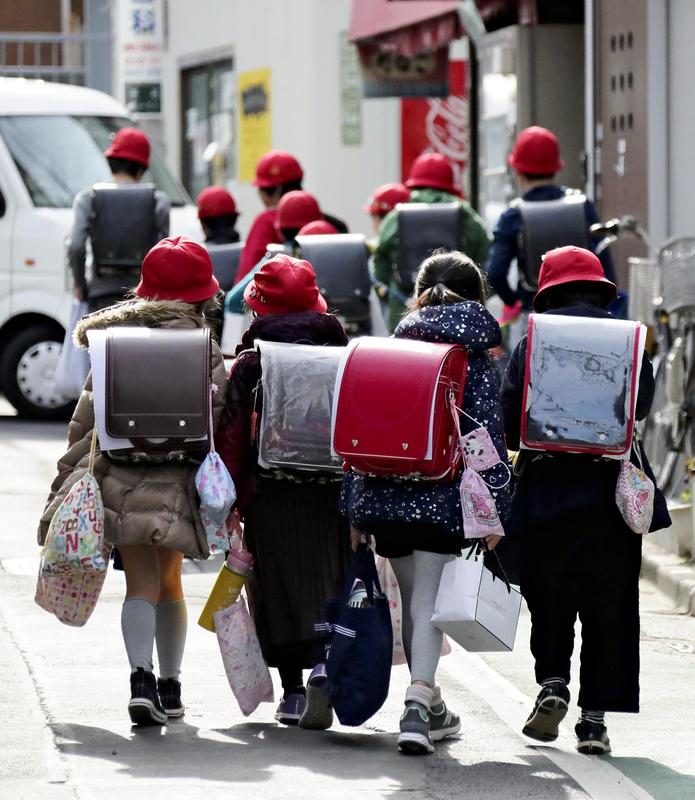
The government's sudden request for temporary school closures as part of measures to prevent a further spread of new coronavirus infections has caused disruptions at small and midsize companies, including medical facilities.
The government on Saturday announced a support plan for parents and others who have no choice but to take time off from work following the government's request. However, if many employees are forced to take leave to look after their children, it is feared that staff shortages could hamper business operations.
Unrealistic proposal
A Tokyo confectioner was told by a female employee who works twice a week that she would not be able to do her shifts because she has to take care of her child. Two other employees of the company also have elementary school-age children.
"I'm grateful for the government's financial support, but if we're short of hands it limits operations at the store," the 52-year-old manager said. "I want to give them time off from work, but we don't have enough time to prepare."
The government is calling for companies to permit teleworking from home, but the idea is not realistic for the operator of a nursing care business in Takamatsu.
"Small companies based outside large cities don't have equipment that makes remote work possible. For us, teleworking is unrealistic. No work gets done unless we meet face to face," he said.
An official of Tokyo Doyukai, which comprises about 2,400 small and midsize companies in Tokyo, said: "The suspension of imports and the decline in the number of visitors and customers are already worsening business performance overall, so we just want to avoid this becoming a vicious circle, with school closures causing staff shortages. We hope the government will provide flexible support to individual companies."
Hospitals suffer
Some medical institutions are considering downsizing their services to treat patients due to concerns over staff availability.
Aiiku Hospital, a facility in Tokyo's Minato Ward that delivers about 3,000 babies a year, held an emergency executive meeting on Friday.
Masao Nakabayashi, director of the Aiiku Maternal and Child Health Center of the Boshi-Aiiku-Kai foundation, said, "We'd like to proceed with our duties without reducing the number of staff handling deliveries."
The hospital has decided to scale back comprehensive medical examinations for inpatients and is mulling doing the same at some outpatient facilities.
A 36-year-old surgical nurse who works at a Tokyo hospital said she was going to send her first-grade daughter to an after-school care facility as the elementary school her child goes to was planning to close. She also has a daughter who goes to nursery school.
However, she was worried that she may not be able to go to work if the after-school facility closes, or one of her daughters gets sick.
"My job is very demanding, and I work shifts, so I find it hard to ask for time off to look after my children." If the school closure period is extended, she said she may have no other option but to leave her eldest child at home alone.
Read more from The Japan News at https://japannews.yomiuri.co.jp/