
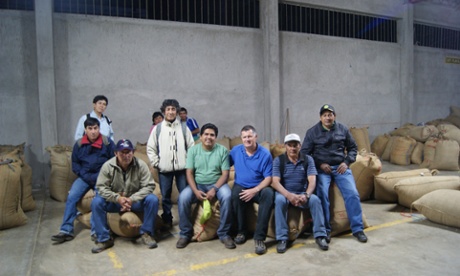
Although it employs just 25 staff, pioneering hot drinks company, Cafédirect benefits about a million people in coffee, tea and cocoa farming communities across Africa and Latin America. The company has been sourcing produce directly from small-scale farmers since it was founded in 1991, in response to the collapse of an international coffee agreement that left millions of farmers with no choice but to sell their harvest at rock-bottom prices.
As well as a commitment to pay a fair price and a Fairtrade Premium, which producers can invest in their business and community, Cafédirect makes annual donations to its producers through an independent charity, The Cafedirect Producer’s Foundation and has reinvested over 50% of its profits in coffee-growing communities. Uniquely, 89% of the producer groups that it works with own shares in the company.
Running a business that promotes the wellbeing of everyone along the supply chain can be highly rewarding, but it can also be challenging as a small business. Speaking at the G7 International Stakeholder Conference in Berlin, John Steel, Cafédirect’s CEO, said that a lack of scale makes it difficult for small and medium sized enterprises (SMEs) to pursue transparency and sustainability in their supply chains. “Scale drives decision making and exerts influence on supply. As an SME you do not have the same opportunities as larger businesses have, to influence suppliers and manufacturers,” he explains. “You are more vulnerable to supply chain volatility, and if you’re working with commodities that can be traded, such as coffee, you are also more vulnerable to market volatility. In recent years we’ve seen some terrible examples of market speculation that have destabilised genuine, hard-working value creation enterprises, for the financial benefit of a few speculators.”
Lack of scale can also act as a barrier to entry for some activities within the supply chain, such as processing and trading, and as a result small businesses can find they are dependent on middlemen. “Finding partners whose approach fits with your sustainability criteria can be challenging and costly,” says Steel. To achieve clear standards, SMEs often rely on third party certification, but a proliferation of these schemes is leading to consumer confusion and competition from big brands.
“Multinationals can use ethical labels as a marketing tool, whilst making minimal impact on their supply chain. Meanwhile smaller businesses that are perhaps more genuinely committed to making a significant, long term impact on their supply chains, are going further and investing more, but consumers can’t necessarily tell the difference. Large brands can also create their own standards and self-certification programmes, with less accountability but bigger marketing budgets.”
Then there are the costs of building and maintaining a sustainable supply chain. The cost of delivering step-change sustainability is extremely challenging for a small business to bear, particularly those operating in a highly competitive environment. “For instance, at Cafédirect we have the cost of engaging the farmers we work with in the governance of the brand, the cost of having two producer directors on our board, and the cost of supporting a standalone charity to implement development projects. Holding company directors to account incurs further costs for the collection of data, measurement of key performance indicators, analysis of performance, and so on. My concern is that the costs for various actors in the supply chain are sometimes inconsistent with the benefits they receive, in both scale and application.”
In such a challenging environment, what can ethical SMEs do to stay afloat, and thrive even? According to John Steel, collaboration is key. “All stakeholders can collaborate pre-competitively to understand the longer term issues in a supply chain and take steps to make it more sustainable.
Tea 2030 is a great example of a cross-industry, step-change initiative, but collaboration can also be on a much smaller scale, for example sharing of resources and best practice with other businesses. Establishing long-term partnerships with other like-minded organisations in the supply chain, whether processors, customers or producers, creates certainty and can also have profoundly positive results, but unfortunately, existing frameworks encourage switching of suppliers in the pursuit of short-term commercial gain.”
Transparency about sustainability programmes and business practices, covering social and environmental impact as well as financial metrics, can enable SMEs to better communicate their point of difference to consumers. However, there’s only so much that small businesses can do without support. Steel believes governments have a role to play in motivating good practice and ensuring that those who engage in best practice get the recognition they deserve.
“Governments should provide incentives for businesses that agree long term supply deals and take steps to increase supply chain capacity. These could include social and environmental standards and reporting criteria for companies, so that consumers can become better informed about the supply chain practices of different brands, and can reach for a product that truly reflects their values.”
Content on this page is paid for and provided by Fairtrade Foundation, sponsor of the spotlight on commodities series




.png?w=600)








