Oscars, schmoscars. The Academy Awards are all set for this Sunday, but expectations are low: according to Variety, its organisers and broadcasters are jittery that the audience might stay away from this year's backslapathon – too few big names, too many apparent shoo-ins; also, you know, there are other things on people's minds right now. That's certainly the case in New York City, where every day brings another chilling pronouncement of economic collapse; in the New York Times this week, the paper's Nobel-winning economics columnist Paul Krugman predicted "a long, painful slump", while a news roundup of ballooning unemployment, nosediving house sales and multi-billion-dollar budget deficits was accompanied by a photo of a 1930s East Side shantytown. Depression is in the air, and dishing out gongs isn't going to dispel it.
They're embracing it, however, at Manhattan's Film Forum, where a season of Depression-era films entitled Breadlines & Champagne is playing all month. Programmed for the arthouse theatre by Bruce Goldstein – who says he got the idea last November after looking in horror at his pension statement – it's an aesthetic stimulus package all on its own. The season suggests similarities between the socio-politics of the 1930s and our present situation, and the gulf between the Hollywood of that time and the one currently preparing for Sunday's awards.
Showcasing more than 50 titles in a schedule of double and triple bills, Breadlines & Champagne spans the spectrum of early Depression-era Hollywood, from grim social realism to flighty escapism. You could, for instance, watch a group of unemployed drifters band together to try to save a parched farm in King Vidor's Our Daily Bread, followed by an early Shirley Temple appearance in Stand Up and Cheer!, in which Hollywood itself (sort of) saves America. William Wellman's Heroes for Sale and Wild Boys of the Road tell strong, politically engaged stories, one of war veterans reduced to unemployment and drug abuse, the other of adolescents living as railroad hobos. Frank Capra's American Madness delivered a more fearsome version of the run on the bank in It's a Wonderful Life. Elsewhere, there are teenage vigilantes in Cecil B DeMille's This Day and Age, a singing homeless army led by Al Jolson in the Soviet-influenced musical Hallelujah, I'm a Bum and a series of blackguardly turns from young Humphrey Bogart as a hoodlum, a kidnapper and a budding fascist.
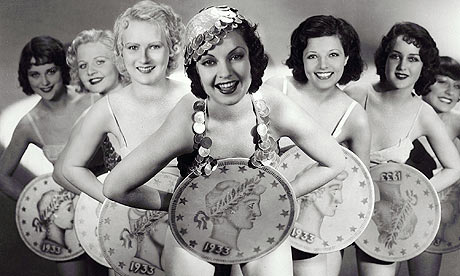
This was also the period that saw the rise of screwball comedies and Universal horror movies, not to mention Busby Berkeley choreography at its most florid. Even where realism was far away, social reality was often glimpsed; Gold Diggers of 1933, for instance, concludes with Berkeley's unemployment-themed song-and-dance extravaganza. Several romantic comedies feature cross-class relationships or shanty-town settings; Three-Cornered Moon, considered by some to inaugurate the screwball tradition, is explicitly about the repercussions of the crash; and the links between hard times and Warner Bros gangster films like Scarface and Little Caesar are widely recognised. Some of the most scandalous content was also tied to economics – in Baby Face, for instance, Barbara Stanwyck unambiguously sleeps her way from speakeasy to boardroom. In 2005, five minutes of extra filth were unearthed, prompting the New York Times to dub it "one of the most stunningly sordid films ever made".
But the season is also a rich sampling of a fascinating period in American movie-making history, between the bedding-in of the sound revolution that began in 1929 and the imposition of the puritanical Hays Code in 1934. It was a commercially precarious time – contrary to received wisdom, the early years of the Depression almost killed off the film business – that spurred the studios to develop stronger cultural identities and institutional machinery. The pictures that resulted match formal experimentalism with a boisterous openness of spirit. Breadlines & Champagne could be seen as an argument for the genius of the system, a demonstration of the riches yielded by even the early stages of a regime in which individual talent was mined for the corporate and public good.
Indeed, many of these pictures pay explicit tribute to collective activity in a way that's somehow hard to imagine from today's Hollywood. If Krugman's long, painful slump does come to pass, it's far from certain that we will find solace in cinema as people did in the 1930s – movie-making is no longer a place where boisterous experimentalism or risqué sensibilities can be cultivated. Nor is moviegoing a cheap night out any more – perhaps the most antiquated aspect of Breadlines & Champagne was the offer of opening gala tickets at the 1930s price of a quarter (£0.17).