"You're a prick of a coach and you were a prick of a player. I could buy you, your house and your family." The words still echo around the halls of Slovenian football, the most quotable part of the diatribe against his manager Srecko Katanec with which Zlatko Zahovic stormed out of the 2002 World Cup, and brought the golden age of Slovenian football to an end. And that, really, should have been that: one golden age is quite enough for a country with a population of only two million.
And yet, it looks as though they might be on the way back. Slovenia began the World Cup qualifiers with a draw against Poland – and might have won but for a highly dubious penalty award against them – and have since beaten Slovakia and Northern Ireland. In an open group, Wednesday's game away against the struggling Czech Republic has taken on vast significance.
It all seemed very unlikely six years ago. The Zahovic outburst was the great manifestation of decline, but that was a side approaching the end anyway. Players were ageing, and the age-old split between Styria and Ljubljana – itself a factor in the Zahovic-Katanec conflagration - was beginning to make itself felt, among both players and fans. Under Bojan Prasnikar, Slovenia finished second behind France in a relatively straightforward qualifying group for Euro 2004, but then lost a two-legged play-off to Croatia.
Prasnikar's results-based approach was widely criticised, and he was replaced by the ebullient and controversial Branko Oblak, the greatest ever Slovenian player, and his predecessor's opposite in every way. Slovenia began well under him, inflicting on Italy their last competitive defeat before winning the World Cup, but their form soon disintegrated – as had always seemed likely after a draw that pitted them against Norway and Scotland, two of the northern sides against whose physical approach they have traditionally struggled.
With the Bezigrad, the national stadium in Ljubljana, crumbling and slated for redevelopment, Slovenia were forced out to Celje to the distinctly unromantic Arena Petrol, away from the Ljubljancan fans whose support had been such a factor in Katanec's time. Selection became inconsistent, and Oblak was sacked, replaced by Matjaz Kek, a former Maribor player and coach and radio pundit. He led Maribor to two league titles, but given they were both achieved with the financial benefits of their Champions League campaign under Prasnikar, it is hard to know just how much credit he was due.
Initially the decline continued. When Katanec had taken over in 1997, Slovenia were ranked 95th in the world. By the end of 2001 they were 25th, but 10 years after Katanec's accession, they had slipped back to 83rd. Kek became known as 'Kekec', a slang term for a naive fool. But Kekec is also the eponymous hero of a hugely popular Slovenian film of 1951, a cheerful and cunning boy who saves the day by setting an owl on the villain in a narrow tunnel. Slowly, it is that Kekec that Kek is beginning to resemble.
Qualifying for Euro 2008 was poor, but a group of Holland, Romania, Bulgaria, Albania and Belarus was always going to be tough. A kinder World Cup draw has coincided with other changes. For one thing, Kek is not Oblak, and so doesn't spend half his life offending people and the other half trying to make up for it. For another, renovation of Maribor's Ljudski Vrt stadium is now complete. It only holds 12,500, but with no running track and good acoustics, it can be intimidating.
The first game Slovenia played there was a friendly against Croatia in August, which was a masterstroke. They have never beaten another former Yugoslav republic, and lost this game 3-2, but they twice held the lead, and the atmosphere against their bitterest rivals was a reminder of the good old days. Ljudski Vrt, it is now thought, could become to Kek as the Bezigrad was to Katanec: a fortress, where once he played, guarded by his fans.
"It's a huge advantage knowing we have a full stadium behind us," said Slovenia's captain, the West Brom midfielder Robert Koren. "We felt something different before these last qualifiers. Good results mean there is going to be more interest from our fans, but you can feel the positive vibes inside the team as well. We feel more confident and more relaxed and that brings better performances."
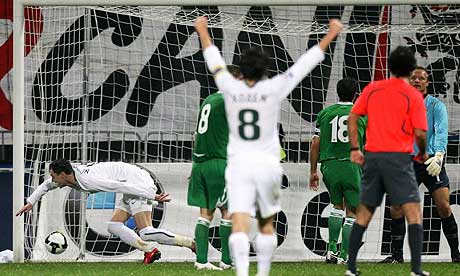
Sure enough, the stadium was bouncing as the tall Cologne striker Milivoje Novakovic got both goals in the 2-1 win over Slovakia. As tickets were sold out 11 days in advance, it was even better against Northern Ireland, a team 40 places higher than Slovenia in the world rankings. Crucially, Kek seems to have developed Katanec's knack for making inspired substitutions. Valter Birsa had been on the pitch three minutes when he laid on Novakovic's 84th-minute opener. A minute later, the other substitute, Zlatan Ljubijankic, added the second. This Kekec is unleashing the right owls at the right time
"We played quite tactically this time," said Mirnes Sisic, the Olympiakos midfielder who is probably Slovenia's most technically-gifted player. "There was a lot of running, closing people down and fighting – things that I am not accustomed to. But for the team and for the points I am willing to give myself completely and there's no other philosophy that counts."
Kek has managed to conjure up the old spirit while at the same time renewing the squad - the most experienced player, Tonci Zlogar, has only 35 caps – and that means that, as in the early days under Katanec, the egos are pulling in the same direction. The downside of that could be a lack of the sort of streetwiseness in which Zahovic specialised. Just how ruthless they will be in tough games is one of the things that will be tested in Teplice.
For now though, even the Alice-banded contrarian himself, now sporting director at Maribor, is starting to have faith. "I believe in fairy-tales," Zahovic said. "And I believe that another one will be written with the new boys."
If Teplice goes well, there could be many others joining him.