Let’s say you’re a smoker and your tobacco manufacturer of choice tells you they’ve got plans to cut your chances of being killed by their cigarettes. Now plainly, the most obvious way to cut your chances of dying from smoking would be to stop smoking. But the tobacco company says its plan to save you from a wheezing death is to deliver your cigarettes in packets printed with non-toxic soy ink. Cigarettes will also be delivered in more fuel-efficient lorries and a new initiative will be introduced to encourage smokers to take a healthy jog to the shops to buy their smokes.
Presented with such pointless measures, most people (and by most people I mean everyone) would rightly tell the tobacco companies to go shove their cancer sticks in a sun-free spot.
The Queensland government’s latest efforts to “protect the Great Barrier Reef” by allowing the massive expansion of coal exports should be met with similar indignation because the logic is similarly insulting to the intelligence.
To make room to export an extra 130m tonnes of coal a year from Abbot Point in north Queensland, about 1.7m cubic metres of seabed need to be dredged. Originally, the spoil was to be dumped at sea. Then it was going to be dumped beside sensitive wetlands.
Now the two miners Adani and GVK, with the backing of the government, will look to dump the dredge spoil on land previously set aside for another port expansion plan.
The Queensland government described the agreement as “environmentally sustainable”. Queensland Premier Annastacia Palaszczuk said this sent a “clear message” that “we can protect the Great Barrier Reef”.
But government agencies and scientists have found that the key long-term threat to the reef is not improving the quality of the water (although this does help in the short term) but the rising levels of greenhouse gases in the atmosphere caused chiefly from burning fossil fuels.
You can’t “save the reef” while expanding the very industry which puts it most at risk.
The Abbot Point plans are a key part of the efforts to open up one of the world’s largest untapped sources of fossil fuel carbon – Queensland’s Galilee Basin. The scale of the emissions from the mines and burning the coal is something to behold.
Adani’s Carmichael mine and GVK’s Alpha and Kevin’s Corner mines would release about 250m tonnes of CO2 every year for 30 years once the coal is burned, according to conservation groups.
If the emissions from the GVK and Adani mines did not go ahead, then this would be the equivalent of Australia suddenly halving its annual greenhouse footprint.
For context, Australia’s unambitious plans to cut emissions by 5% by 2020 would see the country’s carbon footprint reduced by about 159m tonnes from expected levels without the target. If the Adani and GVK mines are developed then they easily scrub out Australia’s greenhouse gas reductions based on that 5% target.
This, remember, comes regardless of whether you think those reductions should come from pricing greenhouse gas emissions, as the previous Labor government would have liked, or from the (misnamed) Direct Action policy of the current government.
The Great Barrier Reef Marine Park Authority – the government agency charged with managing the icon – said in 2009 and again in 2014 that climate change was the main threat to the reef’s future.
Burning fossil fuels impacts the reef in two key ways.
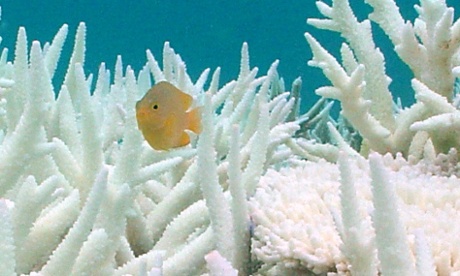
The extra CO2 in the atmosphere interacts with the top layer of the ocean to increase the acidity of the water. The accumulation of CO2 in the atmosphere also drives the warming of the oceans, increasing the risks of coral bleaching.
I’ve had the unfortunate pleasure of seeing the results of an experiment that mirrors the kind of temperatures and ocean acidification that Great Barrier Reef habitats can expect if fossil fuel burning continues unabated.
In tanks on the University of Queensland’s research station on Heron Island, vibrant arrays of soft and colourful corals are transformed into a bleached and algae-coated mess. The increased ocean acidity actually starts to dissolve the corals.
Another study has suggested that coral bleaching will become an annual event on many parts of the reef by around the middle of this century.
If these windows into the future become a reality, then Australia can look forward to an ecological disaster while developing a new multi-cent tourism industry derived from slime gazing.
The mining industry is not surprisingly bereft of credibility when it comes to interpreting the science linking their products to the reef’s welfare. In April last year, the state’s peak mining body used a government-funded study to claim its port expansions would not put the reef at risk, when the same study actually warned that water quality and fossil fuel burning were driving current and future threats.
All of this comes in the context of the reef’s status as a United Nations World Heritage site. The UN committee has warned it could put the reef on a list of sites “in danger” later this year, something the state and federal government is desperate to avoid.
The federal government has even offered international journalists free trips to Queensland where presumably those journalists will be schooled in the government’s own peculiar take on the reef’s future – a take which even it’s own scientists seem to disagree with.
They have even recruited a climate science denier to lobby banks under pressure to rule out funding coal expansions.
Just as the only way to cut your chances of dying from smoking cigarettes is to stop smoking cigarettes, the only real way to “protect the reef” is to stop smoking fossil fuels.