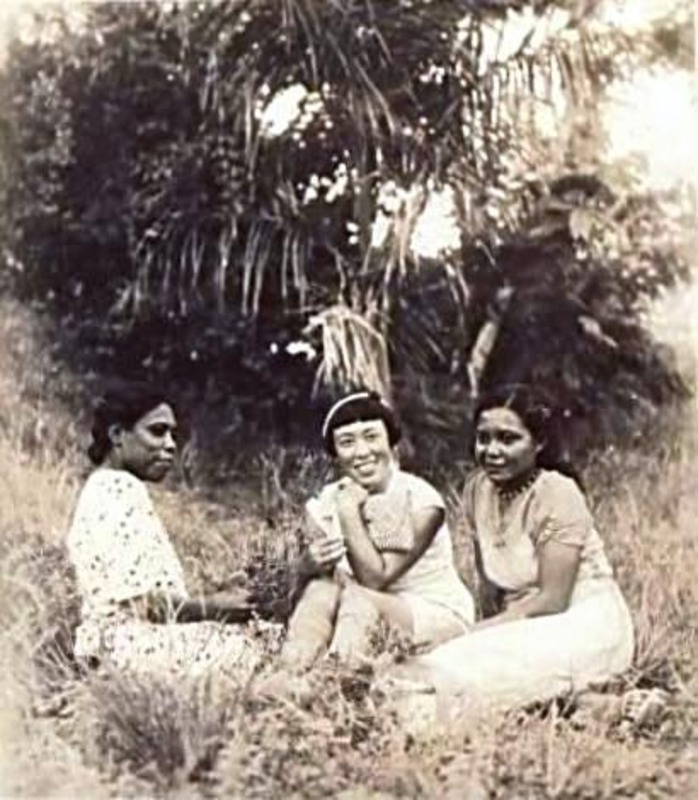
A book of sketches of Palau and other Pacific islands during World War II drawn by one half of the husband-and-wife duo that painted "The Hiroshima Panels" will be published in English and Japanese in September.
Toshi Maruki (1912-2000) -- who painted the panels of the aftermath of the atomic bombings with her husband Iri Maruki -- visited the so-called South Seas Mandate islands in the northern Pacific, then under Japanese administration, for about half a year from January 1940 and sketched lots of scenery. The book identifies the places, plants and other subjects of her drawings.
Maruki visited the main island of Palau as well as Kayangel and Angaur islands as she is said to have admired Paul Gauguin for spending his later years in Tahiti. She drew 200 sketches with remarkable precision.
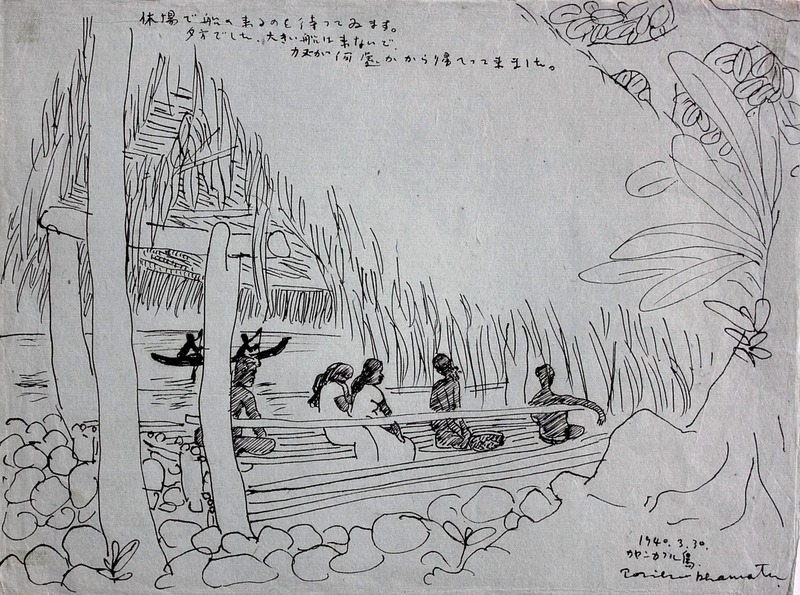
She accurately depicted the bark of the coconut palm and mangrove roots. She was also interested in local customs, and recorded men's tattoos and hair ornaments, women's necklaces and koshimino straw raincoats for the lower body.
She often drew canoes, which are an important transportation method for locals, and showed interest in food culture such as livestock and fishing.
Her stay on the islands "made her start expressing nudity as the root of human beings. She also drew nudity in 'The Hiroshima Panels' to express that the atomic bombs deprived people of their dignity," said Yukinori Okamura, curator at the Maruki Gallery for the Hiroshima Panels in Higashi-Matsuyama, Saitama Prefecture.
"She came into contact with the generous character of the locals, after which her works had more freedom in their expression," he added.
-- Valuable folklore
"Not only are they great as pictures, but they have value as folklore. I thought I wanted to turn it into a book so that people in both Japan and Palau can see it," said Yumiyo Morokawa, who is in charge of explaining the sketches in the book.
Morokawa is a doctor, but she had a close relationship with Yoji Kurata, who conducted research on marine life in Palau before and after World War II.
She has visited Palau many times to identify the places and plants Maruki drew, with advice from Kurata.
Maruki wrote the names of people on her sketches in alphabetic and katakana characters, which led to discovering the descendants of her sketches' subjects.
For example, a woman who Maruki drew bundling palm leaves in one of her sketches was the grandmother of Kayangel Gov. Midas Ngiracheluolu, who is said to have been thrilled to see his grandmother in the sketch as he does not have any photos of her.
Maruki also visited Palau in 1978. Her niece, Hisako Maruki, has a sketch Toshi drew at that time. In the process of making the new book, Hisako found that the name on the sketch from 1978 also appeared on one of the sketches from 1940. Toshi had been reunited with the same person after nearly 40 years.
"At one point, Toshi had wanted to live and draw in Palau like Gauguin. I hope this book will help Toshi's sketches connect Palau and Japan," Hisako said.
The book, scheduled to be published in late September, will be donated to a library in Palau and other places as well as being sold at the Maruki Gallery for the Hiroshima Panels.
Read more from The Japan News at https://japannews.yomiuri.co.jp/