Saturday’s fourth round of the Six Nations offers a contrast. One game is a forgone conclusion, featuring a team with a hand already held out for the wooden spoon. The other is a clash of contenders, with one side going flat out for the grand slam. Ireland go to Wales with as much to play for as the early part of this World Cup year allows, while at Twickenham England, too, are still in the hunt for the title. How can Scotland have sunk so low as to be the forgone element of the day?
There’s something about the Calcutta Cup that normally gives the fixture between England and Scotland a bit of bite. Perhaps it is the trophy itself, a handsome pot of melted rupees, a piece of artwork that has been kicked out of shape and restored in equal measure. Abuse and love: relations between England and Scotland in a nutshell.
England will win (Saturday’s rugby game). They will respond to their lack of discipline, their lack of accuracy, their lack of flow until it was too late, their serious setback in Dublin with positive cruelty. Scotland looked so forlorn after their home defeat to Italy – their third successive loss – that it seemed they had already thumbed the history book that shows they have not beaten England away since 1983. Thirty-two years – that is seriously heavy baggage and Scotland would not appear to have the strength to shift it.
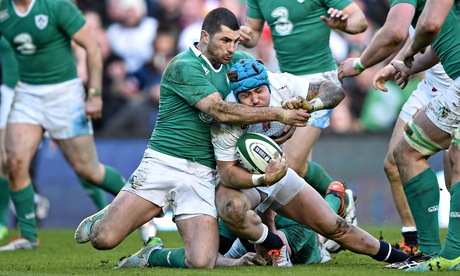
Ireland will have an even longer time in the back of their mind. Not since 1948 and 1949 have they won the championship in successive seasons. But what a chance they now have to do so – and add a grand slam, only their third ever, into the bargain. True, they must play twice away from home, and they may run into resistance of that desperate last-chance kind at Murrayfield in the fifth and final round. But if Ireland are going for the slam, it will take a rare performance by anyone, let alone the great disappointers of 2015, to stop them.
That, they will point out, is to be getting a little ahead of themselves. Before that comes a trip to the Millennium Stadium. The reassuring statistic for the travellers is that they have a healthy habit of winning in Cardiff. Only twice since 1983 – it’s turning into something of a milestone, that little old year – have Ireland lost there. This historical quirk coincides with a more hard-headed belief that the Irish have the measure of how Wales play.
Warren Gatland’s side love to drive hard and fast over the gain line; their every breath on the field is governed by how well they execute that primary requirement. When one of Jamie Roberts, Taulupe Faletau, Jonathan Davies or George North achieves the desired gain in yards in front of the forwards then a world of adventure opens up. Rhys Webb and Dan Biggar can start to play “heads-up” rugby, based on assessing what the momentum has realised in terms of openings and mismatches.
Ireland reckon they can stop Wales before the line of advantage. Funnily enough, the lesson was learnt when Wales defeated Ireland in the quarter-finals of the 2011 World Cup. Sean O’Brien, the back-rower who had flattened Australia with his charges in the pool stages, was cut down and the world learned the worth of Dan Lydiate. Ireland have the high choke tackle; Lydiate gave a masterclass of the low chop tackle.
In their last two meetings, Ireland have led a very aggressive defence of their own and frustrated Wales. And in this flustered state of mind, Wales have a tendency to make mistakes. They were frustrated by England in the second half of the opening round of this year’s championship, and tried to play a passing game from a long way out. A mistake.
Ireland will presumably stray not an inch from the line of fierce resistance in defence. What they presume will happen thereafter is that Wales will lose their accuracy, take risks and lose their composure. The result can then go only one way.
Ireland’s way – because they have taken control physically and mentally. Once they have stopped Wales in their tracks, they can settle the issue on the scoreboard, with the game they have developed since 2012, a style resistant to strain and stress. It does not depend on Sean O’Brien on his own making yards. The kicking game of Jonathan Sexton and the equally accurate Conor Murray has been honed into an attacking weapon. Each probe offers its chaser an opportunity to win the ball, or to make the tackle that will bundle the catcher out of play.
It sounds like rugby that can be appreciated only by an air traffic controller. But an aerial game is only dull when poorly executed – when the ball’s return to earth has no green welcoming committee. Tommy Bowe, Rob Kearney, Jared Payne and Robbie Henshaw have chased and caught and bundled to wonderful effect.
Can it be so very difficult to kick from hand accurately? Ian Madigan is as naturally gifted a manipulator of the oval ball as there is – but compare his efforts to hit a distant target with those of the player he replaced, and the value of Ireland’s first-choice fly-half is clear. Sexton is a genius. His hamstring will be on the receiving end of some of the most intense and loving attention a tendon has ever received.
Wales have rebuilt on the road since defeat to England. They are back on the front foot, storming that line of advantage. Ireland are on a grand-slam roll, their resolve absolute. The point of contact between the two teams is no place for a dodgy hamstring, not even a genius’s. Its healing process between now and Saturday will decide all.