Before the Six Nations started, there was concern for the outside halves of Europe. Would Jonathan Sexton be sound of mind after the multiple concussions of 2014 to direct Ireland’s defence of their title? Would Dan Biggar and Finn Russell be able to carry the authority they showed in November into the championship where there are no secrets. Would George Ford be able to consolidate the position he had carved out for himself at the end of the autumn series?
The questions were asked because the outside world generally cared for these players, (relatively) small of stature but still the central characters on the field. Nobody on the inside had made much of an effort to protect them. In fact, by introducing an offside line five metres behind the rear foot of the set scrum, the game exposed them to the rampages of No8s specifically constructed not to be all-round tall and rangy in the mould of Mervyn Davies, but built for destruction at the end of a burst from a standing start – chargers like Taulupe Faletau, Ben Morgan and Billy Vunipola.
Fortunately – and it was pure luck – this encouragement of gridiron power plays was negated by the collapse of the scrummage as a means to launch an attack. The 10-metre gap (2 x 5m) was born of a good intention – to put distance between the opposing lines of backs. In the age-old struggle between offence and defence, the tacklers were clearly in control. The aim was noble, but it potentially left the No10s on the defending side in front of the onrushing bulls.
For the health of the Billies and Bens and Taulupes, it’s probably just as well they cannot pick up and go. Biggar and Sexton in particular have shredded the safety manual. They have become rabid jack russells, rushing forward in abhorrence of a vacuum, filling the space so precious to the law-makers and hurling themselves into the faces of those under instruction to do them harm. And if it’s not No8s they’re felling, these 10s are equally committed to smashing into the features of anybody else sent their way, namely in the France-Ireland slug-out, Mathieu Bastareaud.
The Finn Russell terrier made a different type of contact, sending Biggar into one of those aerial spin cycles that have become common. Again, the law about not making contact with a player off the ground was made in good faith (safety in this instance), but the ball spends so much time in the sky – high kicks seem more fruitful now than midfield crashes as a means of winning quick possession on the front foot – that contact on at least a few of its returns to earth is inevitable.
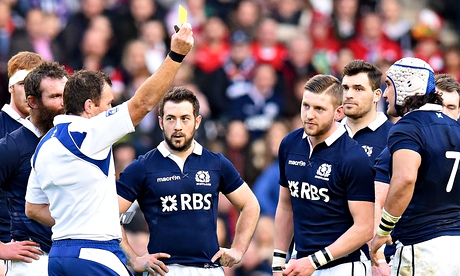
Biggar’s catch of his own kick was a thing of beauty; his landing was a reminder that 10s live in a new world of extreme exposure to injury. And exposure to a ban. Russell (F) made a mistake with his calculations – which is no excuse because all players at this level know exactly what they are doing and what they can or cannot reach (which is relevant in the case of Pascal Papé, whose claim to have kneed Jamie Heaslip by accident must be spurious). Instincts for wrongdoing will never be fully tamed as long as rugby promotes full-on legal contact.
But from 10s? If they no longer need to be protected from the charges of their opponents, perhaps they need to be protected from themselves. It will be the head-to-head of the Six Nations so far when Sexton and Ford confront each other in Dublin a week on Sunday. Presumably there is a risk that it will be literally head to head. Players are deliberately remaining upright to make the tackle that prevents a pass out of the tackle. If the ball-carrier doesn’t hit you face-on, there’s a chance that the next player on the scene will. For those with an aversion to needles and stitches, cage fighting may offer more relaxing viewing.
So far, Ford has been a model of good looks unspoilt, even if he has been inventive in attack and industrious in defence. England were so dominant in the second half against Wales that he had a good old-fashioned armchair ride. From here the small man can make the big beasts run to his tune. It is the wonder of the game.
Italy scored three tries against England. There was something admirable about the spirit of the home team at Twickenham, that they treated this not as an affront but a prompt to score six of their own. England have been the most liberated by far of the Six Nations and Ford (plus Danny Cipriani in his cameo) has been the most relaxed fly-half, and the most removed from danger.
Presumably that is about to change in Dublin. Rugby can also be compellingly stifling and the Sexton-Ford showdown will veer towards the uncompromising at the expense of the free-spirited. Which is fine, as long as the spillage of blood remains limited to a pint or two.
In the long term – nobody is in any rush to look at the statute book in the short – the law-makers will have to address the tackle. The great fear, justified through case study of previous, well-intentioned changes, is that a solution in one particular area simply shoves the problem elsewhere. The scrum, for example, has to be left to its own horrible inadequacies because if you de-power it you redeploy forwards elsewhere. The last thing rugby needs at the moment is more Billy V looking for action in midfield.
If you lower the height of the tackle, from “dangerous” to no higher than the solar plexus, you open up the possibility of all sorts of passes being given out of contact. No more choke holds; no more claret from the heads of 10s. More passing would lead to more tries. That, of course, would be ridiculous.