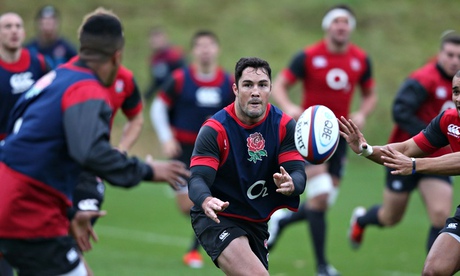
A prediction. Next Wednesday, when Stuart Lancaster announces his squad for the Six Nations, he will signal the end of England’s search for a ball-playing second receiver. The hunt for a creative inside-centre is over.
After the autumn internationals this might not be the most adventurous of predictions, but it will be a considerable concession from a head coach who had laid such store by a midfield template that his words had almost become a mantra.
Instead, throughout the Six Nations and during the World Cup shortly after, England will pick a couple of big men in the middle, probably Brad Barritt and Luther Burrell to start with, but with Manu Tuilagi hopefully returning some time during the Six Nations at the expense of Barritt.
It will not please rugby’s romantics, but England’s head coach is bowing to the inevitable. During the autumn England looked like a side that could win something when Lancaster imposed discipline and a gameplan – kick for territory, use the big men – rather than allowing his players to call the shots.
The performances against New Zealand and South Africa have taught Lancaster that only sides with the experience of the All Blacks can allow the players to make these calls. England’s comparatively young squad performs better when plan A comes from above and when they are playing to more obvious strengths. And these have changed in the past year.
For instance, 12 months ago England would go into a Six Nations in which their second row – Courtney Lawes and Joe Launchbury – looked like world-beaters. An all-action, athletic boiler room helped make a back row work which was unbalanced in that it had no out-and-out “fetcher” or conventional openside. The back five in the pack gelled as a unit, but that changed in the autumn when Launchbury went missing and, at best, the Six Nations will be long gone before the Wasps lock recovers from surgery on his spine.
Instead, England now have Dave Attwood, an improved player who brings his own strengths to the party. I’m not saying whether England are better or worse with Attwood, but they are different. Even a slimmed down, mobile Attwood adds bulk. He makes the set piece, particularly the scrum, more of a threat and my guess is that Lancaster will reflect that.
With Alex Corbisiero and Dan Cole getting over their shoulder and neck injuries, England have considerable front-row strength in depth. The scrum was a weapon against Australia when England beat them in November and will be – probably more so, assuming everyone can be kept fit – when they meet again at the start of October in the World Cup, possibly to decide who progresses from Pool A.
For the Six Nations opener in Cardiff in three weeks time, I would expect Lancaster to start with the destructive scrummaging of Corbisiero, Tom Youngs and Davey Wilson with Joe Marler, Dylan Hartley and Dan Cole to add impact from the bench – the hooker and tighthead starting among the replacements only because of a lack of game time. Behind them and in the squad, I see Mako Vunipola, Rob Webber, who has lost a little ground, and Kieran Brookes, who has made the best of his game time to supplant Henry Thomas.
With Attwood and Lawes understudied by George Kruis or possibly Geoff Parling in the second row, that leaves the starting replacement for Ben Morgan at No8 as the next biggest question regarding the pack. The obvious answer is Billy Vunipola and, because of the self-doubts which the Saracen admits entered his head in the autumn, I’d tell him he had the shirt for the entire Six Nations.
The emotional argument would be Nick Easter, but he is 36 and has been allowed to be outside the England set-up for a long time.
A back row of Tom Wood, Chris Robshaw and Vunipola, with possibly Calum Clark – very much a form player – on the bench leaves England dependent on Wood’s lineout skills, which means it is necessary that Tom Croft makes the squad, possibly alongside Dave Ewers.
If George Ford and Ben Youngs are the starting half-backs, as they were against Australia when they stuck to the letter of Lancaster’s gameplan, and Burrell and Barritt are the centres, that leaves the back three and I can’t see England going far from Mike Brown, Jonny May and Anthony Watson, who ended the autumn internationals as the starting trio.
Make Danny Care and Owen Farrell the back-up half-backs, Marland Yarde the wing cover with Tuilagi, Kyle Eastmond, Alex Goode and Jack Nowell also in the wider squad and that leaves plenty of disappointment to be shared among backs such as Ben Foden, another form player, Jonathan Joseph, Lee Dickson, Chris Ashton, Billy Twelvetrees, Semesa Rokoduguni and especially Henry Slade.
However, if Lancaster has decided how England are going to play I’d understand the logic behind this squad, barring the continued omission of Danny Cipriani if Stephen Myler remains the preferred third-string fly-half. Some time during the Six Nations and beyond, England are going to need a playmaker who can rescue a game.
Predicted match-day 23
15 Brown, 14 May, 13 Burrell, 12 Barritt, 11 Watson; 10 Ford, 9 B Youngs; 1 Corbisiero, 2 T Youngs, 3 Wilson, 4 Attwood, 5 Lawes, 6 Wood, 7 Robshaw, 8 B Vunipola.
Replacements
16 Hartley, 17 Marler, 18 Cole, 19 Kruis, 20 Clark, 21 Care, 22 Farrell, 23 Yarde.
In the squad
Webber, M Vunipola, Brooks, Parling, Croft, Ewers, Wigglesworth, Myler, Tuilagi, Eastmond, Goode, Nowell.