The government declared a state of emergency on Monday for the prefectures of Saitama, Chiba, Kanagawa and Osaka, expanding to six the number of prefectures where such measures are currently in effect.
Also on the day, emergency-level COVID-19 priority measures were put into effect for Hokkaido, Ishikawa, Kyoto, Hyogo and Fukuoka prefectures.
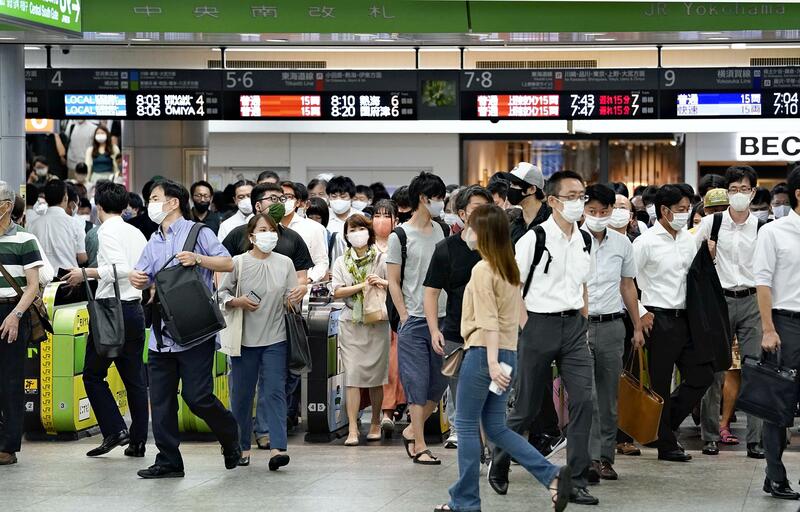
All these measures are effective until Aug. 31. The central government is calling for the public to refrain from non-essential outings and work from home, but the flow of commuters appeared mostly unchanged Monday morning at major stations in the four newly added prefectures.
On Sunday at the Prime Minister's Office, senior Health, Labor and Welfare Ministry officials reported to Prime Minister Yoshihide Suga on Japan's current situation related to coronavirus infections.
In Chiba, Saitama and Osaka prefectures, restaurants that serve alcoholic beverages or offer karaoke are being asked to suspend their operations, while other restaurants are requested to shorten their business hours and close at 8 p.m.
Kanagawa Prefecture, which has implemented its own COVID-19 controls, will expand its measures throughout the prefecture, asking shops to shorten their business hours and stop serving alcoholic beverages.
In areas under the priority measures, shops and restaurants must move up their closing time to 8 p.m. and stop serving alcoholic beverages in principle. Restaurants that meet certain requirements, such as implementing proper infection control measures, are allowed to serve alcohol until 7 p.m. at the discretion of their prefectural governor if infections in that prefecture are on a downward trend.
The prefectural governments will step up their monitoring of restaurants and call for the public not to drink on streets and in parks.
Japan's central government is aiming for 40% of the population to receive a second dose of vaccine by the end of this month, and is encouraging young people to get vaccinated.
-- Foot traffic
Mobile phone data from NTT Docomo, Inc. showed that foot traffic at 7 a.m. Monday decreased by 4.3% at Umeda Station in Osaka and 3.8% at Chiba Station, compared to a week ago on July 26. The percentages increased by 0.9% at Yokohama Station and increased a little at Omiya Station.
At Yokohama Station, a steady flow of commuters passed through the ticket gates on Monday morning.
"The number of people has not decreased at all even after the state of emergency," said a 23 year-old company employee from Tokyo's Minato Ward whose office is near the station. "I think the state of emergency has become less effective."
A 53 year-old company employee from Kawasaki said: "The orders in the past were not effective enough. Once issued, a state of emergency should be continued until infections are significantly reduced. I want the government to put efforts into developing curative drugs, too."
Osaka Station was also crowded with commuters.
"I got on the train after 10 a.m. using staggered work hours, but it was packed with commuters," said a 69 year-old company employee from Toyonaka, Osaka Prefecture.
A 40 year-old nurse from Naniwa Ward, Osaka, said: "I think many people no longer feel like refraining from going out. The medical system is in trouble. I hope the government will take measures that are more effective."
People seeking to telework came to a hotel near Omiya Station on Monday morning. Reservations for a plan to stay at the hotel for up to 11 hours have increased in line with the spread of infections, with 120 people using the service in July.
The hotel had received five such reservations by 10 a.m. Monday. A hotel spokesperson said, "Now that a state of emergency has been declared, we'll have more guests. We'll provide rooms with thorough infection control."
A restaurant near Chiba Station planned to stop its nighttime operations from Monday night and operate only during lunchtime.
"We have no choice but to keep labor costs down and operate frugally," the restaurant's owner said.
Read more from The Japan News at https://japannews.yomiuri.co.jp/