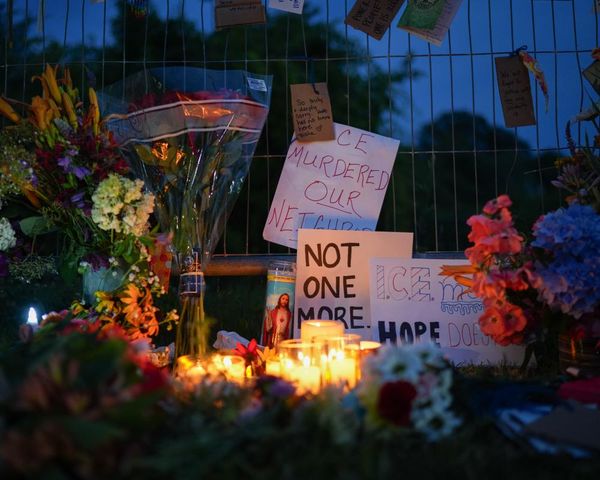
HOUSTON — The prosecutor responsible for the largest county in Texas says the federal government has not released the single fact every homicide investigation begins with: the name of the person who pulled the trigger.

Six days after a U.S. Immigration and Customs Enforcement officer shot and killed Lorenzo Salgado Araujo, a 52-year-old homebuilder, on a street in Houston's East End, Harris County District Attorney Sean Teare told reporters Monday that his investigators are being forced to work backward — canvassing businesses, chasing tips, reconstructing the agents' movements — because no federal agency will identify them.
A Blackout With No Local Precedent
Ordinarily, Teare said, when a Texas officer or deputy kills someone, his office has the shooter's name inside 12 hours. That standard, he told the Texas Tribune's news conference audience, has now been exceeded roughly twelvefold.
"No one on the state level knows who they were or where they are right now," Teare said, calling the situation unacceptable.
So his office has begun treating the killing the way it would treat any shooting by an unidentified assailant. Appearing alongside Precinct 1 Commissioner Rodney Ellis, Teare said his prosecutors intend to run the case exactly as they run every other criminal matter. "We are good at identifying individuals who don't want to be found," he said. He also warned that resolution could be many months away, and possibly years.
The Department of Homeland Security has declined to release the officer's name, pointing to a rise in threats and violence against immigration agents. The Atlantic, citing an unnamed senior ICE official, has reported that the shooter is a career officer with more than twenty years of federal experience.
An Evidence File Built From Storefront Cameras
The hole at the center of the case is a visual one. The agents wore no body cameras — DHS has blamed government shutdowns for the equipment gap — and, according to U.S. Rep. Sylvia Garcia, D-Houston, who was briefed by acting ICE Director David Venturella, the agency's vehicles produced no dashboard footage either. Venturella has since promised that field officers will be equipped with cameras before the month is out.
That leaves Teare's team assembling the morning from fragments: surveillance clips pulled off businesses near the intersection, bystander phone video, and what he described as well over 100 communications from members of the public. Investigators were unable to reach the scene for hours after the shooting. Teare's office also has yet to speak with the DHS inspector general at all.
He has, meanwhile, opened a channel to the Hennepin County Attorney's Office in Minnesota, which is examining the January killings of Renee Good and Alex Pretti by federal immigration agents — Minnesota prosecutors went to court to pry evidence out of federal hands. Local prosecutors, in other words, have begun comparing notes on how to investigate officers who won't say who they are.

Two Irreconcilable Accounts
ICE's version is that Salgado Araujo ignored commands, rammed a government vehicle, and "weaponized his vehicle in an attempt to run over" an agent, prompting a shot fired in self-defense. He was taken to Ben Taub Hospital with CPR underway and pronounced dead there.
The three men in the van with him — one of them his brother — describe something close to the opposite. Attorney Hugo Balderas, who represents two of the passengers, says his clients are clear that "the shots came from the sides, not from the front," and that no agent was ever standing in the van's path. In accounts relayed to the Washington Post, the passengers went further, saying it was the ICE vehicles that rammed the work van, and that an officer ran up from the side, shouted, and fired through the passenger side.
Immigration lawyer Ruby Powers, who represents the victim's brother, Victor Hugo Salgado Araujo, says the DA's office has already interviewed her client — he was in the passenger seat — and that he has told her no officer was ever in danger. All three men remain in ICE custody at the Montgomery Processing Center in Conroe. Powers is working to get her client released so he can serve as a witness.
The Harris County Institute of Forensic Sciences has ruled the death a homicide, listing the primary cause as a penetrating gunshot wound of the torso.