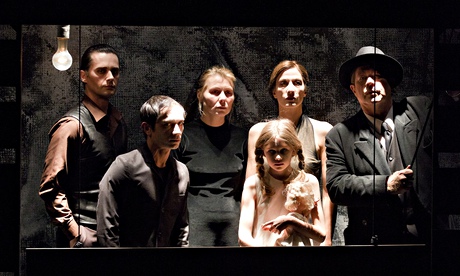
Everyone accepts that Luigi Pirandello’s 1921 play is a seminal theatrical work. But how do we actually stage it today? In Rupert Goold’s 2008 revival it was, somewhat confusingly, relocated to the world of TV docudrama. This striking production, in French with English surtitles, by Emmanuel Demarcy-Mota for the Théâtre de la Ville in Paris, sticks closer to Pirandello’s text while adding its own interpretative layers.
It starts with a company rehearsing Pirandello’s The Rules of the Game. One is instantly struck by the satiric portrayal of the director as a tin god who conducts the text rather than explores it and treats his actors as if they were slaves to his will. Then the six characters arrive, demanding that their tragic story be told: one that hinges on the father’s unwittingly making love to the stepdaughter in a carefully camouflaged brothel. Intrigued and horrified, the company of actors attempt to give the tale theatrical life.
What comes across most vividly in Demarcy-Mota’s production is the essential paradox of theatre. There is something comically absurd about the actors’ initial attempts to mimic reality. They shadow the six characters, copying their every action but, when they re-create the brothel scene, it is painfully stagey. It is a point reinforced when the originals recapture the tawdry squalor of the moment when the father is caught with his pants down with his semi-naked stepdaughter. While Pirandello’s point about theatre’s falsification of reality is exactly caught, the production also demonstrates the therapeutic necessity of drama. The six characters are an unusually angry bunch, demanding their story be told as if to give it completion.
It’s a play of endless Chinese boxes, but the wittiest feature of this production is that it becomes an attack on directorial ego while being exceptionally well-directed. Yves Collet’s set and lighting make astute use of billowing screens and shadow play. The stage also features a portable rostrum, on which characters leap with athletic agility – the director to show off; the father out of anxiety to tell his story.
Hugues Quester lends the homburg-hatted father a rasping ferocity, as if his guilt can only be assuaged through enactment. Valérie Dashwood plays the stepdaughter as a tormented figure who yearns for her degradation to be fully known; and Alain Libolt makes Pirandello’s director a figure of suavely punctured omnipotence. It is a prime example of how a classic can be reimagined without being subverted.
• Until 7 February. Box office: 0845-120 7511. Venue: Barbican, London.