
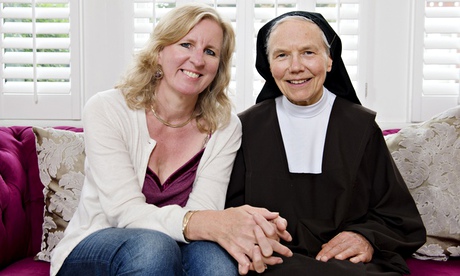
In the summers of my childhood I saw my aunt every day. But we weren’t allowed to speak to each other and although I was forever glancing in her direction, hoping for a smile, she never once caught my eye. Because Bernadette was, and is, an enclosed nun. My daily sightings of her came at morning mass, when my grandmother and I would sit on the front pew in the convent chapel, from where we had a perfect vantage-point into the nuns’ choir behind its wrought-iron grille. Bernadette knelt second from the front in the long line of serene-looking nuns, her hands neatly hidden below her brown scapular, her head covered by a white wimple and a black veil, a creamy woollen cape across her shoulders.
To most people in the congregation, all those identically clad Carmelites looked exactly the same. But I was always absolutely sure which nun was mine, even if she wasn’t allowed to look across and smile at me the way other aunts would have done.
Hers seemed an impossibly romantic existence and I was fascinated by everything about her. My grandmother, who perhaps never quite recovered from the blow of hearing that her only daughter was going to enter a Carmelite convent in a small town called Presteigne on the Welsh border, rented a cottage nearby. She liked to be close, even if they couldn’t do normal mother and daughter things like shopping, having meals together (Carmelite nuns never eat with other people), going to the theatre or even a walk.
To some extent, I stepped into the breach: born two years after Bernadette disappeared behind the heavy enclosure door, I was always very close to my grandmother. I spent my summers with her, whiling away the days in the peaceful Powys countryside and never missing morning mass at the convent to catch that precious glimpse of Bernadette.
We were only allowed to visit for one hour a week on Sunday afternoons at 3pm. That hour was the most precious of the week for Granny and I knew I was privileged to share it. The visitors’ parlour was at the back of the whitewashed convent: we would ring the tinny little bell (frugality, fashionable today, has been de rigueur for Carmelites for centuries) and a hatch would be opened through which we could see the wimple-haloed face of the sister whose job it was to connect with outsiders. Then we’d go through into the parlour, a windowless room with a kind of iron fence across the middle of it, marking the threshold between our world and theirs. The grille was waist-high, and when Bernadette appeared she would lean across it for a moment and envelope us in her scratchy, carbolic-scented habit for a hug before we sat down to chat.
But we were lucky to get that hug, because it was only at the end of the 1960s that Carmelite life began to edge its way slowly out of the 16th century. Until then, and the reforms of Vatican II, the nuns in Bernadette’s convent were not allowed any physical contact whatsoever with outsiders. What that meant was that when my grandparents kissed their daughter goodbye on a cold winter’s day in 1961, they believed they would never kiss, touch or hug her again. In those days the parlour was much more austere: the grille stretched from the floor to the ceiling, and at one side there was a big drawer that slid through from one side to the other, via which visitors could pass authorised items (mostly religious books). When my sister was a baby, my parents broke the rules. She was a few weeks old and they had brought her to the convent to introduce her to Bernadette for the first time. My aunt had given up the chance to have children of her own – but that didn’t mean she hadn’t wanted them. “I’d love so much to hold her,” she said. So my mum and dad posted their infant through in the drawer and, for a few moments, Bernadette got what she had forgone forever, the chance to cuddle a baby.
After my grandfather’s death in 1965 (Bernadette was unable to go to him as he was dying or to attend his funeral), some of my grandmother’s friends thought she might follow her daughter and become a Carmelite. How we used to laugh at that: the notion that Granny, whose idea of a mixer for her Green Chartreuse was a large brandy, would join the abstemious ranks of self-denying nuns, gave us a giggle.
It wasn’t until I was much older, and a little bit wiser, that I realised Granny was living her daughter’s vocation already, every bit as much as Bernadette was. She didn’t need the brown habit and the enclosure to be part of the sacrifice, and the Green Chartreuse and brandy could only offer brief consolation for what she’d lost.
But what made Bernadette give up her life to become a nun – and what went on behind the grille in that world we could only glimpse from a distance?
When I was 21 – the same age as Bernadette when she entered Carmel – I got the chance to find out. I was studying journalism in Cardiff, not far from the convent and when we were asked to do an in-depth feature about a way of life that was difficult to penetrate, I didn’t hesitate. I asked the nuns if I could stay inside the community for a week, in order to write about it. To my surprise (I have often wondered whether they thought I might have had a vocation myself and this was my way of trying it out) they agreed.
Sharing their life was an extraordinary experience; my strongest memories are of a total lack of creature comforts – bare wooden floors, my spartan cell with just a bed, desk and chair – and of a silent world governed by bells and constant trips in and out of the chapel. But there was a peace there like no peace I’ve ever experienced, and when I’m up against it I sometimes remember what it was like to kneel in the choir at first light (morning prayer was at 5am) and the ethereal sound of the nuns’ voices as they sang the psalms.
And being inside the convent brought me, of course, closer to Bernadette. We had never expected to be able to spend this sort of time together; and having always seen her as a nun, I began to see her for the first time as a woman. I still found it hard to understand why she had chosen this radically different existence, but I could see that she felt utterly convinced that it was her calling.
The life of an enclosed nun makes no sense at all without faith in God and I could see what a deep faith Bernadette had, and has now. But I also realised that faith doesn’t make everything else easy. There were clearly plenty of bumps along the way in Carmel, just as there are in any way of life: sometimes even an enclosed nun must just cling on and hope that the things she has always believed in are true, and that everything will be all right in the end.
The other thing I realised was that, while I was part of Bernadette’s blood family, the Carmelites were her real family now. She had swapped us for them, although she still cared deeply for us. The nuns are “sisters”, and that is genuinely how they think of one another. The prioress is the “mother” and, like all mothers, she has to keep charge and ensure that there is discipline as well as laughter and purpose and fun.
And there was fun in the convent: at recreation, the one hour of each day when the nuns are allowed to talk, they chatted ten to the dozen, and their stories were often accompanied by whoops of laughter and much merriment. Being a Carmelite is a hard life but it’s one these women have embraced: they don’t see the strictures as demanding – they see them as liberating. They free them to concentrate on what they see as the important things in life: an interior journey, sustained by prayer, that takes them closer to God.
A few years after my spell inside the convent, there was another surprise. The nuns in Presteigne decided to close the convent: they didn’t have enough young recruits and couldn’t see how they would be able to carry on with the dwindling number of sisters. It was a tough time: Bernadette had expected to end her days there and to be buried in the little graveyard in the enclosure where so many of her sisters now lay. But it wasn’t to be, and she had to decide where to go next.
There are other Carmelite convents in the UK, but Bernadette dropped a bombshell: she wanted to go to South Africa. We were astonished: she had never been to any part of Africa, and this was in the days of apartheid. What on earth was going to become of her?
Saying goodbye to her was difficult. It was early 1992, and I was pregnant with my first baby: I remember Bernadette feeling her kicking through my growing belly before she boarded her ship at Tilbury docks. We were both on the verge of new lives – me as a parent, her in a new continent – but we didn’t know for sure whether we’d ever meet again. She gave me a little holy picture on which she’d written: “Farewell dearest Joanna, united with you always in thought and prayer.”
And then she was gone.
This was before email, but Carmelite nuns are inveterate letter-writers, so we always kept in touch. I filled her in on the story of my growing family over the years that followed, and she kept me posted on the often difficult demands of trying to set up a new community in a far-flung part of the world. She couldn’t meet my daughters, but she could hear all about them – and I heard all about her new sisters in a little convent outside Johannesburg.
While we couldn’t see each other any more, we always were – as she had said – united in prayer. I would not claim to be a particularly devout Catholic but when I was up against it, it always helped to know that Bernadette would be making full use of her hotline to the Almighty. And – who knows? – maybe her prayers did help to sort out difficult situations.
Several years after she had gone to Africa, Bernadette wrote with some unexpected news. She was allowed to come home on a visit. It was extremely unusual, as enclosed nuns don’t usually go out or travel, still less make trips to stay with relatives. However, because Bernadette’s situation was so rare, in that she was enclosed but on another continent, special dispensation had been granted.
So began the latest and, in a way, the most unusual situation of all in our relationship. Because now, every few years, I pick up Bernadette from Heathrow and bring her back to stay at my home. The distant nun from my childhood is now as close an aunt as any niece could have – in fact, we are closer because she has no daughters of her own. My own children, now in their teens and early 20s, are bemused by the occasional visits from a habited nun who knows nothing of iPads or Kindles and has never heard of X-Factor or You Tube.
For my husband, Gary, who was raised in a staunchly Church of Scotland family, being in proximity to an enclosed nun is an unexpected oddity, but one he has embraced with gusto. On Bernadette’s first visit home, we took her to Manchester on the M1 (the first time she had ever driven on it) and Gary fulfilled a secret ambition to “do a ton with a nun”. Another time, when we were delivering her to a Carmel in London, we were warned that it was an old-fashioned place and we should expect a full grille. Gary thought that meant he was getting a fry-up.
On visits home, Bernadette has, sometimes cautiously, dipped a toe into the world she gave up so long ago. She has a cheap mobile phone so she can keep in touch as she travels the country visiting relatives and friends, and has even mastered the ATM. She’s in Britain at the moment and we’ve been out for pizza, walked along the Thames and travelled into town by tube – all things she never thought she would do again in her life.
As always on her visits, we’ve had loads of fun. Because here is the most important thing about Bernadette: she’s about the least pious person you could imagine. Prone to giggles, the biggest chatterbox in the family, and always up for a challenge, she’s the very antithesis of a disapproving or judgmental holy person. Her way of life might be disappearing (not many young women enter religious orders these days) but she remains an extremely good advertisement for it.
Although I think it’s unlikely in the extreme that any of my daughters will follow her into the convent, I’m glad their lives, like mine, have been touched by the depth and mystery of a life as different as that of a Carmelite nun.









.jpg?w=600)



