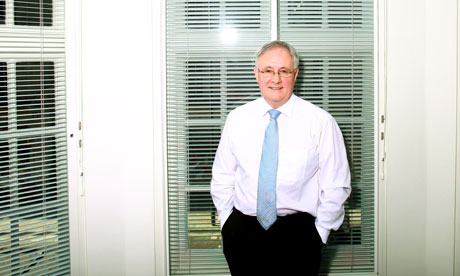
When "cock-ups" is the most memorable phrase of Sir Michael Lyons's farewell speech, you have to wonder about the legacy of the first BBC Trust chairman. Thursday will be taken over by the Patten show, and it is the nature of things to ignore the old and obsess over the new. But it's worth pausing a second or two to assess Sir Michael's record.
Cock-ups, of course, are an inevitable fact of life at the BBC (or any media organisation). It's how you handle them that counts (think Dyke on Gilligan – inflame the situation until you get forced out). There's no doubt that the trust was slow, oh so slow, to respond to the Brand-Ross crisis - although in the end it hasn't done much too dent the BBC's reputation in the long haul. Compliance, it turned out, was the ultimate winner.
Nevertheless, what Brand-Ross did reveal was a Trust that lacked a popular touch, even though Lyons says he is there to "represent the interests of the public". There were endlessly critical reviews of BBC1, BBC2 (not distinctive enough) and Radio 4 (too middle class), none of which seemed to grip any important points or problems with BBC coverage. It would have been refreshing for Lyons to say that something on the Beeb wasn't good enough without the trouble of ordering a review first.
Lyons's era was also notable for the endless sniping from cash-strapped competitors, which at one point amounted to an unholy alliance of a recession-hit ITV and a perennially aggressive News Corporation/Sky. ITV managed – amazingly – to force Lyons into criticising management for scheduling Strictly against The X Factor as if it was time to abolish competitive scheduling in the era of Sky+. Endless commercial criticism from News and other publishers also persuade Lyons to trim some of the Beeb's commercial activities, although Lonely Planet was still both bought and not sold.
There was endless discussion, too, about talent pay – spurred by an agreeably dishonest pitch from the nation's newspaper journalists. Bluntly, media hacks know stories about the pay of Ross and the other BBC stars made good copy, and they were always going to press for more disclosure on the "public money" argument. Actual viewers, though, are rather more neutral on the point, tending to expect entertainers like footballers to be well paid – and expecting the Beeb to have some famous people on air.
Yet Lyons fell in with the press and continued to push for individual salary disclosures when frankly it is not obvious that pay reveals would have led to salary deflation ("I want what Moyles/Paxman has got"). It would also make it far easier for ITV and Sky to poach talent too. And while disclosure is relevant, as long as you know what the boss class earns, who needs to know exactly what Chris Evans earns.
A bigger question, though, is whether the BBC got worse or better during the Lyons era. In truth you could argue about this endlessly, but for all the fine debate, the broad point holds up – by and large the BBC remains the home of high quality television and radio. Those who say the licence fee remains worth paying just for Radio 4 have a point - although watching recent coverage in Libya and Egypt, or any number of programmes over the past four years will know how much quality there is out there.
The problem there, though, is that the quality of the BBC's output has little to do with the regulator and rather more to do with generous funding and the talent within the corporation.
There, is, something else. When it mattered – and it did really matter – Lyons did something critical. In a moment of madness this autumn it really looked as if Iain Duncan Smith was going to kill the BBC by loading the half a billion and more bill for free TV licences for the over-75s onto the corporation. With a licence fee freeze thrown in, that would be time for shutting BBC2 to make the books balance.
What Lyons did in that critical moment was make it clear that he and the Trust would not stand for it. That they would, in short, resign if ministers tried to press the idea through. And if that helped safeguard the future of BBC, then, frankly, it such an important act that everything else pales into insignificance.
If that is Sir Michael's legacy - so be it.