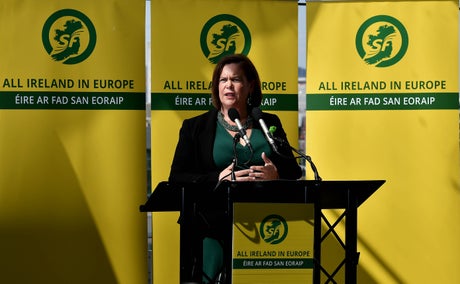
Sinn Fein would be the largest party in both Northern Ireland and the Republic of Ireland if fresh elections were held today, polls show.
The nationalist party has opened up a significant lead over its nearest unionist rivals north of the border, after a sharp collapse in support for the hard-right DUP.
And in the south it has enjoyed a narrow but consistent lead in polling for the next Dail elections since the start of the year, just ahead of Leo Varadkar's Fine Gael, according to a poll of polls.
The party could capitalise on its buoyant support in elections to Stormont scheduled for next year, but would have to wait until early 2025 for the next scheduled general election in the Republic of Ireland.
A new survey for the Belfast Telegraph conducted by pollster LucidTalk shows Sinn Fein with a 9 per cent lead over the DUP.
The unionist party’s support has halved since the general election 17 months ago with a historic low of 16 per cent. Its slide comes amid a backdrop of loyalist discontent over Brexit, and the replacement of its leader Arlene Foster with Edwin Poots.
The survey found that the DUP’s support has fragmented between the even more hardline Traditional Unionist Voice (TUV), the more moderate Ulster Unionist Party, and the non-sectarian Alliance Party.
The Alliance is itself on 16 per cent in joint second place, trailing Sinn Fein on 25 per cent.
In the Republic, a polling average calculated by the website Politico Europe has Sinn Fein averaging 29 per cent of the vote, ahead of Fine Gael on 26 per cent and Fianna Fail on 15 per cent.
The Republic’s government is currently a coalition between Fianna Fail, Fine Gael and the Green Party.
At Stormont, securing a place as the largest party would guarantee Sinn Fein the office of first minister under the power sharing settlement. The deputy first minister would automatically be drawn from the unionist community.
Parties in the Republic have been reticent to form coalitions with Sinn Fein because of the organisation’s historic links to the IRA – with then prime minister Mr Varadkar saying it was “not a normal party”.
But the leadership of his rivals in Fianna Fail was reported to have softened on the idea of working with the left-wing republicans, although such a pact did not materialise after the last elections.
In the Republic Sinn Fein has grown its support in recent years by focusing on economic and social issues such as housing.
A LucidTalk poll commissioned by BBC Northern Ireland’s Spotlight programme last month found only a narrow majority of people in Northern Ireland now oppose a united Ireland.
The poll found that 49 per cent of the North’s residents favour remaining a part of the UK while 43 per cent supported leaving. The same survey found that in the Republic, 51 per cent favour a united Ireland with 27 per cent supporting a continuation of the status quo.