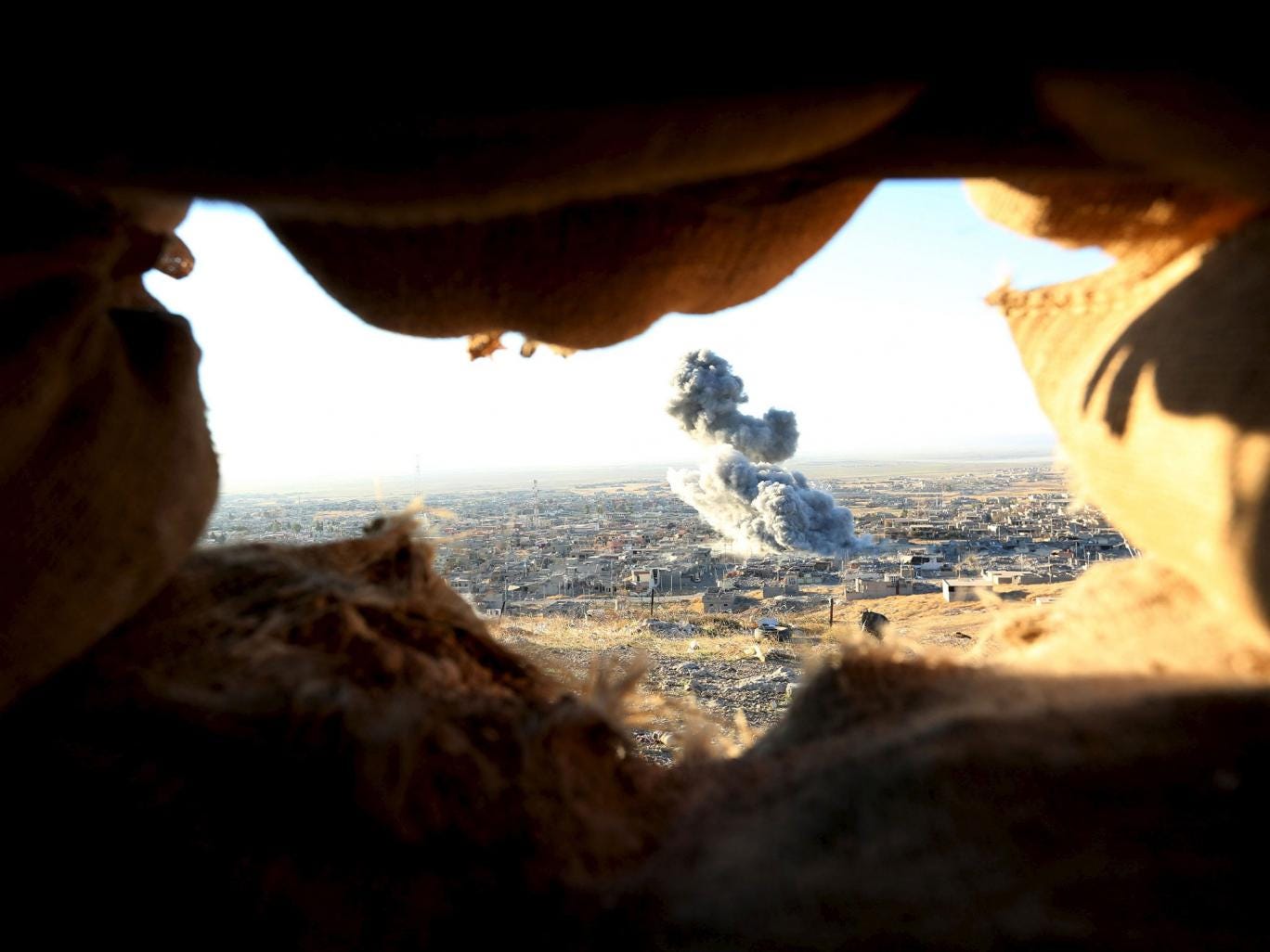
An ambitious military offensive has finally been launched to retake a key town from Isis which, if successful, could split the militant group’s territories in two.
With the support of US-led coalition air strikes at their backs, up to 8,000 Kurdish and Yazidi soldiers have reportedly captured a number of villages on their way towards the Iraqi town of Sinjar.
Lying on a key road between Isis’s Iraqi stronghold of Mosul and its “capital” in Syria, Raqqa, the town was overrun by militants in a significant blow for the Iraqi army more than a year ago.
Operation Free Sinjar aims to seize back the town, shutting off major Isis supply routes and establishing a buffer zone to protest its civilians from artillery fire.
The offensive has been long overdue, delayed by infighting between rival local forces.
But overnight, coalition jets pounded Isis positions as thousands of Kurdish special forces, peshmerga and Yazidi fighters descended from the mountain that shares its name with the town towards the frontline in a military convoy.

The Kurdish security council said on Thursday that its forces had captured a village to the west of Sinjar and two others on the eastern outskirts, though this could not be independently verified.
It later said its fighters had reached Highway 47, the key road between Mosul and Raqqa, in two different areas.
A team from the Associated Press said they had seen a small American unit positioned on top of a hill calling in and confirming air strikes.
Maj. Gen. Seme Busal, commander of one of the front lines, told reporters after the initial push: “(Peshmerga) troops are holding their position, waiting for reinforcements and more air strikes so they can then move into the centre of the town. Air strikes have been very important to the operation getting to the point where it is now.
According to Reuters, Isis snipers have fallen back to take up positions inside the town.
And it reported that militants could be heard communicating in frantic tones over Arabic and Turkmen over intercepted walkie-talkie chatter.
“Where are you,” asked one. “Praise be to God,” said another. One fighter noted that a car used by comrades had been destroyed.
Speaking about the strategic significance of Sinjar, Captain Chance McCraw, a military intelligence officer with the US coalition, told journalists: “If you take out this major road, that is going to slow down the movement of (IS's quick reaction force) elements.
“If they're trying to move from Raqqa over to Mosul, they're going to have to take these back roads and go through the desert, and it's going take hours, maybe days longer to get across.”
But for the Yazidi forces taking part, the battle is very much about retribution.
Mount Sinjar came to international attention when tens of thousands of Yazidis fled there in the summer, where the militants surrounded them, trapped and exposed in the blazing heat.
The crisis prompted the US to launch air drops of aid to the stranded, and then on 8 August, it launched the first round of air strikes in what would mark the beginning of a broader coalition effort to battle the militant group in Iraq and Syria.
The PKK has trained a Yazidi militia in Sinjar, while tribal groups operate independently. Several thousand Yazidis have also joined the elite peshmerga.
Hussein Derbo, the head of a peshmerga battalion made up of 440 Yazidis, said the men under his command could have migrated to Europe but chose to stay and fight.
“It is our land and our honour,” he said. “They (Islamic State) stole our dignity. We want to get it back.”
Additional reporting by agencies