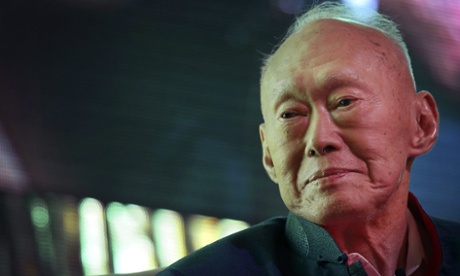
Singapore’s first prime minister, Lee Kuan Yew, has died aged 91, its current leader has confirmed.
In a statement released on Sunday evening, the serving prime minister Lee Hsien Loong said the country’s former leader died in the early hours of the morning.
“The prime minister is deeply grieved to announce the passing of Mr Lee Kuan Yew, the founding prime minister of Singapore.
“Mr Lee passed away peacefully at the Singapore general hospital today at 3.18 am. He was 91,” it read.
Lee Hsien Loong added that arrangements for the public to pay respects and for the funeral proceedings would be announced later.
Lee was admitted to Singapore general hospital on 5 February for severe pneumonia and was later put on life support.
Lee, a Cambridge-educated lawyer, is widely credited with building Singapore into one of the world’s wealthiest nations on a per capita basis with a strong, pervasive role for the state and little patience for dissent.
He co-founded the People’s Action party (PAP), which has ruled Singapore since 1959 and led the newly born country when it was separated from Malaysia in 1965.
He stepped down as prime minister in 1990, handing power to Goh Chok Tong, but remained influential as senior minister in Goh’s cabinet and subsequently as “minister mentor” when his eldest son Lee Hsien Loong became prime minister in 2004.
The older Lee left the cabinet in 2011 and had cut down his public appearances in recent months due to his age and declining health.
Lee was feared for his authoritarian tactics but insisted that strict limits on speech and public protest were necessary to maintain stability in the multiethnic and multi-religious country.
The Australian foreign minister Julie Bishop paid tribute to Lee Kuan Yew, describing him as a political giant.
“The passing of a giant like Lee Kuan Yew is the end of an era,” Bishop told Sky News.