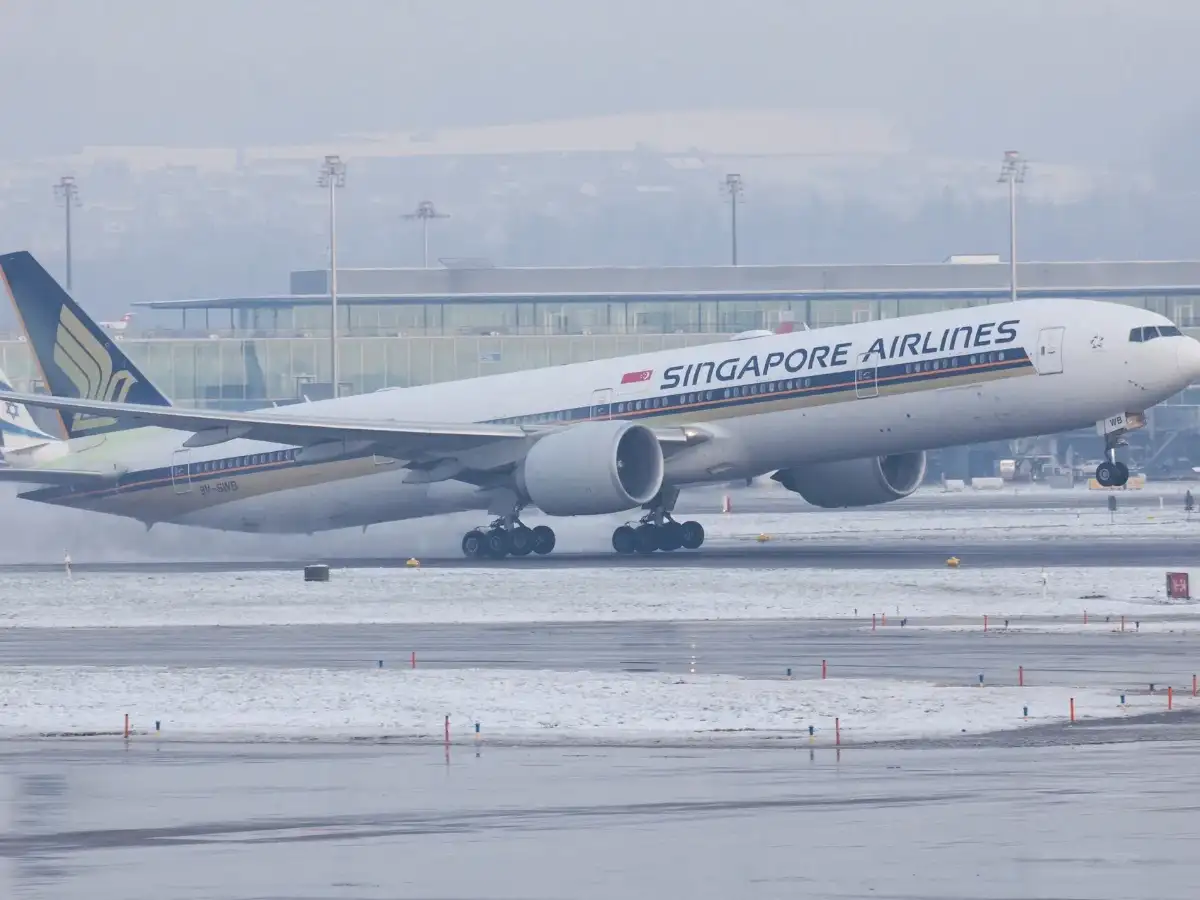
Singapore: Singapore Airlines on Tuesday said that tangible progress has been made towards Air India's fleet renewal and aircraft retrofit programmes, as well as on-ground and in-flight service enhancements, and operational performance.
The airline group said its 25.1 per cent strategic stake in the Air India Group is a key pillar of its multi-hub strategy.
"SIA and its partner Tata Sons are committed to Air India's long-term success, and to working together to support its multi-year transformation programme," said the airline in its latest financial report for the first quarter of 2026-27, released on Tuesday.
Also Read: IndiGo bets on India's aviation boom despite West Asia turbulence, oil price risks
During the latest April-June quarter, the Group reported a net loss of USD 76 million, a deterioration of USD 262 million year-on-year, due to the drop in operating profit to USD 299 million and a higher share of losses from Air India at USD 42 million, partially offset by lower tax expense of USD 85 million.
During the reporting quarter, the Group said it continued to make progress in forging deeper win-win partnerships with like-minded carriers in key markets, allowing it to offer customers an even wider network and greater value.
SIA and Air India have agreed to deepen their commercial partnership by enhancing network connectivity, expanding codeshare arrangements, and collaborating on loyalty programmes. These are expected to roll out progressively over the course of this year.
Also Read: Air India's stumble creates a bigger problem than aviation duopoly
Demand for air travel remains robust, underpinned by seasonal travel flows, it said, adding that cargo demand shows resilience across most key verticals, with semiconductor and data centre-related movements providing support.
The airline also said that geopolitical developments, including the Middle East conflict, continued to add uncertainty to the industry's operating environment. The most immediate impact is on jet fuel prices, the Group's single-largest expenditure item.
Sustained elevated prices relative to pre-conflict levels have added significant cost pressure, it said.
While SIA and Scoot have adjusted air fares and cargo rates to help mitigate this, these measures do not fully offset the impact of significantly higher fuel prices, it said.
Besides, a prolonged conflict in the Middle East may also affect supply chains, global trade, and macroeconomic conditions.
Against this backdrop, the SIA Group will continue to seize growth opportunities, leveraging its well-diversified global passenger and cargo network anchored by Singapore's position as a strategic Asia-Pacific hub.
The report also highlighted that the dual-brand portfolio of Singapore Airlines and Scoot provides flexibility to calibrate capacity and schedules as demand patterns evolve, allowing it to remain nimble and agile.
Underpinned by its robust balance sheet, industry-leading digital capabilities, and talented and resilient people, the Group said it will continue to strengthen its long-term competitive position. This will allow the company to reinforce the industry-leading position of SIA and Scoot, and invest in service excellence, product leadership, and network.
The SIA Group achieved a record revenue of USD 5,714 million during the first quarter of FY2026/27, logging an increase of USD 924 million (19.3 per cent) year-on-year.
The Group continued to seize the opportunities and benefit from the robust demand for air travel, with passenger revenue rising 18.6 per cent to USD 4,582 million.
SIA and Scoot carried a record 10.9 million passengers during the quarter under review, up 6.3 per cent from a year ago.
Group passenger load factor (PLF) stood at 87.1 per cent, 0.5 percentage points lower year-on-year, as capacity expansion of 5.9 per cent outpaced traffic growth of 5.3 per cent. Passenger yields rose 12.0 per cent to 11.2 cents per revenue passenger-kilometre.
Its cargo revenue grew USD 178 million (33.5 per cent) to USD 708 million, driven by a 28.1 per cent improvement in yields and a 1.9-percentage point increase in cargo load factor (CLF) to 58.8 per cent. The higher CLF was underpinned by higher cargo loads (4.0 per cent) relative to moderate capacity growth (0.5 per cent).
Expenditure rose 27.9 per cent to USD 5,609 million, mainly due to a USD 991 million (78.5 per cent) increase in net fuel cost to USD 2,253 million.
Jet fuel prices, which are typically priced on a lagged basis, experienced a surge arising from the Middle East conflict that started on February 28, 2026. As a result, fuel cost, before hedging, more than doubled (118.7 per cent) this quarter on elevated fuel prices (USD 1,459 million) and higher consumption (USD 42 million).
The increase in gross fuel cost was partially reduced by a swing from a fuel hedging loss of USD 60 million last year to a gain of USD 376 million this year.
Non-fuel expenditure rose 7.4 per cent, driven by overall capacity expansion and inflation pressure.
Given the sharp rise in fuel costs, the Group recorded an operating profit of USD 106 million, down USD 299 million, or 73.8 per cent, from a year ago.