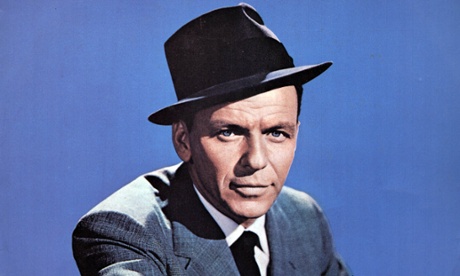
It’s an irony Frank Sinatra would appreciate: his official career retrospective, a glossy exhibition that takes great pains to minimize his legacy of snap-brim libertinism and dark motivations, opens by accidentally emphasizing his connection to the mafia.
To be fair, the large gold lettering “M.O.B. Assn” that greets viewers of Sinatra: An American Icon doesn’t reference organized crime; it nods to Marty O’Brien, the boxing pseudonym of Sinatra’s father, and the bar he owned. It’s also an outlier in the otherwise singularly reverential display, a big-band crescendo that only rises steadily in its chaste enthusiasm. On view until 4 September at the New York Public Library for the Performing Arts, the exhibit posits itself as the tentpole of the Sinatra estate’s many centennial festivities this year.
Sinatra does tout an impressively dense swath of awards, personal totems and career bric-a-brac. Young Frank’s childhood ID card (his Hoboken address scrawled in shaky block lettering) rests alongside his faded grin on the cover of a bobbysoxer magazine called Swoont News. A belt buckle given by Ronald Reagan etched “The Buckaroo Stops Here” perches near a natty fedora, cocked at his trademark assertive angle, and an immaculately pressed tuxedo. Gold records and Grammys join his first Academy award, for the charming 1945 short film The House I Live In, in which he stops a pack of jingoistic boys from bullying a Jewish peer (in part, by crooning “The children in the playground/ The faces that I see/ All races and religions/ That’s America to me”). Previously unreleased family photos show him later in life, zealously chomping a wedge of watermelon and hoisting a model train with the glint in his eyes once reserved for grabbing Ava Gardner’s bum.
It is an enjoyable collection of artifacts, and it prompts a just awe in Sinatra’s tremendous, diverse talents – but it also wholly ignores the stormy romances, career slumps and hard-living lifestyle that are integral to his artistic identity. Somewhere amid all the dutiful curios, Sinatra commits the cardinal sin of making the progenitor of rock star behavior seem boring.
One issue the Chairman would surely find unforgivable: no photos of his dames. The libido that led Dean Martin to joke, “When he dies, they’re giving his zipper to the Smithsonian,” is neutered (and, spoiler, no such relic is here). It would be understandable if his copious conquests were undercut, but his first three wives, as famous to his iconography as his Pal Joey suit, only receive perfunctory mention in his general timelines – even the bona fide star Gardner. The biggest snub is reserved for his fourth and final wife, Barbara, with whom he remained the longest and who is omitted entirely. I even spotted one woman scanning the succinct chronologies for mention of Ronan Farrow, Sinatra’s all-but-confirmed love child with his then-ex-wife Mia Farrow – a futile endeavor.
The hagiography of the exhibit isn’t surprising; it was curated with the Grammy Museum in Los Angeles (where it will travel after New York) and the Sinatra family. But their approach buckles under palpable biases. Marx reportedly clashed over Sinatra’s portfolio with his youngest daughter, Tina, principal manager of Frank Sinatra Enterprises. Inexplicably, the Rat Pack, one of the most joyous and defining of Sinatra’s endeavors, is reduced to a small poster for their film Robin and the 7 Hoods – no items from their other movies, including Ocean’s 11, nor their years in Las Vegas, so imperial that the Strip lights dimmed in tribute after the deaths of Sammy Davis Jr in 1990, Dean Martin in 1995 and Sinatra in 1998. The merry fraternity does receive one placard, of significantly fewer words than any of the three individual ones devoted to Sinatra’s children; Frank Jr’s closes with a boast about a cameo on Family Guy. However, all of them are dwarfed by the formidable glass case that chronicles the Chairman’s love for Jack Daniel’s – purveyors of a new “Sinatra Select” reserve this year.
Sleek tableaus are scattered throughout the exhibition. One corner mimics his beloved Studio A at the Capitol Records Tower in Hollywood, detailed down to the highball of Jack on a stool, as audio outtakes from an early-1960s session waft around the slim space. (“I think I swallowed a shot glass,” he groans after a particularly iffy start to Nice ‘N’ Easy, a welcome instance of his trademark wise cracks.) An elaborate digital jukebox houses 72 of his hits, including Fly Me to the Moon and Night and Day further back; an easel displays a chipper impressionistic painting of orange poppies, one of many pieces created in his twilight years.
The most modern element of the exhibition, a digital photo booth, feels like a missed opportunity, positioning its Frankophiles in front of a risibly drab logo for the exhibition instead of, say, Sinatra himself, or the Sands casino, or some evocative scrap of New York, New York pride (even a particularly interesting sandwich Joey Bishop ate once).
It’s frustrating to parse through the saccharine biographical blips because Sinatra’s creative legacy is a deeply personal one; his glories were fueled by the irrepressibility of his emotions. The underdog defensiveness he felt in his early-1950s career decline suffused his Oscar-winning comeback role of Maggio in From Here to Eternity (this formidable professional slump, the hinterlands after his teen-idol heyday, is glossed over to the point that it undermines the drama of his resilience). His real-life carousing sold his soused joviality with the Rat Pack; his heart-on-sleeve romances gilded the baritone that soothed similar lonely hearts.
As Pete Hamill wrote in Why Sinatra Matters, the man “perfected the role of the Tender Tough Guy and passed it on to several generations of Americans”. It speaks to his lore that supporting anecdotes – not all gallant – continue to surface. For as many stories of his chivalry toward women and extreme generosity toward friends, there are anecdotes that now ring of abuse, such as his valet’s recent tale about assaulting a girlfriend with a plate of spare ribs. Sinatra’s intimidation tactics were legendary, especially toward female reporters (he sent a custom tombstone to one), and his mafia connections have been well explored.
But he also deserves a centennial celebration and the continued reverence; it is the more suave flip-side of that bold nature, combined with his emotional depth and progressiveness on race and religion, that continues to inspire. Bob Dylan released an Ol’ Blue Eyes covers album last month and is working on another; despite Sinatra’s famous contempt for rock’n’roll (the music of “cretinous goons”, in his ring-a-ding parlance), stars from Bono, Maroon 5 and The Kills continue to sing his standards. Bill Clinton, Gore Vidal and Ocean’s 11 remaker George Clooney have lauded more patriotic aspects. The Sinatra Foundation’s other endorsed ventures even this year include a two-part documentary on HBO, remastered LP releases and screenings of his movies at the Tribeca Film Festival. A new stage production is coming to London.
Maybe one of those many endeavors will capture the man’s true, complex charisma. Much like another problematic recent retrospective, An American Idol feels disingenuous to the creative spirit of its subject: it’s a clinical appraisal of a man governed by passion.