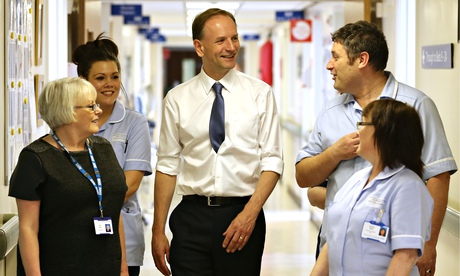
Simon Stevens’s 26-year career in healthcare has been partially defined by questions about the role of private enterprise.
The £189,900-a-year NHS England chief executive (he volunteered for a 10% pay cut this year in solidarity with wider pay restraint), took up one of the toughest jobs in public life in April after having settled with his American wife and children in Minnesota where he was president of the global health division of UnitedHealth Group, a giant US private healthcare company.
Prior to his move across the Atlantic he had been a key player in the direction of the NHS under Tony Blair’s government where, as well as advising on a huge public reinvestment programme, he championed the use of privately-run independent sector treatment centres.
Birmingham-born and comprehensive-schooled, Stevens joined the NHS as a graduate in 1988 after studying at Balliol College, Oxford. He spent his first week portering patients around the hospital in County Durham and doing paperwork in the mortuary. He described it as “invaluable experience, because it gives you a clear sense of what life’s like at the sharp end and can be quite different than how it seems in the national debates”.
He went on to become general manager for mental health services at North Tyneside and Northumberland and also group manager of Guys and St Thomas’ hospitals in London.
In 1997 he became policy adviser to Frank Dobson and then Alan Milburn, the Labour secretaries of state for health. In 2001 he rose further to become Tony Blair’s health adviser in Downing Street.
On his second day as NHS England chief executive he angered Unison, which represents 400,000 NHS workers, by praising private health firms and “the innovation value of new providers”.
But he has also stressed the NHS is at the point of “the most sustained budget crunch since the second world war” and has called on NHS managers to provide “open-minded and pragmatic” responses.
• This article was amended on 23 October 2014. An earlier version referred to Simon Stevens as “NHS chief executive”.