Itch is about a 14-year-old, Itchingham Lofte, who is living in Cornwall and who is, it’s fair to say, obsessed with science. Where did you get the inspiration for such a character?
The inspiration for Itch was a combination of my youngest son Joe, who came home from school at the age of 10 and was obsessed with science, and David Hahn. In 1991 David Hahn was nicknamed “the radioactive boy scout” in the press because he built a nuclear breeder reactor in the shed at the end of his garden. I thought, if a teenage boy can do that in real life, what could he do in a novel…
It’s a notable feature of the book that “lofteium,” the element Itch discovers, is Element 126. But what happened to Elements 118-125?
At the moment there are only 118 elements in the periodic table but new elements are being discovered. All of these new elements only exist for fractions of a second and are created in labs by scientists. However, there is a theory that revolves around the Island of Stability that indicates that some undiscovered elements may exist stably but they would be very radioactive. As an Element Hunter, discovering a new element would be the best thing you could hope for. As none of these elements are known to exist yet, I thought why not 126?
You weren’t keen on science lessons in school, so why did you have such a change of heart when writing this book?
Itch started out as a short story for my son. While I was researching David Hahn to write this story I came across the phrase “Element Hunter”. Who wouldn’t want to be an Element Hunter? I set about researching this and then ended up with a novel. I do wish I’d started taking an interest in science sooner.
Two years ago you did another interview with us here at the Children’s books site and you said that you made a point of making Itch very different from your own son. Why did this become a priority?
I don’t think it would be fair to write a book about someone in my own family. I wanted to make it clear that I wasn’t writing about Joe, although he was the original inspiration. So, in appearance and age, he and Itch weren’t similar.
You also said that the “magic in Itch is real.” How far did you go to ensure that Itch was factually correct and how well do you think you did with it?
Because science isn’t my subject I went to great lengths to find people who could help me get the facts right! Professor Andrea Sella, who works at University College London, told me about the Island of Stability and it was Professor Paddy Regan, a Nuclear Physicist who works at the University of Surrey, who told me to create Element 126 instead of using an existing element. I wanted to make sure that if the currency of the book was science then it was accurate.
You still present the Radio 2 Drivetime show, in which you also present the Radio 2 Book Club. What made you make the change from talking about books to actually writing them?
I had an idea! I didn’t grow up wanting to write but as soon as I was writing the story for my son and found out about Element Hunters I was hooked. Now that I’ve written three books I have a better idea of the process and challenges which makes for a different kind of interview on the Radio 2 Book Club.
The Itch trilogy is now finished; will there be any spin offs from the series and will you continue writing books?
I’m not sure that it is finished! I could be tempted to write another one but at the moment I am writing a brand new novel that will come out next year.
Many people have noticed the complete absence of any relationships or qualities that you’d typically find in a teen book, like excessive swearing, violence or sex. This is something that has been welcomed though. Was this just coincidence or was it intentional?
It depends on what your comparison is – I’d say the Itch series has a similar level of language and violence to the Alex Rider series. Anthony Horowitz once told me that English is such a rich language there’s usually another word you can use in place of swearing. I think a book can be scary and thrilling without bad language. So, in that sense it’s intentional. There is a lot of vomit and many broken bones in the Itch series. There’s also clearly a low-key romance going on between Itch and Lucy…
Do you think you’ll continue writing teen books or do you think you’ll write books aimed at other age groups now?
My new novel is aimed at a slightly older age group but I also have an idea for a younger series.
What tips do you have for anyone who wants to become a writer and what advice do you have for anyone that hates science?
The conventional wisdom is good – read as much as you can! But not only stuff you know you’ll like. And write every day if you can – even if it’s just a paragraph.
If you hate science then you don’t have to do it after you finish school! I find it a fascinating and extraordinary subject but I only discovered this in my 40s. The Itch books aren’t science books – you don’t have to like science to enjoy them.
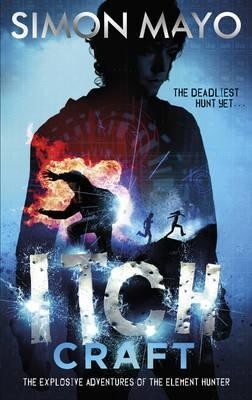
Itchcraft by Simon Mayo is published tomorrow. Simon will be attending the Edinburgh Science Festival on Saturday 18 April.