The canopy that was never cut
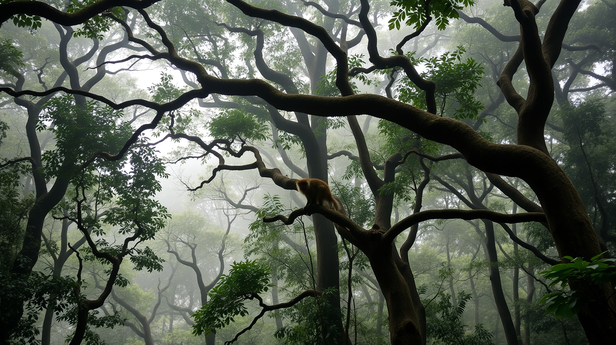
Most of India's forests have been cleared at least once, for timber, agriculture, or infrastructure, and then allowed to regrow. Silent Valley was not. The Kunthipuzha river valley in the Nilgiri hills of Kerala contains one of the last remaining stretches of primary tropical rainforest on the Indian subcontinent: forest that has stood continuously for tens of thousands of years without a single logging cycle. That continuity is the biological fact everything else here depends on. Old-growth rainforest accumulates complexity over centuries. The soil microbiome, the fungal networks connecting root systems, the layered canopy structure that creates dozens of distinct microclimates within a single hectare, none of these can be replicated by plantation forestry or even by secondary regrowth given a hundred years. Silent Valley's 237 square kilometres of core forest are what a tropical ecosystem looks like when humans have never reset it.
The lion-tailed macaque and what its presence signals
The lion-tailed macaque (Macaca silenus) is one of the world's most endangered primates, with a global wild population estimated at fewer than 4,000 individuals. Silent Valley holds one of the highest-density populations of this species anywhere. The macaque is what conservation biologists call an umbrella species: its survival requires such a large, intact, and connected forest territory that protecting it automatically protects hundreds of other species sharing the same habitat. A lion-tailed macaque cannot persist in a fragmented or secondary forest. Its presence in Silent Valley is therefore a direct biological indicator that the forest itself is functioning. The species feeds on over 50 plant species across the canopy and mid-storey, and its seed dispersal behaviour shapes the forest's own regeneration. Remove the macaque, and the plant community shifts. The animal is not merely a resident; it is part of the forest's operating system.
Endemic species: what lives here and nowhere else
Silent Valley has been surveyed to contain over 1,000 species of flowering plants, 400 species of moths and butterflies, 34 species of mammals, 200 species of birds, and 13 species of amphibians. Of these, a significant number are endemic, found only in the Western Ghats, and in several cases only within Silent Valley itself or its immediate buffer zone. Among the more precisely documented endemics:
- The Malabar giant squirrel (Ratufa indica), which requires continuous high canopy to move between feeding trees and will not cross open ground, making intact forest non-negotiable for its survival.
- Nasikabatrachus sahyadrensis, the purple frog, a species so evolutionarily ancient that it belongs to a family, Nasikabatrachidae, with no other living members. It spends most of its life underground, surfacing for only two weeks a year to breed in fast-moving streams. Its evolutionary lineage separated from its closest relatives when India was still a separate landmass drifting toward Asia.
- The Nilgiri laughingthrush (Trochalopteron cachinnans), a bird restricted to the shola-grassland mosaic of the upper Nilgiris, with Silent Valley's buffer zones forming part of its core range.
The Western Ghats as a whole is one of eight hotspots of biological diversity identified globally by Conservation International. Silent Valley sits at the wettest and most ecologically intact section of that hotspot.
The dam that was not built
Silent Valley almost ceased to exist as a forest. In the 1970s, the Kerala State Electricity Board proposed a hydroelectric dam across the Kunthipuzha river that would have submerged the valley floor, precisely the riparian forest that anchors the highest species density. The project had government clearance. What stopped it was one of India's first major environmental campaigns, led by the Kerala Sastra Sahitya Parishad and supported by naturalists including M. Krishnan and Salim Ali. The campaign ran through the late 1970s and early 1980s, eventually reaching Prime Minister Indira Gandhi, who ordered the project shelved in 1983. Silent Valley was declared a national park in 1984. The scientific argument that won the debate was specific: the valley's unbroken forest was irreplaceable, and no benefit from the dam's power generation could be calculated against the permanent loss of a primary ecosystem. That argument has since been vindicated by every biodiversity survey conducted in the park. The species lists grow longer with each systematic study, not shorter.
What the forest floor holds
The amphibian diversity of Silent Valley is a particular measure of the forest's health. Amphibians are among the most sensitive biological indicators available: they require clean water, stable humidity, and intact leaf litter for breeding, and they absorb environmental contaminants directly through their skin. A forest with high amphibian diversity and density is a forest where the water system, the soil, and the microclimate are all functioning within tight tolerances. Silent Valley's stream systems have been found to support species that disappear within one or two kilometres of any agricultural boundary. The purple frog's breeding streams require water chemistry so specific that even minor upstream land-use change eliminates the species from a site entirely. The fact that these animals persist here in documented numbers is not a conservation achievement in the conventional sense. It is the consequence of the forest never having been damaged in the first place. Silent Valley does not need restoration. That distinction is rarer in India than any individual species it contains. The canopy age, the macaque density, the purple frog in its stream, and the dam that was never built are not separate facts about the same place. They are the same fact, stated four different ways: that a primary forest, once lost, cannot be recovered on any human timescale, and that Silent Valley is one of the last places in India where that loss has not yet been measured.