
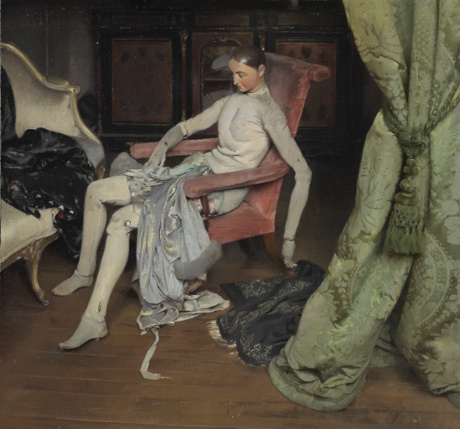
Walter Sickert saw the strange half-life of mannequins straight away. In need of a model who would not wilt, or fidget, or turn up late, he ordered one of these lay figures instead. When the wooden man arrived, its moving limbs were so realistic, its fingers so articulate, its careworn face so expressive, it seemed more like a person than an object – and not so much inanimate as temporarily asleep. Sickert immediately cast the figure as Lazarus returning from death.
George, as it was known, is currently lying in state in Silent Partners, a riveting and highly original show devoted to the use (and abuse) of mannequins in art. To walk among these extraordinary effigies, and very often the actual paintings in which they appear, is not just to learn how certain pictures were made – huge battle scenes, say, or elaborate flights of airborne fantasy – but to understand something more about the painters and even to see their work in a new light.
Michelangelo used mannequins, so did Leonardo. Poussin shifted wax figures about inside a box to try out a composition. But who knew that Cézanne sometimes used pillowy dummies instead of Madame Cézanne, or that Courbet – out there in the field, famously dedicated to realism – worked with wooden maquettes?
Some of Gainsborough’s doll-like subjects turn out to be doll-like precisely because their bodies were based on stiff toys. One looks anew at Mr and Mrs Andrews, so smugly posed before their country estate, with the realisation that the sitters didn’t remain for a moment longer than it took to paint their faces in the studio (or perhaps Gainsborough had no time for their company).
Secrets emerge from behind the scenes. The pre-Raphaelites, so faithful to replicating nature in every dimple and dewdrop, hired cloth mannequins from the art supplier Charles Roberson. Ford Madox Brown couldn’t manage real bodies; Millais resorted to dummies when models wouldn’t keep still. They both used the same effigy – one of the most sinister exhibits in this show.
Child 98 is a small dark figure with what looks like a Klansman’s hood for a head (Philip Guston irresistibly comes to mind) that stood in for many a Victorian waif. Unlike George, who shows signs of life, it is a hauntingly funereal ghost.
What life do they have, or express, these curious surrogates – somewhere between sculpture and mechanism, portrait and doll? Some of these mannequins are almost abstract in their reduced form, but others have real force of personality. A star turn is Il Mannequino, an elegant renaissance youth from Italy whose very toes can be posed to suggest gaiety. His face is pure classical beauty, and painted too, so that one may imagine how the ancient Romans might have looked.
The show, superbly curated by Jane Munro, does not stint on the queer allure of mannequins. Some of the wooden figures here are so shapely you simply want to draw them; but others have a more pressurising presence, especially the so-called Perfected Mannequin from 19th-century Paris, with her plump padding, pretty plaster face and silk-stocking epidermis, a figure so paradoxically naturalistic she might as well be a living model.
In the 19th century, such mannequins become muses – Pygmalion-style – and one wonders about the private fantasies of Edward Burne-Jones, for instance, whose many versions of this legend seem to drool over the perfect, depilated mannequin; or Wilhelm Trubner whose maquette is all action compared to the real woman next to it: wooden, incomprehensible, inert.
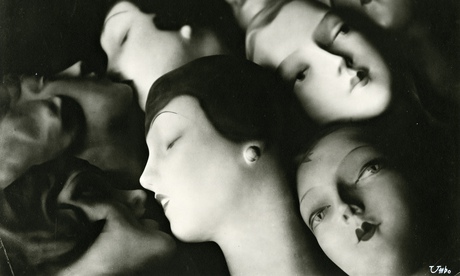
The show keeps a terrific focus while branching out in many directions: towards living dolls, and Thomas Edison’s first speaking toy, which terrified children in the 1890s; towards fashion mannequins, which leads on to surrealist photography from Dalì and Dora Maar to the ill-begotten dolls of Hans Bellmer. It even opens delightfully into comedy. Munro has found a fragment of a 1900 George Méliès film in which the pioneer film-maker plays the role of an artist whose model is so annoying he swaps her for a mannequin, with many droll consequences.
Mannequins gradually begin to appear in art as themselves, so to speak. John Ferguson Weir’s His Favourite Model says it all: the painter hand-in-hand with his comely lifesize mannequin. And in a series by the underrated painter Alan Beeton, the mannequin finally takes centre stage, striking dramatic poses, receiving her own portrait. But in the final picture, Decomposing, she appears rejected with her head in a cloth, as if the affair was all over.
For it is a fraught relationship. Contemporary artists may use mannequins to unsettle us – a couple of snout-faced Chapman Brothers’ kids are strategically positioned to give you a real fright, which is their sole purpose and definition – but far more disturbing is the way mannequins have affected their owners.
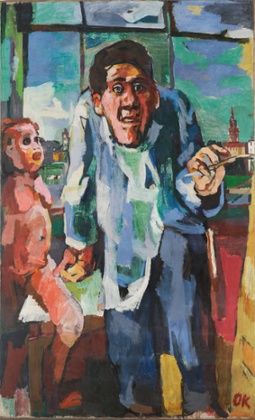
Oskar Kokoschka was so obsessed with his ex-lover Alma Mahler, he had her ghoulishly recreated as a mannequin (Munro has discovered an old photograph of the figure creepily covered in soft fur). He lived with this dead doll for years, slept with it, took it to parties, and eventually decapitated it in a drunken rage. And still Alma would not die; the real woman, or her more biddable surrogate, lives on in countless tortured paintings.
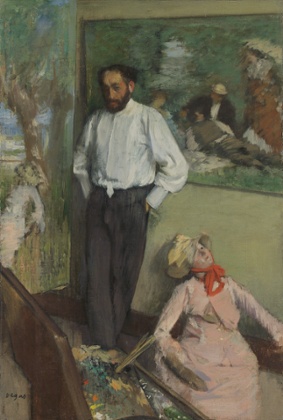
But the highpoint of the show is Degas’s portrait of the artist Henri Michel-Levy walled up in his studio with a lifesize mannequin in bonnet and gown abjectly slumped on the floor. Michel-Levy has a defensive, wary, even defiant look in his narrowed eyes, as if he may have abused her, as if he cannot handle real women. Degas does not determine the relationship between the two figures, living and unliving, but he plants the seeds of doubt.
Tracey Emin – RA, CBE, professor of drawing at the Royal Academy – has been back to life-drawing classes herself, and the sequence of blue gouache nudes in her White Cube show seem all the better for it. Still, they have the tremulousness of her scratchy and rachitic monoprints, but the paint gives them a more suave and lissome register.
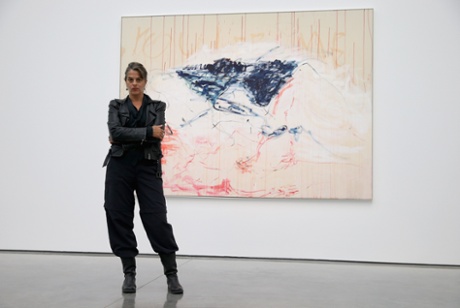
They are all self-portraits, of course – not that you can tell from the faces; Emin does not rise to actual faces. The expressiveness of her art is anatomical: knees spread, legs hunched, bum in the air, tossing and turning, almost always in recline. Her bodies are awry, though not always on purpose. That is evident from the huge embroideries derived from the gouaches, exposing their shortcomings and reducing their awkwardness to a mannerism.
Emin remains nakedly sentimental – “Your absence only makes me love you more” in baby-blue neon – and overtly twee, casting little birds and lambs in white metal. Her new bronze sculptures are a cumbersome hybrid of Rodin, Matisse and Rebecca Warren, managing to be both ungainly and wan. Her paintings of sex are timid and chaotic.
But the self-portraits have captions – “Alone Is Alright”, “Rough Me”, “I Think of You Too Much” – which gather into a potent narrative. Emin’s strongest form of expression has so often been her own voice. Without her words, the work is often flimsy, weak and haphazard. That’s its style, of course – open vulnerability – but it has very often been at odds with her strident public address. Here the two seem better matched: firmer images, subtler words.













.jpg%3Bhttp%253A%252F%252Fen.wikipedia.org%252Fwiki%252FPygmalion_and_the_Image_series%3B532%3B705)