Between reading the Shusaku Endo novel "Silence" in 1989, and completing his own "Silence" in 2016, Martin Scorsese made some other movies _ among them "Goodfellas," "The Age of Innocence," "Casino," "Gangs of New York," "The Departed" and "The Wolf of Wall Street." But the Endo book always stayed with him. He just needed to find a way into it.
"The Roman Catholic/Christian iconography sort of came out of my system in a way in 'Last Temptation of Christ,'" Scorsese said in Manhattan recently, referring to his controversial 1988 Jesus drama. "When the film was finished, Archbishop Paul Moore, of the Episcopal Church in New York, gave me this book and said, 'Take a look at this one' because he liked 'Last Temptation of Christ.' I found it went deeper, and that's where I wanted to go. But I didn't know how to go there."
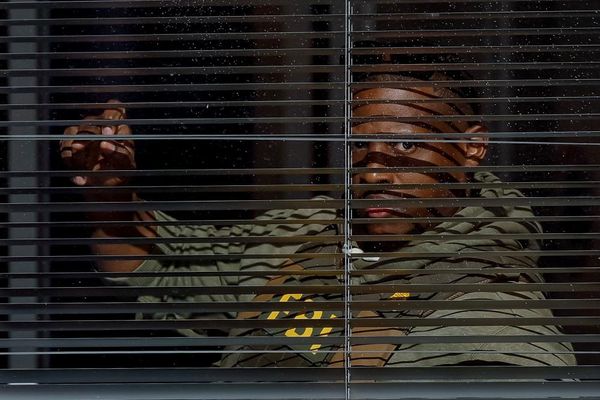
He figured it out, of course _ structurally, visually, spiritually. And he took several people with him on what was always going to be a journey of the soul _ including his two young stars, Andrew Garfield and Adam Driver, who play Jesuits trying to spread the Gospel in a country _ 17th century Japan _ whose authorities are actively persecuting Christians.
The devoted Portuguese priests, Rodrigues (Garfield) and Garrpe (Driver), are in search of the mysterious apostate the Rev. Ferreira (Liam Neeson), who is said to have renounced his faith under torture. Rodrigues and Garrpe can't believe it. But what they learn in Japan will be enlightening. And agonizing, in every way.
In preparation for the role, Driver _ best known, perhaps for his recurring part on "Girls" _ said he delved into the contemporaneous Japanese history as well as the history of the Jesuits. He also spent time with Garfield at a retreat house in Wales called St. Bueno's, with a group of actual Jesuits.
"It was glaringly obvious who the two actors were," Driver joked.
For Garfield _ whose character is really the center of the "Silence" story _ the Jesuitical training was more extensive.
"I led Andrew through the entire Spiritual Exercises over the course of several months," said James Martin, S.J., author ("Jesus: A Pilgrimage"), editor-at-large of America magazine and a consultant on the Scorsese movie. "We met in my office here at America House, unless one of us was traveling, and we met over Skype. We met every week _ religiously, you might say."
Garfield was in the third stage of the Exercises _ developed by St. Ignatius of Loyola in the early 16th century _ when he and Driver had to leave to do research in Portugal. "Both Andrew and I were loath to break off for any length of time," said Martin. "So I arranged for him to be at St. Bueno's, so that we could Skype every night. That way we could continue while he was in Europe, and he'd also get an experience of praying in a retreat house. Adam also was interested in doing a retreat, so we arranged for him to be at St. Bueno's as well."
"He took us so far," Driver said of Martin, "and then we had to personalize it for ourselves."
For Neeson, who grew up Catholic in Northern Ireland, the experience of "Silence" _ which opens wide Jan. 13 _ drove him in various directions, from the atheistic writings of Richard Dawkins to a sense of awe regarding the faith of the persecuted Japanese _ some of whom, as the film shows, would be crucified at the edge of the sea, beaten by the waves while slowly suffocating. Or hung upside down over pits of excrement, their heads blocked from the light by wooden boards, with a cut in their neck so they would slowly bleed.
"Ferreira was quite a famous Jesuit," Neeson said, "and he was a huge embarrassment to the church when the news filtered back. Ferreira apparently withstood the torture for five hours, but some of these extraordinary Japanese Christians lasted for days. Days. I guess there was a side of Ferreira that just couldn't handle this horrible torture. I did it for two, three minutes and it does things to your brain. Five hours? 30 days?"
Violence is hardly unknown in the films of Martin Scorsese, but neither, he said, are the kinds of spiritual directives one finds in "Silence."
What happens to his two priests, the director said, show _ "possibly" _ a road into what "true faith and true Christianity is, which has always been foremost in my mind no matter what I've done."
"Even going back to 'Mean Streets,'" he said of his breakout 1973 drama, "the opening line is, 'You don't make up for your sins in the church. You do in the streets, you do it at home,'" meaning that you don't keep religion in a building and go outside and act differently.
"The struggle," he said, "is outside."