The helper's high is not a metaphor
In 1988, sociologist Allan Luks surveyed over 3,000 volunteers across the United States and found that more than 90 percent reported a distinct physical sensation after helping others, warmth, energy, and a calm that lasted hours. He called it the "helper's high." Neuroscientists later traced it to a spike in dopamine and endorphins, the same neurochemical cocktail released during exercise. Jorge Moll's 2006 research at the National Institutes of Health used fMRI scans to show that charitable giving activates the brain's mesolimbic reward pathway, the same circuit that lights up for food, sex, and social bonding. Giving, in other words, is biologically rewarding. The Sikh tradition did not need the fMRI. The Guru Granth Sahib states plainly: "Vich duniya sev kamaiai, taa dargah baisan paiai", serve within the world, and you will find your place in the court of the Divine. The theology and the neuroscience are describing the same loop from opposite ends.
What Langar actually does to the person serving it
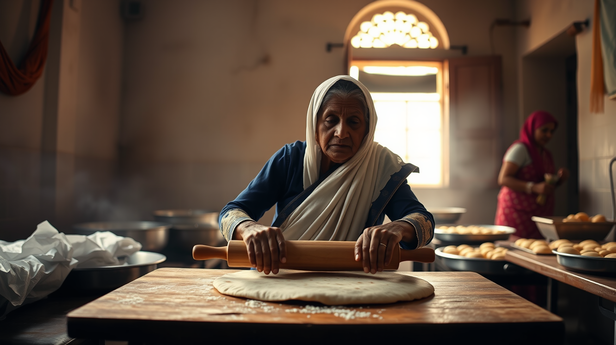
Every Gurdwara runs a Langar, a free community kitchen open to anyone regardless of caste, religion, or income. Millions of volunteers across India, from Amritsar's Harmandir Sahib to the Gurdwaras of Delhi's Tilak Nagar, chop vegetables, roll rotis, and wash dishes without pay and without credit. Psychologists at the University of British Columbia found in a 2012 study published in the journal Health Psychology that people who spent money on others showed measurably lower blood pressure than those who spent it on themselves, and the effect held even when the amounts were small. The mechanism is not generosity as self-sacrifice. The mechanism is that other-focused action interrupts the rumination loop. When you are rolling a roti for a stranger at 5 a.m. in a Gurdwara kitchen, you are not running your anxiety about your EMI, your promotion, or your mother-in-law. Seva structurally removes the conditions that produce stress. Chanakya wrote in the Arthashastra that a ruler who acts for the welfare of his subjects secures his own welfare in the process, the logic of interdependence over isolation. Seva operationalises exactly this: your wellbeing is downstream of others'.
The identity shift that service produces
Shawn Achor, whose research at Harvard popularised the term "happiness advantage," found that people who performed one conscious act of giving per day for 21 days showed sustained increases in optimism and social connection, not just in the moment of giving, but as a baseline shift in how they experienced ordinary days. This is not the same as occasional charity. It is the difference between a one-time donation and a practice. Sikhi has always insisted on the practice. Seva is not a weekend activity. It is one of the three pillars of Sikh life alongside Nam (meditation on the divine name) and Dasvandh (tithing one tenth of earnings). The repetition matters because identity is built by repeated action. When you serve regularly, you stop being someone who occasionally helps and start being someone for whom helping is a natural expression of who you are. Psychologists call this a "helper identity." The Sikh tradition calls it becoming Gurmukh, one who is oriented toward the Guru's teaching rather than toward the self.
Why anonymous service works better than recognised giving
Sonja Lyubomirsky at UC Riverside has studied the conditions under which giving produces lasting wellbeing versus a short spike that fades. Her findings: variety matters more than volume, and anonymity preserves the effect longer than public recognition. When giving becomes a performance, when it is done for social credit, for Instagram, for a certificate at the office CSR event, the brain registers it as a transaction. The reward circuit dims because the behaviour now has an external payoff, and the internal one shrinks. Sikhi anticipated this with the concept of Nishkam Seva: service without desire for reward or recognition. The Gurus were specific. Seva done for status is not seva, it is ego dressed in service clothing. The neuroscience of motivation, developed largely through self-determination theory by Edward Deci and Richard Ryan at the University of Rochester, reaches the same conclusion: intrinsic motivation produces deeper and more durable satisfaction than extrinsic reward. The Punjabi grandmother doing seva at the Gurdwara langar who would be offended if you offered to pay her is not being modest. She is protecting the quality of her own experience.
The science of happiness has spent decades building instruments to measure what Sikhi encoded as practice centuries ago. What the research keeps finding is that the self is a poor object of investment, not because selflessness is virtuous, but because the architecture of the brain is wired for connection and contribution, and seva is one of the most direct ways to engage that architecture deliberately.