Hospitals beds for COVID-19 patients may end up in short supply as the daily number of newly confirmed infections with the novel coronavirus, which causes the disease, hit record highs for two days in a row on Thursday and Friday.
In addition to the highest number yet, 293 new cases on Friday, there is an increasing number of infected people for whom infection routes and other details cannot be confirmed.
Though the Tokyo metropolitan government has accelerated measures to cope with the increase, medical workers have been increasingly anxious.
Tokyo Gov. Yuriko Koike said at a regular press conference Friday that the number of newly found infections "rises exponentially," showing a steep upward curve. She expressed a strong sense of caution saying, "I really want to be cautious toward the rise of the number of people who test positive."
The rapid increase of the number of newly found infections is partly because the number of polymerase chain reaction (PCR) tests, which was about 1,000 a day in early April, has increased to surpass 4,000.
But the metropolitan government pays particular attention to the trend in the number of infected people whose infection routes are unknown.
The weekly average daily number of such infected people as of Friday was 98.1. The number was more than 30 times higher than the 2.7 as of May 23, when the increase in the number of cases had slowed down.
The number as of Friday was close to the previous record of 116.9 as of April 14, when the nation was under the government's declaration of a state of emergency.
Norio Ohmagari, director of the Disease Control and Prevention Center, which is a unit of the National Center for Global Health and Medicine, warned at a conference of the metropolitan government on Wednesday, "If this tendency continues for another four weeks, the number of infected people, whose infection routes is unknown, could alone reach about 1,200 per day."
Meanwhile, the number of patients hospitalized for COVID-19 has surpassed 800, while the number of hospital beds that the metropolitan government has secured for inpatients of the disease is 1,500.
The number of inpatients has risen four-fold compared with 204 as of June 20, when the number was its lowest since the lifting of the state of emergency on May 25.
If young patients with mild symptoms fill up the designated hospital beds, it is feared that hospitals may face difficulty in accepting patients with serious symptoms.
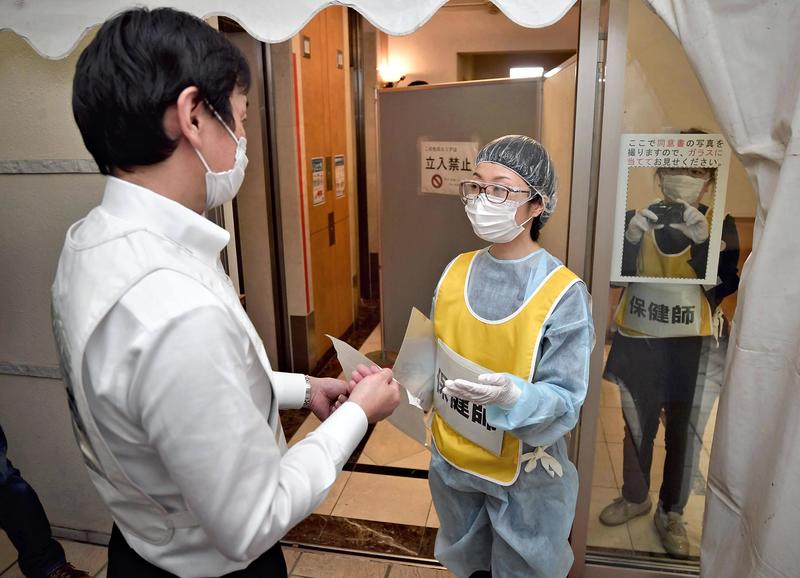
Therefore, the metropolitan government is hurriedly trying to secure hotel rooms where patients with mild symptoms can recuperate.
The metropolitan government began using a hotel for the purpose in Toshima Ward starting Thursday, and will begin to use one more hotel building on July 23.
However, because the pace of securing hotel rooms to accommodate such patients has not caught up with the increase in patient numbers, there are 240 people recuperating at home instead of in hotel rooms.
This situation presents the risk that infections among family members may occur. Many medical experts have pointed to this problem.
On July 7, the metropolitan government asked medical institutions in Tokyo to increase the total number of hospital beds for the purpose to 2,800, but it has taken long time for many of the medical institutions to make the preparations.
In its four-level assessment of the condition of the medical care supply, the Tokyo metropolitan government regards the current situation as being on the second most serious level, in which enhancing systems is necessary.
But Hiroyuki Yokota, a professor emeritus of Nippon Medical School who is an expert on emergency medicine studies, said, "If the rapid increase of infected people continues, not only hospitals but also hotels and other recovery facilities will become unable to accommodate all of them."
He added, "The metropolitan government needs to improve preparedness as soon as possible, anticipating the worst-case scenario."
Meanwhile, Yasutoshi Nishimura, minister in charge of economic revitalization, said during a videoconference with the governors of Tokyo and three neighboring prefectures on Friday evening, "We are in a phase where we need to consider measures that are one step deeper."
He indicated a plan to request consumer-facing businesses with insufficient prevention measures to voluntarily close based on Article 24 of the revised law on special measures for new types of influenza and other infectious diseases.
Read more from The Japan News at https://japannews.yomiuri.co.jp/