
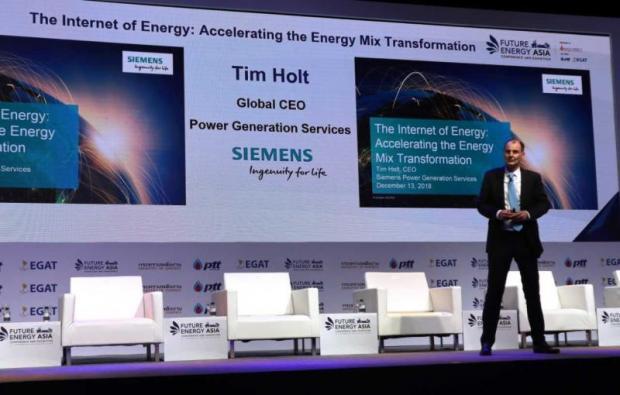
Thailand is well on its way to a sustainable and green energy future, based on a diverse mix of energy sources and lower reliance on coal, say top executives at the global energy company Siemens.
"Thailand is ahead of the region in terms of the energy mix portfolio. When it comes to clean energy, the largest fuel source is gas, as opposed to coal in other countries. When it comes to environmental impact, Thailand is already quite well-developed," said Markus Lorenzini, chief executive of Siemens Thailand.
He said Thailand is "under the process" of adopting smart grid technology, which will make energy usage more efficient in major cities.
"With renewable options like solar rooftops, smart grids are more important to stabilise grids and have a reliable power supply," said Mr Lorenzini.
Solar rooftops is a growing trend in Thailand, with many who can afford it opting to generate their own energy. This can create complications for the power grid as some homes won't generate enough energy on a cloudy day and have to use external power sources, while others may generate too much power, and wish to share some of the excess with their neighbours. A digitised smart grid is better equipped to deal with the more complicated grids of the future.
"This kind of smart grid is necessary for the implementation of solar rooftops," Mr Lorenzini said. "The question is who has to make this investment, and we still need to find out if in Thailand it is the producers themselves, as well as who will regulate it and who will supply all the technical components to make the grid reliable."
Tim Holt, global chief executive of Siemens's power generation services division, pointed to a Siemens project in Brooklyn in the US, where a small neighbourhood implemented a "microgrid" from which residents were able to buy and sell rooftop solar energy from their neighbours through blockchain technology.
"The application is quite interesting, but right now it's still in early phases and we have to figure out how to implement it in larger communities," Mr Holt said.
Siemens is involved in the government's Eastern Economic Corridor (EEC) scheme, where it has designed the area's smart grids, as well as installed gas turbines, increased connectivity between Bangkok and the EEC, and promoting automation and digital features in factories.
Siemens is working with government regulators and bidding on projects to bring smart grid technology to Bangkok.
The company also developed the largest onshore wind turbine farm in Southeast Asia, a 260-megawatt plant in Nakhon Ratchasima province.
The Germany-based company has operated in Thailand for over 100 years and employs about 1,400 people in the country.
"Our focus is to support the development of Thailand and the people, whether it's the private side, the government side or power generation, transmission and distribution or upgrading the manufacturing base from labour-intensive to automated," Mr Lorenzini said.













