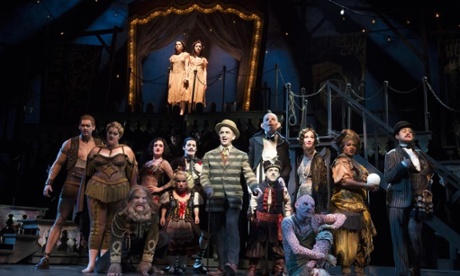
Daisy and Violet Hilton, twin girls conjoined at the pelvis, were born in 1908 in the English town of Brighton. A century or so later, they’ve been reborn on Broadway.
Side Show, a musical by the composer Henry Krieger and the book writer and lyricist Bill Russell, loosely based on the lives of the Hilton sisters, debuted on Broadway in October 1997 and closed not long after. Though the show had its devotees, problems of tone and story and what at least one critic described as the “ick factor” (read: twincest) meant that it never caught on with audiences generally.
But Bill Condon, the director of movie musicals like Chicago and Dreamgirls, which featured songs by Krieger, expressed an interest in reviving it. With Krieger and Russell, he has scrapped a fair number of the songs and requisitioned new ones. He has also altered the book, bringing the show more specifically in line with the biographical facts of the Hiltons’ lives, and gave the actresses Erin Davie and Emily Padgett a shot at repeating the star-making turns that won Alice Ripley and Emily Skinner an unprecedented joint-Tony nomination.
As before, the show opens with Daisy and Violet on display in a seamy carnival (the song is Come Look at the Freaks). Unlike the original production, the actors playing the attractions now sport extraordinary masks and special effects makeup (by X-Men and Star Wars special effects artists Dave and Lou Elsey). The arrival of would-be vaudeville impresario Terry (Ryan Silverman) and his pal Buddy (Matthew Hydzik) occasions a lengthy flashback, in which Harry Houdini needlessly appears. There’s a new emphasis on the trial in which the twins sued for their emancipation from a cruel and unscrupulous guardian (Robert Joy, seedier than a gardening catalogue), aided by their loyal protector Jake (the oddly unexpressive David St Louis). There are a couple of new vaudeville numbers too.
But some of the problems that plagued the original production still remain. Despite the additions and subtractions, the story arc is oddly misshapen. It takes a long time for little to happen. And the thematic emphasis is still murky. Is this a love story? A self-love story? A standard biography? An allegory of freedom?
If the book is more serviceable than it is distinguished, Krieger’s songs, while not especially innovative or distinct, make you feel as though you’ve always known them. The lyrics can be a bit pro forma and sometimes worse than that, like the soaring ballad Who Will Love Me as I Am?, which somehow packs poignant force even as the twins compare themselves to a fish, a zoo animal and a teary clown.
If songs like that work, a lot of the credit goes to Davie and Padgett, accomplished singers and actors both, Davie particularly. And yet the play still hasn’t managed to provide full characterisations for either woman. Though they sing, in unison, “We’re nothing alike,” the script only distinguishes them by a few oppositions: Daisy is bold and outgoing, Violet introverted and circumspect. If they interest us, it’s less because these are full, rich roles than that they offer an opportunity to watch two fine actresses sing and dance and emote while joined quite literally at the hip.
“We’re freaks,” says Daisy, sadly, in an early scene. As much as the show gestures toward humanising them, it doesn’t entirely disagree.