Side hustling is more than a way to supplement your income. It lets you express your individuality and independence. Even people with dream jobs are looking for fulfillment outside the eight-hour workday. Luckily, technology and the post-industrial economy have blurred the line between work and leisure, allowing us to pursue other passions with more flexibility.
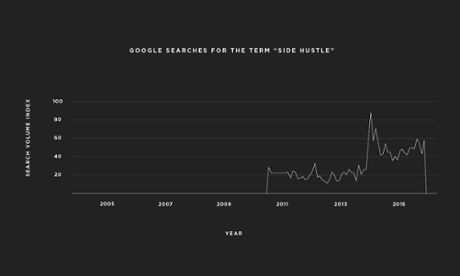
After the financial crisis of 2007-2008, side hustling started to become more common. According to Google trends, there was a significant rise in searches for the term “side hustle” in 2009.
With necessity being the mother of invention, it seems that after the financial crisis, those who lost jobs needed to create their own – and those who still had employment needed a better sense of security. People began to take ownership of their hobbies and ideas, turning them into side gigs.
Whether your side project is spurred by financial necessity or a passion, there’s great value in pursuing a creative venture for yourself. In fact, many top creative professionals got to where they are because of their side gigs.
When designer and side hustle guru Tina Roth Eisenberg asked Ji Lee, creative director at Facebook, about the importance of passion projects, he told her: “I work on personal projects because they’re fun, they give me a deeper purpose in my life beyond money and career, and they give me confidence I can make any idea happen. I also realized they lead me to my dream jobs.”
Adopted by millennials and baby boomers alike, the side hustle is part economic progression, part cultural phenomenon. It’s enabled by what technology forecaster Paul Saffo calls the “creator economy”, defined as “an age in which the central economic actor is someone who both produces and consumes in the same act”.
Saffo told McKinsey Digital that he “[likes] the term ‘creator’, as this new kind of actor is doing something more fundamental than the mere sum of their simultaneous production and consumption. Creators are ordinary people whose everyday actions create value”.
Technology continually offers ways to start side hustles – for example, the vintage retail company Painted Fox Treasures started as a Facebook page – and those passion projects’ values run deeper than money. As Ji Lee exemplifies, we can use a side hustle to extend our identities beyond our day jobs. We can take ownership of something and ultimately find fulfillment on our own terms.
Content on this page is brought to you by Squarespace. Receive 10% off your new Squarespace signup with offer code SIDEHUSTLE.