The longest human connection that most of us will experience won’t be with a spouse or a childhood pal – it will be the one we share with our siblings. With any luck, we will know our brothers and sisters for almost an entire lifetime; for the most part, we meet them before we make friends outside the family, and usually long before we choose a romantic partner.
In the UK, approximately 80 per cent of us have siblings, and if you are lucky, this bond can be one of life’s greatest joys. I love that I share an almost-identical library of memories with my two younger sisters – and that they can probably recall every single fashion mistake I made between the years 2005 and 2012. And I love that, although we have very different temperaments, sometimes one of them will say exactly what I’m thinking.
There’s research to back up that nebulous feeling of being on the same “wavelength” – in 2024, a Finnish neural imaging study found that sisters showed more similar brain activity than friends or acquaintances while watching a film. It’s just one of a handful of fascinating pieces of research that explore the impact of this relationship. In 2024, one analysis published in the Journal of Family Psychology found that a warm bond with a sibling in early adulthood can mean lower levels of anxiety and depression in midlife, and vice versa. Another study, published earlier this year, found that a child’s sense of wellbeing and security might be rooted not only in their attachment to their parents, but in their connection to their siblings.
What is clear is that siblinghood shapes our lives significantly – for better or worse. It is not always simple, and can be fraught with jealousy and resentment. Old slights and open wounds can take you back to childhood in an instant; stories of long-standing sibling rivalries go all the way back to the Bible, and have been crafted into the stuff of compelling drama in shows such as Succession.
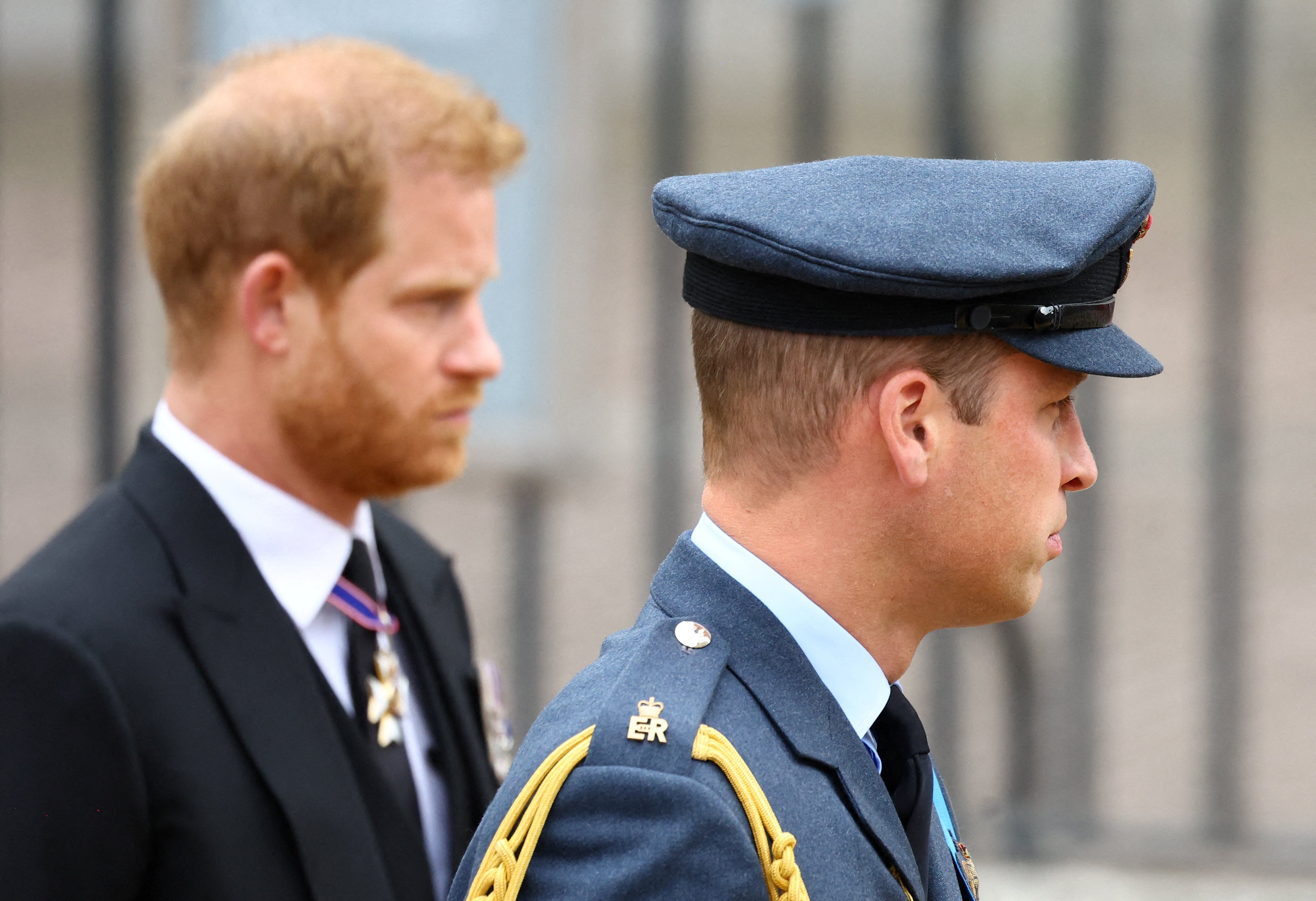
One study estimates that around one in four are estranged from their brother or sister; you only have to glance at headlines about intra-family rifts between the Beckham brood or the animosity between Princes William and Harry to see just how painful navigating this dynamic can be.
Perhaps you’re somewhere in between the two extremes, meeting up at annual get-togethers, but nothing much beyond that. There is no one way to be a sibling, and that’s what makes it such a fascinating relationship. Yet we often entirely overlook this unique connection, prioritising friendships or romantic love instead.
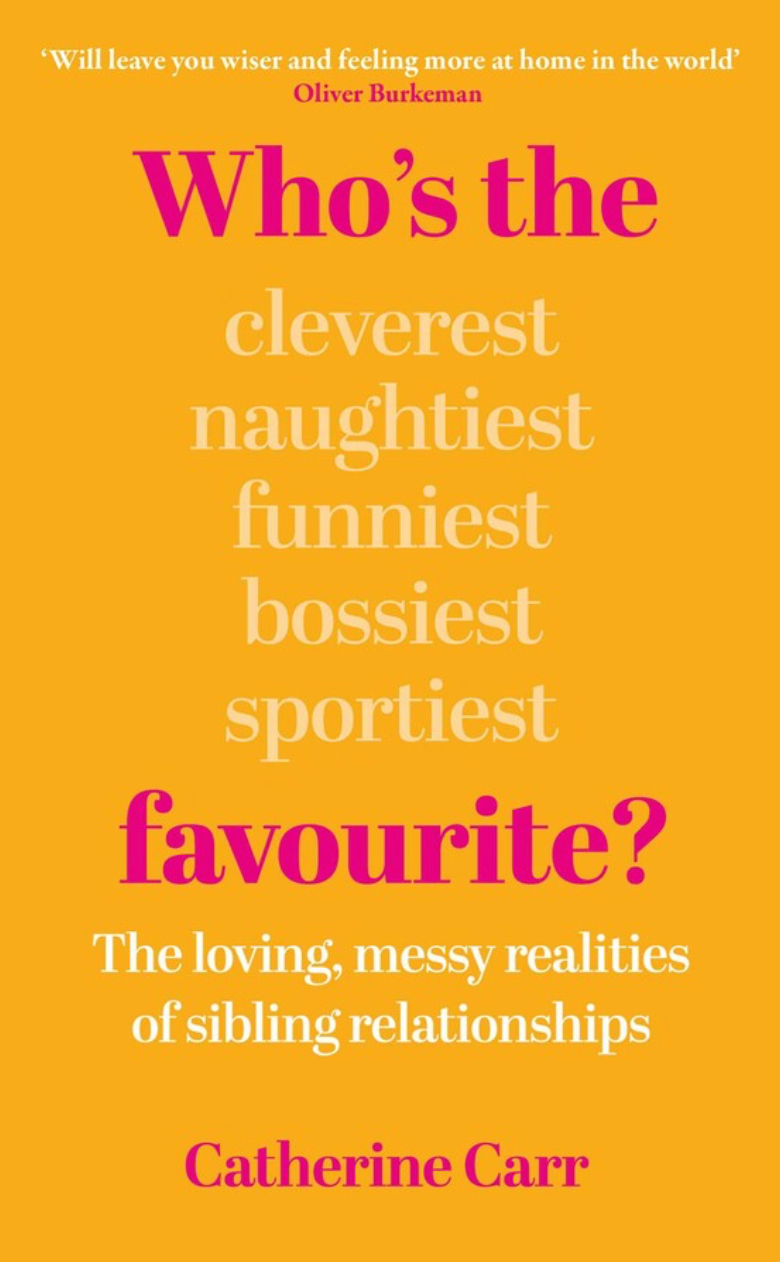
That, however, has never been the case for the broadcaster and writer Catherine Carr, the host of the podcast Relatively. Her new book, Who's the Favourite?: The Loving, Messy Realities of Sibling Relationships, seeks to examine this particular form of kinship with the depth and nuance that it deserves. Carr is one of three sisters, but her family circumstances have had a unique impact.
She spent her early childhood in the Netherlands, then, when she was 11, her parents split up. Carr’s mother moved to a nearby town with her new partner. Carr’s youngest sister went with her mum; Carr and her older sister returned to the UK with their father.
Their “unit of three”, she writes in the book, “was forever changed”, the “hierarchies realigned”. The older girls became a twosome, while the baby of the family became “a de facto only child”. When both parents remarried, two sets of step-siblings entered the equation, too.
Her experience means that she has had to think “more intentionally” about building the sibling bond than people who grew up in the same house, who – not in a way that I would feel judgemental about – might take their sibling relationships for granted. I couldn’t take mine for granted. And so I’ve always been intentionally working to be close to my sisters, together as a three”.
The connection between brothers and sisters, Carr says, can be difficult to navigate partly because “you don’t choose them” and partly because our position in relation to them will shift over time. “They don’t start out in life as your peers,” she notes. “You start out hierarchical: someone’s above you, someone’s below you, you’re somewhere in the middle. And then, over time, you become horizontal peers.”
The authors of the Journal of Family Psychology study mentioned earlier pinpointed the age of 23 as a real turning point when these relationships became more emotionally stable. Essentially, once you grow up, you start to settle into parallel life trajectories; an age gap of a few years doesn’t make much of a difference. “That doesn’t really happen with other relationships,” Carr adds.
How we consider our sibling relationships are often rooted in rudimentary assumptions about birth order, and how this might shape our personality from infancy to adulthood. These stereotypes are practically “sibling 101”, as Carr puts it.
Eldest siblings are painted as responsible high-achievers. There’s even an entire genre of social media psychology dedicated to unpacking the “eldest daughter” disposition (I can’t help but nod along in recognition – although confirmation bias does tend to play a part in the way we identify with these labels, Carr notes in her book).
Meanwhile, middle kids are supposedly blighted by “middle child syndrome”, overshadowed by the brothers and sisters they are sandwiched in between. And the youngest ones? They’re the pampered princes and princesses of each family, of course.
Many of these cultural ideas stem from the work of Alfred Adler, a psychologist who was a contemporary of Freud in early 20th-century Austria. Perhaps the question of birth order played on his mind so heavily because he was one of seven siblings. Whatever the reason for his fascination, he considered firstborns to be “privileged, but also burdened by feelings of excessive responsibility” and “prone to score high on neuroticism” – the neuroses, he reckoned, were the result of having the parents’ full attention for a time, only for it to be snatched away when a new baby comes along.
Middle kids, he reckoned, were “jealous, insecure, outgoing and adaptable”, kickstarting generations of negative stereotyping, while the youngest ones were more likely to be “charming, outgoing, free spirited, manipulative, immature and open to taking risks”.
Then, in the Nineties, the US psychologist Frank J Sulloway put forward the idea of “niche theory”, suggesting that children take on disparate roles or traits to differentiate themselves from their siblings and maintain mum and dad’s attention. If all of them had similar personalities, or so the theory goes, then they might not be “distinctive enough to pique their parents’ interest”, as Carr puts it in her book.
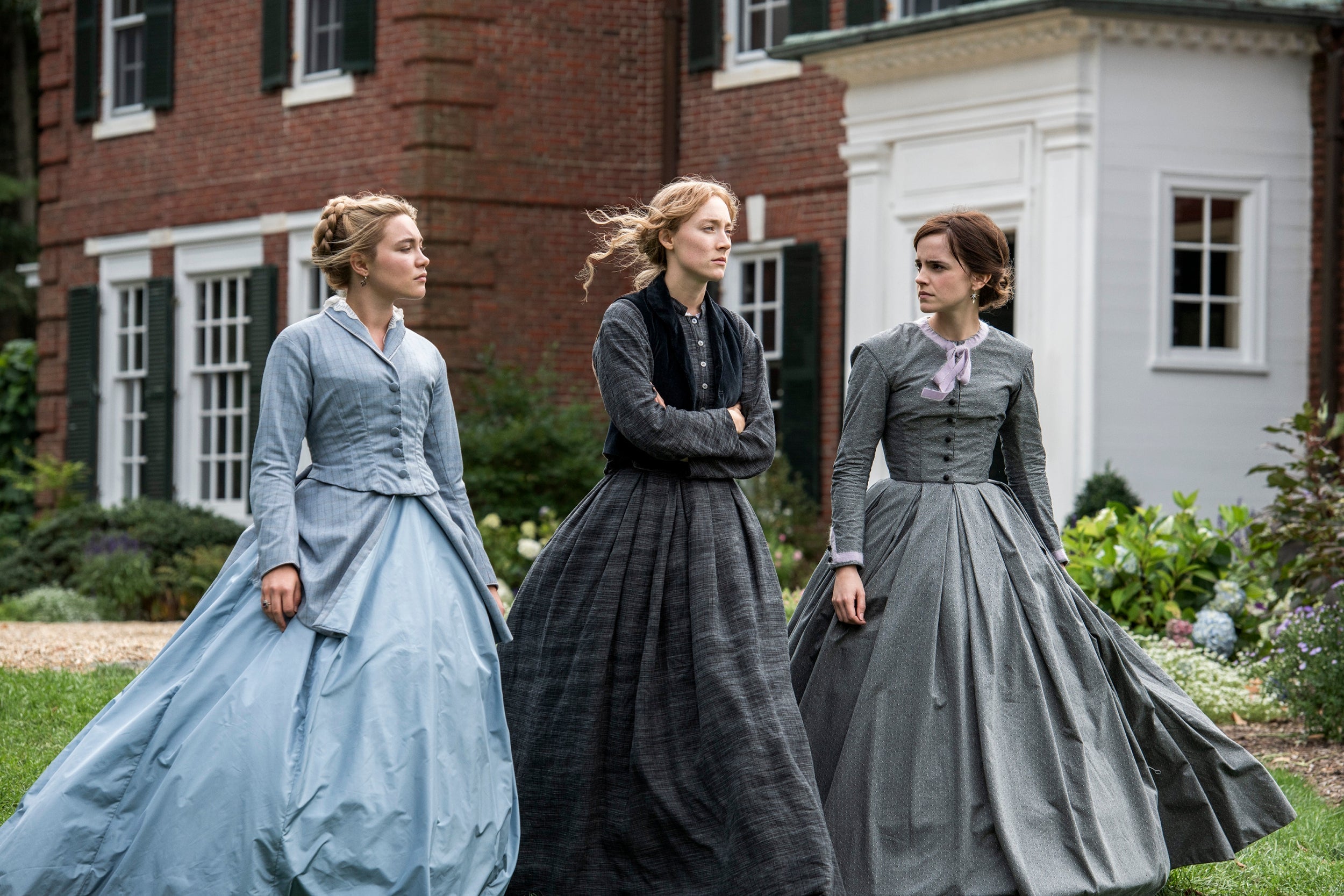
Pop culture also has a “call and response” effect, she reckons, reinforcing some of these “easy tropes” – think of the kids in The Lion, The Witch and the Wardrobe, say, or responsible Meg, firebrand Jo, meek Beth and spoiled Amy in Little Women. We absorb these ideas in childhood and cling to them for decades, “performing a role” that aligns with our idea of what it means to be a certain type of sibling.
“Some people have a very old idea about their role in the family, how [they’re] known and how [they’re] seen,” Carr says. “And they still think that’s their reputation, and they might sort of squash themselves into it or feel a little bit constrained by it,” she adds. Family dynamics are strange, she notes, in that they are one of the only set-ups where we “get our sense of self from comparing ourselves to just a handful of other people”.
These are ideas that are based on how you were when you were seven – there’s no other relationship or situation where you would be using that as a benchmark
If your sister is the “bright one”, for example, you might view yourself as less smart by default. “Why are you comparing yourself to two people and getting a sense of your identity, then walking out into the world of eight billion people and thinking, ‘I’m not as clever as Juliet!’ Well, you’re not as clever as Salman Rushdie, either. That doesn’t mean you’re not clever. It’s a very funny thing to carry that sense of relativity with you. These are ideas that are based on how you were when you were seven – there’s no other relationship or situation where you would be using that as a benchmark.”
Carr’s book isn’t intended to be a manual for dealing with siblings – she’s not trying to masquerade as a therapist. Neither is it meant to present a “sunsets and Hallmark” sentimental version of this relationship. But she does think that allowing the connection to change over time, adapting to what your siblings are like now, rather than being fixed in some antique idea from childhood, is one way that we can foster a healthier bond.
You can “start to think about changing the way that you’re seen by the family by letting them see you more as you are in the world”, she suggests. Recently, she recalls, her younger sister surprised her by upending the sibling hierarchy and taking charge, booking her into an Airbnb for a few nights, so that she could focus on an impending work deadline. “You can sometimes be taken care of [by others], you know,” her sister told her, adding: “Just consider it payback for some of the other stuff.”
‘Who’s the Favourite?’ by Catherine Carr is out now (Oneworld, £18.99)
Ciara Miller reveals ‘craziest part’ of Amanda Batula and West Wilson relationship
Sydney Sweeney and Scooter Braun appear to confirm romance with Instagram photo
Cat missing for seven years is taken 2,500 miles across US to reunite with family
You don’t need a full reset to get fitter – try these small changes instead
Vogue Williams shares heartbreak of two miscarriages as she expects fourth child