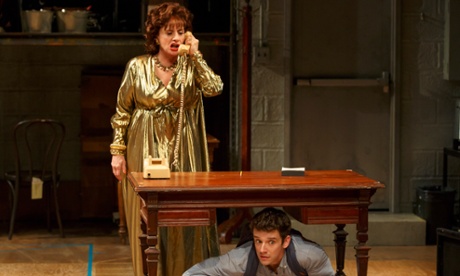
Patti LuPone is now in her mid-60s. Though she remains an indomitable force in American theatre, roles that require her to strip down to a black brassiere, stab herself with a stage knife, fake a seizure, canoodle with a teenager, contemplate her own mortality, swan about in a gold lamé gown, direct The Great God Brown and pronounce the word rumspringa with nearly erotic enjoyment just aren’t as common as once they were.
As Irene, LuPone gets to do all that and much (too much) more in director Jerry Zaks’s overstimulated debut of Douglas Carter Beane’s Shows for Days. Beane is a writer of quippy, clever, sexually frank comedies (The Little Dog Laughed, The Nance), some of which suggest an anguish just below the surface antics. Shows for Days shows how Beane learned, forcibly, to layer the lachrymose with the laughs. LuPone’s Irene, the founder of a community theater group, does the teaching. “I give you heartbreak,” she announces in the final scene.
She might. The play doesn’t.
After a brief speech framing the circumstances and setting, Shows for Days begins in 1973 when Michael Urie’s 14-year-old Car finds his way to the Prometheus theatre in Reading, Pennsylvania. Car is gay and artistically inclined, so he quickly falls under the sway of the actors and techies, the butches and queens – joining them onstage that very first night as the butler in a Philip Barry play.
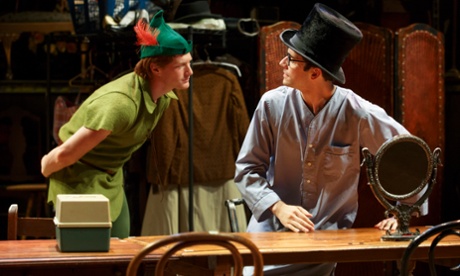
Like The Torch-Bearers or A Chorus of Disapproval, Shows for Days is both a love letter to and a satire of amateur dramatics. The set is the typical rehearsal room mess of props and spike tape and costumes all jumbled together, but the characters treat it like a pilgrimage site. Nearly everyone involved with Prometheus works a nine-to-five, but they think of themselves as artists first, and dress and swagger and swoon to prove it. Most of these characters are stereotypes (or, as Car eventually admits, “composites”). Though there are fine actors inhabiting them, Zaks’s amped-up style overwhelms much in the way of nuance or personality.
The result is strangely insular and ultimately inconsequential – a story about community theater that doesn’t create a sense of community. There are plenty of theatre in-jokes and some decent one-liners, but Beane never strikes a plausible balance between experiencing these events as a teenager and commenting on them as an adult. It’s ultimately too arch to feel emotionally real.
Urie has sixth-level black belt in charm and while LuPone does not, she’s never less than watchable. But Zaks urges the actors to overplay nearly every moment so that the struggles of the characters matter less and less as the play progresses. In a curtain speech, Irene exhorts her actors: “Open strong, close solid and they’ll forgive you for everything in between! Sell it!”
The tepid applause at a recent preview suggests that not everyone is buying.