More retailers are establishing showrooms that allow customers to try on clothes or glasses and then easily purchase them afterwards via smartphone app. The trend taps into the deep-rooted desire of consumers to physically handle a product before buying it -- a demand that online shops by themselves cannot meet.
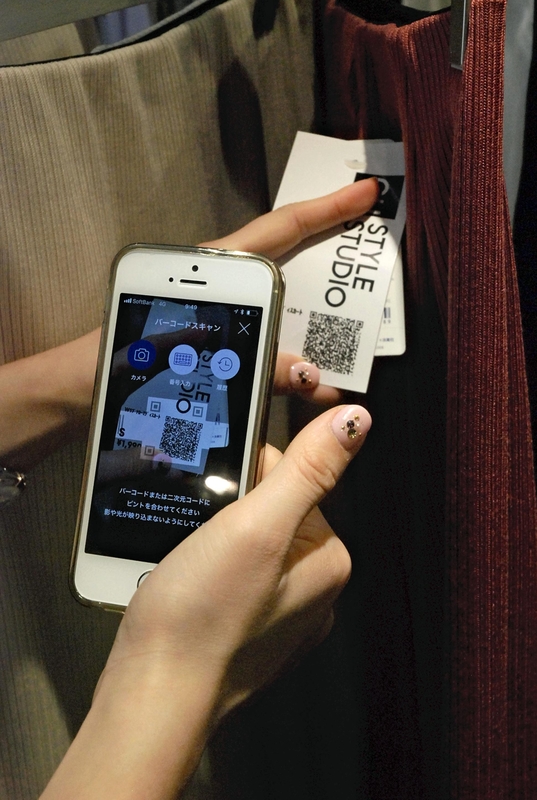
Casual wear retailer G.U. Co. opened a showroom called GU Style Studio in Shibuya Ward, Tokyo, in November last year. The shop only stocks clothes for trying on. After sampling different clothes, customers use the company's official smartphone app to scan the QR code printed on the tag of a product they may want to buy. Items purchased through the app are then delivered directly to the customer.
A customer can make a purchase whenever they want after trying on different clothes and scanning their QR codes at a showroom. They need not spend time searching for products on the company's regular online store.
"Once a customer has seen a physical item, tried it on and found that they like the color and texture, they can purchase the product much more easily than with regular internet shopping," said Noriko Uehara, the shop's manager.
Such services have emerged to meet the needs of shoppers who are leery of purchasing clothes online because they cannot physically handle the products.
Waseda University Prof. Tomoo Noguchi, an expert in marketing theory, explains: "Online shopping has advantages over brick-and-mortar stores in some aspects, including the number of products and the fact that customers can shop at any time of day and don't have to carry products home with them. However, physical shops have an advantage in that customers can check the products in person and make purchases after talking to store clerks. At showrooms, online shopping and brick-and-mortar stores complement each other. This new retailing style has emerged in response to consumers' frustrations with internet shopping."
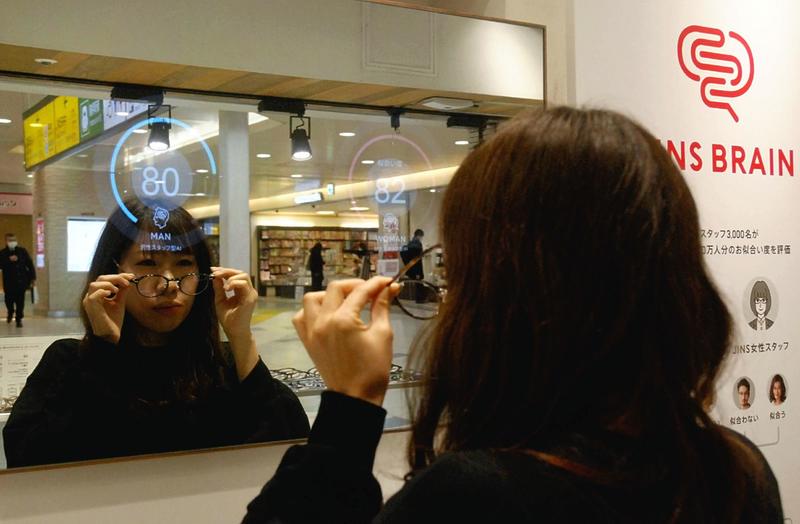
In January, Tokyo-based optician Jins Inc. opened a showroom inside Ecute Ueno at JR Ueno Station in Taito Ward, Tokyo. The shop -- Jins Brain Lab -- has some 270 pairs of glasses for customers to try on. Customers who already know their prescription can check whether frames are comfortable and look good on them before scanning the information on their favorite items using the shop's app. Purchases can then be made at any time.
The showroom also offers another service: When a customer tries on a pair of glasses in front of a mirror, artificial intelligence gives them a score of up to 100 points based on how good they look in them. Customers can also have their eyesight checked in the store.
A 42-year-old male office worker from Saitama Prefecture was enthusiastic about the service.
"It's more convenient than buying glasses at a regular store because you don't have to waste time waiting for your glasses to be ready and returning to the store," he said.
Showrooms have another advantage for retailers: They don't need to stock them with a lot of products. As a result, store clerks can spend less time taking care of inventory and more time serving customers. Showrooms also require less floor space for displaying products and can operate even in small areas.
Regular internet shopping has the advantage of allowing customers to buy the same product repeatedly without visiting a physical store, while traditional shops' strength lies in allowing customers to immediately take products home.
"I think we'll see an increase of showrooms that coexist with conventional stores," Noguchi said.
Read more from The Japan News at https://japannews.yomiuri.co.jp/