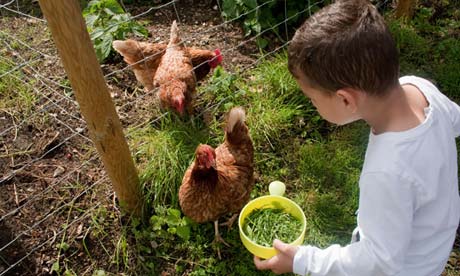
Many backyard poultry keepers supplement their chicken feed with scraps from the kitchen, particularly during the winter months. It seems sensible: it helps to keep the feed bill under control and makes excellent recycling sense. But did you know it's illegal, according to Defra rules?
The main thrust of the legislation hinges on the risk of the scraps coming into contact with unacceptable forms or levels of animal proteins within your kitchen environment (unless it's vegan kitchen, in which case it's ok). Looking carefully at the legislation, though, it is acceptable to take a lorry load of crisps and incorporate them into the diet of a flock of thousands of chickens, because the source of the crisps (which could contain low levels of animal protein, but not enough to be considered a risk) is regulated - unlike my kitchen. However, if I were to take a crisp from a packet in my kitchen and feed it to one of my chickens, that would be a breach of the legislation, because my kitchen is not regulated, so the crisp could come into contact with said animal proteins. This example throws up two key points: first, the quantifiable risk, and second, I wouldn't feed crisps to my chickens.
Risk is a calculation of probability and impact. If we take the probability of the crisps containing unacceptably high levels of animal proteins as being the same in both scenarios, then the impact is different. In one instance, a couple of chickens in a backyard flock may encounter the animal protein, whereas thousans of poultry, and potentially an entire supply chain, are exposed in the other.
The second point the scenarios illustrate may not have devastating consequences, but is equally as important. I wouldn't feed my chickens crisps. It's alarming to find out just what is deemed as acceptable food, simply because the source is considered controlled or regulated. Feeding the wrong stuff to animals in the commercial supply chain contributed significantly to the occurrence of the legislation, and granted, there are certain things from the household kitchen that should never be fed to chickens. But rather than apply a blanket ban that could never be policed and fails to have a scalable impact in its application, why not ensure that correct education is given to reduce the probability of the risk occurring?
In fact why not take it one step further and show people how to feed their poultry economically and healthily with the correct "waste" from their households, as a contribution towards improved sustainability and greener living? It has to be worth a thought.
• This post is part of a series on poultry keeping from Andy Cawthray, a self confessed chickeneer who writes for a number of magazines, provides talks & courses on keeping poultry at home and shares his experiences on his personal blog TheChickenStreet.