Bananas are the UK’s favourite fruit: we spend over £700m eating 5bn of them each year. Yet instead of making a decent living, many of the banana farmers that supply their fruit to the UK are struggling to make ends meet. In countries such as Ecuador, Colombia and the Dominican Republic, many banana farmers and workers live below the poverty line. Despite working long hours, they still don’t earn enough to cover their families’ basic needs, but they continue to work in the banana industry as there are few alternatives.
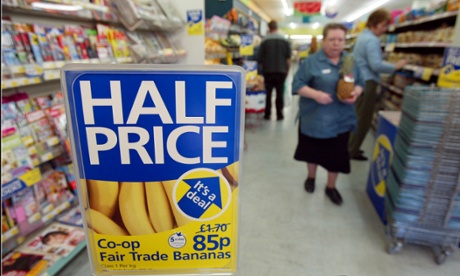
The supermarket price wars here in the UK make this situation worse. Loose bananas are one of the “essential” basics that several of the supermarkets price check and price match each week, along with items such as bread and milk. When one retailer cuts the price of any of these basics, others usually follow suit. As a result, the UK retail price of loose bananas has almost halved over the past 10 years and they now typically cost 68p per kilo, compared with £1.08 in 2002, which adjusted for inflation is equivalent to £1.40 today. Over the same time period, the cost of producing bananas has doubled. Ultimately, it is banana farmers and workers that pay the price, with many becoming trapped in an unrelenting cycle of poverty.
But retailers who source their bananas on Fairtrade terms can assure their customers that whatever price they pay at the till, the farmers and workers who grow their fruit are being protected from the impact of supermarket price wars. It means they have paid at least the Fairtrade minimum price for their bananas (or the market price, if that is higher), which aims to cover the cost of sustainable production and acts as a vital safety net when market prices fall. Producers also earn an additional Fairtrade premium - $1 (63p) per box, or $55 (£35) per tonne – which can be invested as the farmers choose, in their business or in social projects that benefit their community, such as education, housing and healthcare. Fairtrade also provides an independent assurance about working conditions and rights.
UK shoppers have been able to buy Fairtrade bananas since 2000, when they were first stocked by The Co-operative and Sainsbury’s. Initially introduced as an option alongside other bananas, both these retailers now source 100% of their bananas on Fairtrade terms, as does Waitrose. But some of the other major retailers – including Asda and Tesco, which together sell almost half of the bananas that we eat in the UK – source less than 10% of their bananas in this way.
While both retailers say that they pay fair prices to their banana farmers, there is growing evidence that UK shoppers want independent verification of such claims. A recent survey by the Department for Business, Innovation and Skills found that almost two thirds of UK shoppers don’t think it is good enough for retail companies to simply say that they are ethical, they need to prove that they are. A separate poll of 2,000 shoppers carried out by ICM found that when it comes to farmers and workers getting a fair deal, shoppers trust independent third-party certification more than retailers’ own claims, with Fairtrade being the label they trust most in this area.
It is not just shoppers that feel this way. At the other end of the supply chain, banana producers also welcome the independent assurance of fair prices, additional premiums, long-term contracts and other benefits that come from selling their produce on Fairtrade terms. TV presenter and businessman, Nick Hewer recently visited banana producers in the Windward Islands, where he saw first-hand the challenges that banana producers are facing as a result of the supermarket price wars, and the benefits they have gained from being Fairtrade certified. In the Windward Islands, it was the British government that, several decades ago, encouraged farmers to switch from growing sugar, which was in decline, to growing bananas. Yet life is tough for many of these farmers as a result of the long hours that they work and the low prices that we pay for their fruit.
Cornelius Lynch, a banana farmer from St Lucia, says that Fairtrade has had a huge impact on his community that goes beyond financial benefits, such as a minimum price and a social premium:
“Beginning with improving the standard of living, changing the mind-set of little or no regard for the environment, bringing people of common objectives together, empowering producers and communities - the list goes on. In short, Fairtrade has proven to be our window of hope in this global environment - without it we would be in desperate trouble.”
Earlier this year, the Fairtrade Foundation launched a campaign to ‘Make Bananas Fair’, which put the issues facing banana farmers and workers on the agenda of UK government and retailers. More than 70,000 members of the public signed a petition that called on the government to step in on unfair banana pricing. Although business secretary Vince Cable acknowledged the need for retailers to treat their suppliers in a fair and sustainable way, he didn’t take any action on the issue, stating that he believes the market works because consumers get cheap bananas. Fairtrade disagrees. As long as the price wars continue to keep banana prices unsustainably low, vulnerable farmers and workers will remain trapped in poverty. This is not what consumers want – in fact more than eight in ten shoppers say that they would be willing to pay more for their bananas, if the farmers and workers who grew them benefited from the extra payment.
In the long-term, we need retailers or government to take action on banana pricing, but in the meantime shoppers can show their support for banana farmers and workers by asking their local Asda and Tesco to switch their bananas to Fairtrade. It is the only independent assurance that they are being paid a stable price that aims to cover the costs of sustainable production, and an additional premium so they can invest for a better future.
Jonathan Smith is head of campaigns at Fairtrade Foundation
Read more stories like this:
-
The future of Fairtrade: let’s not be afraid to dream big
- Fairtrade pioneer Clipper Tea visits India to assess impact after 20 years
- Fairtrade Access Fund offers up-front finance to farmers who need it most
Content on this page is paid for and provided by Fairtrade Foundation, sponsor of the supply chain hub