

The most pressing problem with Shopify (NADAQ: SHOP) stock is its valuation. The stock commands a significant premium, trading at over 120X trailing earnings, but it is well-deserved and prices in a robust outlook. The company self-funds growth, sustains a high-20% growth pace, and points to compounding results in the upcoming year.
Looking ahead, the forward estimates are robust, placing this stock in the low teens by 2035, suggesting a solid upside. In this scenario, Shopify’s stock could rise by 70% or more simply to align with broad market trends, and that’s not counting its emerging position as an AI-powered eCommerce leader.
The company is leaning hard on its 20 years of eCommerce data, using it to power agentic and assistant AI tools internally and for its customers. Internal uses increase productivity and throughput while the client-facing ones enable quick, easy, scalable online business construction, maintenance, client acquisition, sales, and payments. Execs say the advantage puts them in a category of one and expect results to compound in 2026.
Shopify Accelerates Growth in Q1: Guides Hot
Shopify had a robust quarter, which is saying something for a company that has sustained high growth for many years. The Q1 results reflect an acceleration compared to the prior quarter and the prior year, with revenue up 34.3% and outpacing the consensus by 250 basis points (bps). Strength was driven by all geos, merchant sizes, and channels, with gross merchandise volume up 34.7%, monthly recurring revenue up by 16.5%, and strength in both subscriptions and merchant services. Subscriptions were weakest, rising by only 21%, but were compounded by services penetration, which increased by nearly 40%.
Margin was another area of strength, despite the contraction in GAAP results, caused by a non-cash one-off. The company experienced gross margin pressure but navigated the environment well, with gross profit growth trailing revenue growth by only 210 bps, and operational strengths offsetting the difference. Operating income increased by 88% and, equally important, the free cash flow margin was maintained at 15%.
Guidance is a bullish catalyst for this market, though it was insufficient to immediately support the price action after the release. The company forecasts revenue in the high-20% range compared to the consensus 26.75%, with a mid-teens free cash flow margin. Among the sticking points are increased spending, which is cutting into the profitability outlook. The caveat is that investment in operations and AI has been paying off for the business and is likely to continue doing so.
Bullish Analysts Enter Wait-and-See Mode
The analyst response was ultimately bullish for the stock price, although near-term headwinds have emerged. No analyst revisions were issued immediately after the release, but several commentaries were, highlighting slowing growth and increased spending.
The critical detail is that the group of 44 provides a high conviction in the Moderate Buy rating, as there is a 77% Buy-side bias, coverage has been increasing, and the price target trend is positive as of early May. Consensus forecasts a 40% upside relative to critical support targets, with the high-end adding double-digits.
Institutions are a concern for Shopify investors in 2026. The group owns nearly 70% of the stock and has been distributing aggressively, with activity ramping sequentially into Q1 2026. The pace is also high, about $3.5-to-$1, and central to the stock price action over the past few quarters. The good news is that early Q2 activity reverted to accumulation, helping cement the market floor. However, there is a risk that institutions sell into any rally that forms.
Shopify Stock Is at Rock Bottom in 2026
Shopify stock may struggle to advance until later this year, but it is not expected to fall significantly either. The market shows clear support at the 150-week exponential moving average, a trigger point for long-term buy-and-hold investors, including institutional traders. The likely outcome is that Shopify trends sideways within its existing range, possibly retreating to the $110 level or slightly lower before rebounding within it.
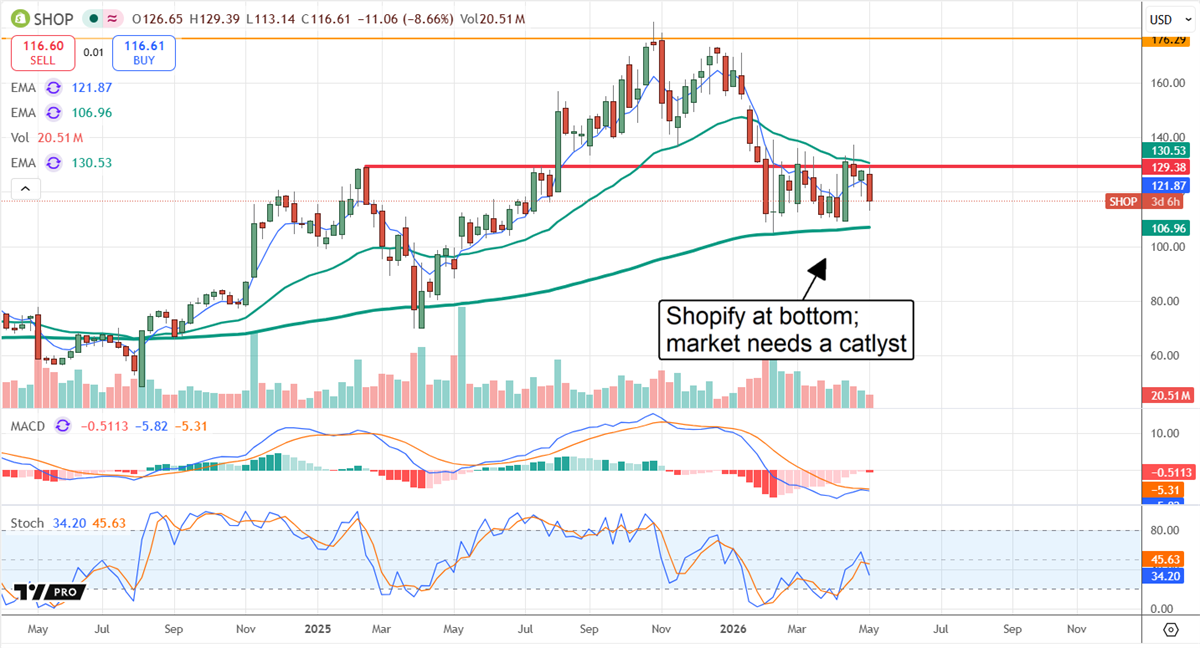
Catalysts in 2026 include the buyback authorized at the end of FY2025. Worth $1 billion, it underscores management's confidence in the company’s financial position and has begun providing shareholders with leverage. While incremental, sequential share count reduction will add up over time and help lift this market. Future catalysts include the potential to accelerate returns, such as additional buyback authorization and dividends. Risks include increased competition from names like Amazon (NASDAQ: AMZN) and Mercado Libre (NASDAQ: MELI), which continue to take commerce share in developing and emerging markets.
Where Should You Invest $1,000 Right Now?
Before you make your next trade, you'll want to hear this.
MarketBeat keeps track of Wall Street's top-rated and best performing research analysts and the stocks they recommend to their clients on a daily basis.
Our team has identified the five stocks that top analysts are quietly whispering to their clients to buy now before the broader market catches on... and none of the big name stocks were on the list.
They believe these five stocks are the five best companies for investors to buy now...
The article "Shopify’s Valuation Crisis Creates Opportunity in 2026" first appeared on MarketBeat.