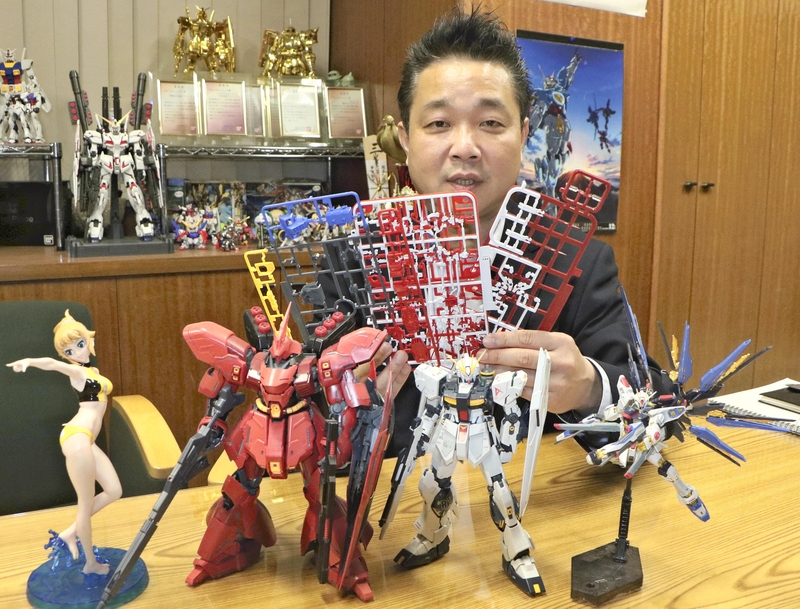
SHIZUOKA CITY -- This year marks the 40th anniversary of the launch of "Mobile Suit Gundam" plastic models, which first hit the shelves in 1980.
Manufactured at the Bandai Hobby Center plant in Shizuoka City, model kits featuring characters from the hit anime Gundam series continue to attract legions of fans, even today.
Continuous innovation, rigorous planning and craftsmanship of the highest quality are behind the popularity of the models.

The Shizuoka plant is in charge of all aspects of production, including product planning and design, which is done with 3-D computer-aided design (3-D CAD) software.
The plant ships more than 15 million products annually.
To make the first series of plastic models required skills using paints and adhesive agents to assemble models that looked like the ones depicted on the boxes.
Children who bought the products would struggle to apply coats of paint evenly or end up staining parts of the model with adhesive agents
Fortunately, it is now much easier to reproduce the likenesses of the characters from the much-loved anime series.
This partly due to a unique technique called "multicolor molding," in which multiple colors of plastic are used in a single mold.
Model parts are made by pouring melted plastic into metal molds.
Before, manufacturers were limited because only one color could be poured into a single mold. As a result, few models could be reproduced without hobbyists having to paint the assembled miniatures.
The original 1/144 Gundam kit included only white parts, while the original 1/144 Gouf had only blue parts. With the multicolor molding technology, four different colors can be poured into a single mold at once.
The plant has also introduced a molding technique that involves overlapping layers of resin. By adjusting the thickness of the surface layer so that the color of the underlying layer is visible, it is possible to create a finish that resembles human skin, with no paintwork involved.
"All scenes in the Gundam anime series can be perfectly reproduced," said Hirofumi Kishiyama, 51, assistant manager of the engineering team at Bandai Spirits Co.
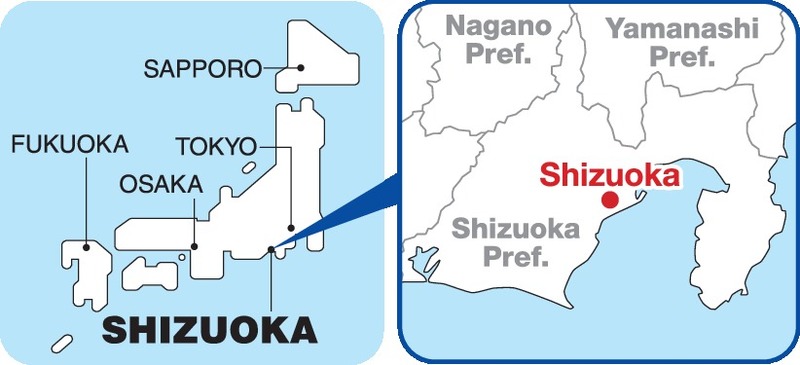
Shizuoka Prefecture is a major production area for miniature models. According to a survey by the Economy, Trade and Industry Ministry, the value of Japan's total shipment of plastic models in 2017 was about 20.4 billion yen. Shizuoka manufacturers accounted for about 18.3 billion yen, about 90 percent of the total.
Close to the Japanese Southern Alps, Shizuoka Prefecture is where many highly experienced wood craftsmen were based because of the region's high-quality timber. Bandai Co., Tamiya Inc. and many other major toymakers established production bases in the area as wood was one of the materials widely used in the industry.
A Bandai Hobby Center employee in charge of mold maintenance said: "This job requires advanced metalworking skills. A mark that is only a few millimeters long will be reflected in the product. My motivation stems from the fact that the world is our stage."
Read more from The Japan News at https://japannews.yomiuri.co.jp/