The establishment of Rekishi Shiryo Network (Shiryo Net) organizations, designed to rescue cultural property at times of disaster, has been spreading nationwide. The movement gathered momentum in the aftermath of the 2011 Great East Japan Earthquake.
More than 20 Shiryo Net organizations are active now. But there are limits to what can be done by owners of historical materials -- including archives and everyday tools -- in disaster-hit regional communities to preserve and administer them independently. Hence, the important roles of Shiryo Net have come into spotlight.
The first Shiryo Net was established in Hyogo Prefecture in the aftermath of the 1995 Great Hanshin Earthquake. Similar organizations were inaugurated in 2011 in six other prefectures, including Iwate and Ibaraki. Given the frequent occurrence of natural disasters in recent years, Shiryo Net organizations have been established in one prefecture after another.
In an open forum held Feb. 27 at Tohoku University in Sendai, Miyagi Prefecture, Shiryo Net activities in various parts of the country were discussed. Associate Prof. Atsushi Kawauchi of Tohoku University explained how archives were rescued in the town of Marumori and other municipalities of Miyagi Prefecture that were hit by Typhoon No. 19 last year. He said that archives about to be discarded as disaster debris were recovered and preserved as historical materials after conducting operations such as drying treatments.
Based on lessons learned from the Great East Japan Earthquake, Associate Prof. Yuichi Ebina of Tohoku University has been compiling a digital map of cultural properties. The map incorporates locations of yet-to-be-designated cultural assets that were found to exist through interviews with residents. Information obtained by comparing the map with the damage situation in flooded areas will be used as the basic data for mapping out rescue activities for historical materials in times of disasters.
Ebina recommends that relevant officials in other prefectures work out their own digital maps of cultural assets, saying, "To conduct effective rescue activities through the cooperation of disaster-stricken areas and other communities, it is essential to accumulate data before the occurrence of a disaster."
Hyogo Prefecture's Shiryo Net, which pioneered the cultural property rescue activities, is imparting its know-how to other areas of the country.
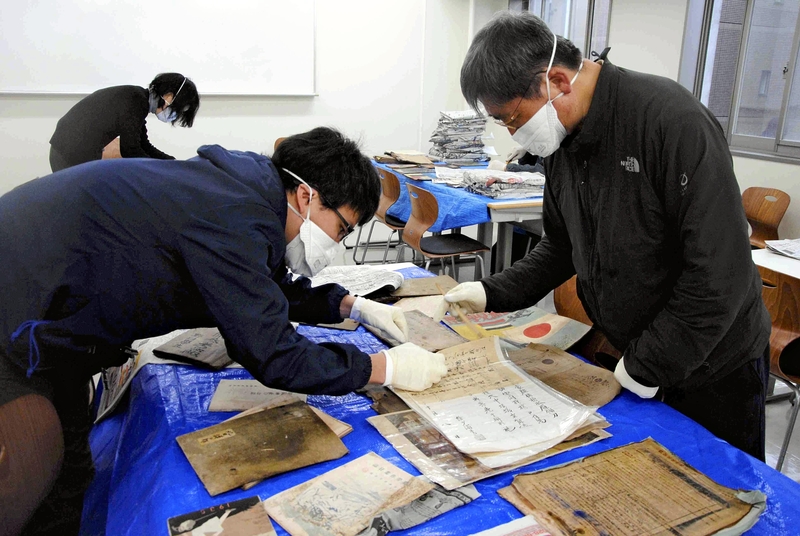
When Typhoon No. 19 hit eastern Japan last year, Hyogo Shiryo Net received a request for the rescue of historical materials from their owner in Sano, Tochigi Prefecture. The owner's collection of war-related items, including Rising Sun flags with messages of encouragement for those going to war and military mail, was said to have been flooded. Koichi Onozuka of the secretariat of Hyogo Shiryo Net, who is a researcher at Kobe University, and others rushed to the flooded area in Sano. There was no Shiryo Net in Tochigi Prefecture. Part of the historical materials were stored temporarily at Utsunomiya University. The work to remove moisture from the recovered materials was done on March 3-4.
Challenges to overcome
Associate Prof. Keiko Takayama of Utsunomiya University, who took part in this work, showed a willingness to establish a Shiryo Net in Tochigi Prefecture. She reportedly even told researchers about the history and folklore of the prefecture. "I felt it was really necessary to establish an organization to undertake rescue of historical materials in times of disaster."
Onozuka, a researcher of Kobe University, stressed that "it is desirable for Shiryo Net organizations to be set up in each prefecture." A future challenge is to reduce the number of prefectures where there are no Shiryo Net activities to zero. But some prefectures are faced with difficul situations, such as a lack of university instructors specializing in history who would play core roles in Shiryo Net activities.
A breakthrough measure that can be used as a reference amid such a situation is the promotion of cooperation in two or more prefectures. Four prefectures in the Tokai region ― Aichi, Gifu, Mie and Shizuoka ― set up Tokai Shiryo Net in February.
Taking into account that damage could be anticipated across expansive areas if an earthquake occurs in Nankai Trough, Tokai Shiryo Net aims to secure flexible response measures, including providing post-disaster support with the participation by researchers of the four prefectures that are deeply connected with each other culturally as well as residents interested in history.
As for rescued historical materials, a challenge is how to secure places for their preservation. During its activities in the aftermath of the 2016 Kumamoto Earthquake, Kumamoto Shiryo Net interviewed many residents who were at a loss of how to preserve historical materials, because their homes and storehouses were destroyed. Based on this experience, Prof. Tsuguharu Inaba of Kumamoto University has proposed setting up a public archive that can house valuable historical materials owned by individuals.
In the process of rescue activities, cases arose in which the value of materials was reassessed to become candidates for designated cultural property. It is hoped that Shiryo Net activities will further expand because they contribute to reassessment of regional histories.
Read more from The Japan News at https://japannews.yomiuri.co.jp/





.png?w=600)