Central Japan Railway Co., also known as JR Tokai, has begun developing a battery-powered mechanism that allows Shinkansen bullet trains to continue running for a period of time during power failures.
Shinkansen routes include a number of tunnels, bridges and elevated tracks, and would face challenges in quickly evacuating passengers in the event of a large-scale disaster such as an anticipated Tokai or Tonankai earthquake.
JR Tokai aims to install the battery in its new N700S model train, which will be introduced to the Tokaido and Sanyo Shinkansen lines in fiscal 2020.
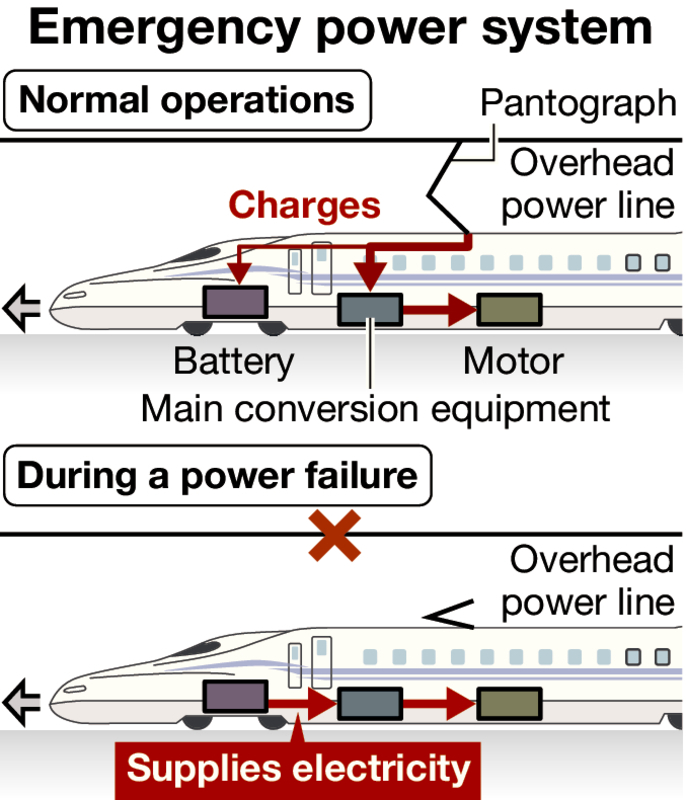
The battery would be placed beneath the floors of train cars, and will charge during the train's normal operation through wires running above the train. Should a power outage occur, the train will be able to continue running at about 30 kph.
Through the mechanism, JR Tokai hopes to enable trains to move clear of all tunnels and bridges, including the eight-kilometer Shintanna tunnel in Shizuoka Prefecture, the longest tunnel on the Tokaido Shinkansen line.
Shinkansen models have thus far lacked space for batteries due to the presence of other devices beneath the floor. However, JR Tokai has miniaturized and reduced the weight of such devices embedded in the N700S, freeing up space for the new batteries. The company plans to begin trials of the batteries in September.
The rescue and evacuation of passengers during power outages has become a significant challenge for railway companies.
Passenger evacuations
Following the Great East Japan Earthquake in March 2011, multiple trains on both Shinkansen and ordinary lines stopped between stations, forcing companies to transport passengers to nearby evacuation spots in buses and cars.
A similar problem occurred last September when trees toppled by Typhoon No. 18 triggered a power outage. Trains on the Sanyo Shinkansen line were stopped between stations for up to four hours, stranding about 290 passengers until operations resumed.
Areas where Tokaido Shinkansen trains run are expected to be hit by Tokai and Tonankai earthquakes in the future. A JR Tokai official said, "We want to implement [this mechanism] as a means of dealing with natural disasters."
Railway companies in the Tokyo metropolitan area are likewise moving to introduce emergency batteries.
Tokyo Metro Co. has begun installing batteries in some of its Ginza Line trains and plans to introduce them on the Marunouchi Line by the end of fiscal 2022. Keio Corp. installed the batteries in its latest train model, which started operations last September.
However, there are still technological and financial obstacles to miniaturizing and reducing the weight of the batteries. In response, some operators have decided not to modify their train cars, instead equipping electrical substations and other installations with power storage devices.
The Tokyo metropolitan government's transportation bureau plans to equip part of the electrical substations for the Toei Shinjuku Line with storage devices by the end of this year.
Read more from The Japan News at https://japannews.yomiuri.co.jp/