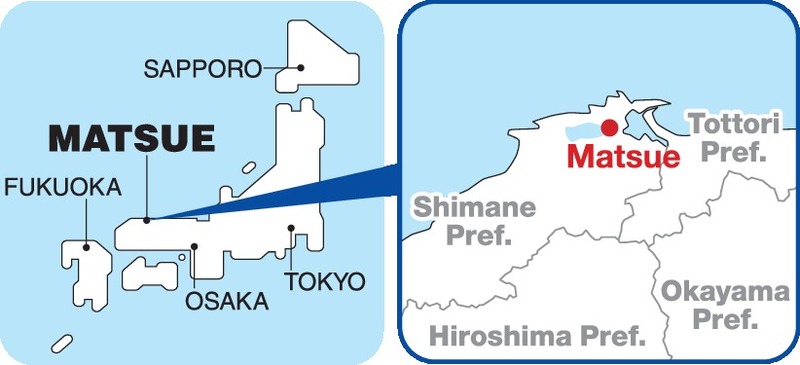
MATSUE -- This year marks the sesquicentennial of writer Lafcadio Hearn's (1850-1904) immigration to the United States from Ireland. He later became known in Japan as Yakumo Koizumi.
A special exhibition is being held at Koizumi Yakumo Kinenkan (Lafcadio Hearn Memorial Museum) in Matsue, focusing on the relationship between the Koizumi family and two Americans.
One of the two Americans is Bonner Fellers (1896-1973), who loved reading Yakumo's books. After the end of World War II, Fellers submitted a report about the advantages of avoiding an indictment of Emperor Showa, when he was a close aide to Gen. Douglas MacArthur, the supreme commander for the Allied Powers.
Among the exhibits, some items are being shown to the public for the first time, such as a sketch drawn by Yakumo himself that was found in a house of Fellers' grandchild, and a letter written by Fellers asking Walt Disney to make a movie about Yakumo's life.
Japanese feelings
Fellers learned about Yakumo's books from a Japanese student who came to the United States to study and with whom he got acquainted in his university years. Fellers was deeply impressed by the books.
When Fellers came to Japan in 1930, he visited Yakumo's wife, Setsu, and told her, "He taught me to love Japan." Fellers went on to deepen his friendly ties with the Koizumi family.
Once the Pacific War began, Fellers ironically commanded U.S. soldiers as an expert on the psychological war against Japan.
Fellers had empathy for Yakumo's way of understanding Japanese culture that the people's worship for ancestors and emperors are in an inseparable relationship.
After the end of the war, Fellers described the Emperor as "a symbol of the people" in his report to MacArthur dated Oct. 2, 1945. It is said that the report played an important role in deciding the course that Japan should take after the war.
Resumption of exchanges
On the other hand, Fellers reconnected with the Koizumi family and resumed his exchanges with them. He supported the family's daily living by continuing to send them food and clothing.
In the exhibition, letters sent to Fellers by Kazuo Koizumi, Yakumo's eldest son, in 1947, is displayed.
In one of the letters, Kazuo expressed his gratitude for the goods sent by Fellers and wrote that the Koizumi family "deeply bowed" to a portrait of Fellers.
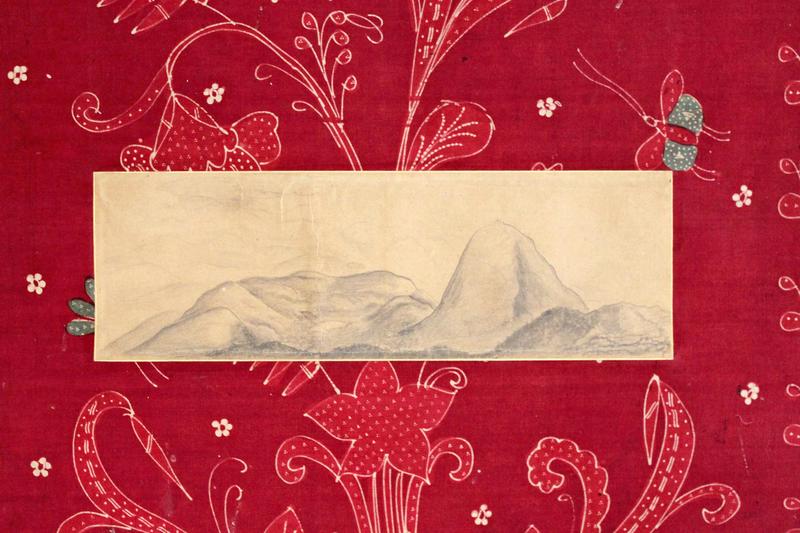
An eye-catching item in the exhibition is a hanging scroll, which Kazuo presented to Fellers when Fellers went back to the United States in 1946.
The hanging scroll is decorated with a sketch of scenery on Martinique Island in the Caribbean Sea, where Yakumo lived before coming to Japan. The sketch was found in the house of Fellers' grandchild by Bon Koizumi, a grand-grandson of Yakumo and the director of the museum, and others.
In a letter from Kazuo to Fellers to announce the birth of Bon, Kazuo wrote about his delight, saying, "We named [the baby] Bon" after "Bonner."
After the end of the war, Fellers sent a letter to Walt Disney asking him to make a movie that would introduce the life of Yakumo. The letter indicates how deeply Fellers admired Yakumo. A reply from the Disney side said that such a movie would not match the taste of the company's products.
Love-like ties
Another American who was fascinated by Yakumo's books is Elizabeth Bisland (1861-1929). In the exhibition, letters and books showing her close ties with Yakumo are displayed.
Bisland was impressed by articles written by Yakumo when he worked as a newspaper reporter in New Orleans. She joined the same newspaper company.
She understood Yakumo's literary talent and insight. After her visit to Japan, she made efforts so that Yakumo, who was struggling at the time, would be able to give lectures in a university in the United States. She continued to exchange letters with Yakumo until he died.
In letters displayed in the exhibition, she wrote, "You would never know what a delight your books had been to me." When Yakumo suffered illness, she wrote, "I wish I were near enough to help nurse you."
Yakumo expressed his frank feelings in his letters, writing in one, "I ought not tell you of any troubles of mine -- but if I could not, what would have happened to me?"
The written conversations reveal that the relationship between Bisland and Yakumo was a friendship resembling that between lovers in their minds.
A copy of Yakumo's posthumous book, "Japan -- An Attempt at Interpretation," is displayed in the front of the exhibition hall. The book is a compilation of Yakumo's drafts for lectures in a U.S. university, which were not realized.
It is said that Fellers read the book later and recommended to MacArthur that he avoid indictment of Emperor Showa as a war criminal.
Shoko Koizumi, coordinator of the museum, said: "The work connected the two who admired Yakumo. By introducing these two with close ties to the Koizumi family, we want to show the roles played by Yakumo for the mutual understanding between Japan and the United States."
The special exhibition lasts until June 7 next year. For more information, call the museum at (0852) 21-2147.
Read more from The Japan News at https://japannews.yomiuri.co.jp/