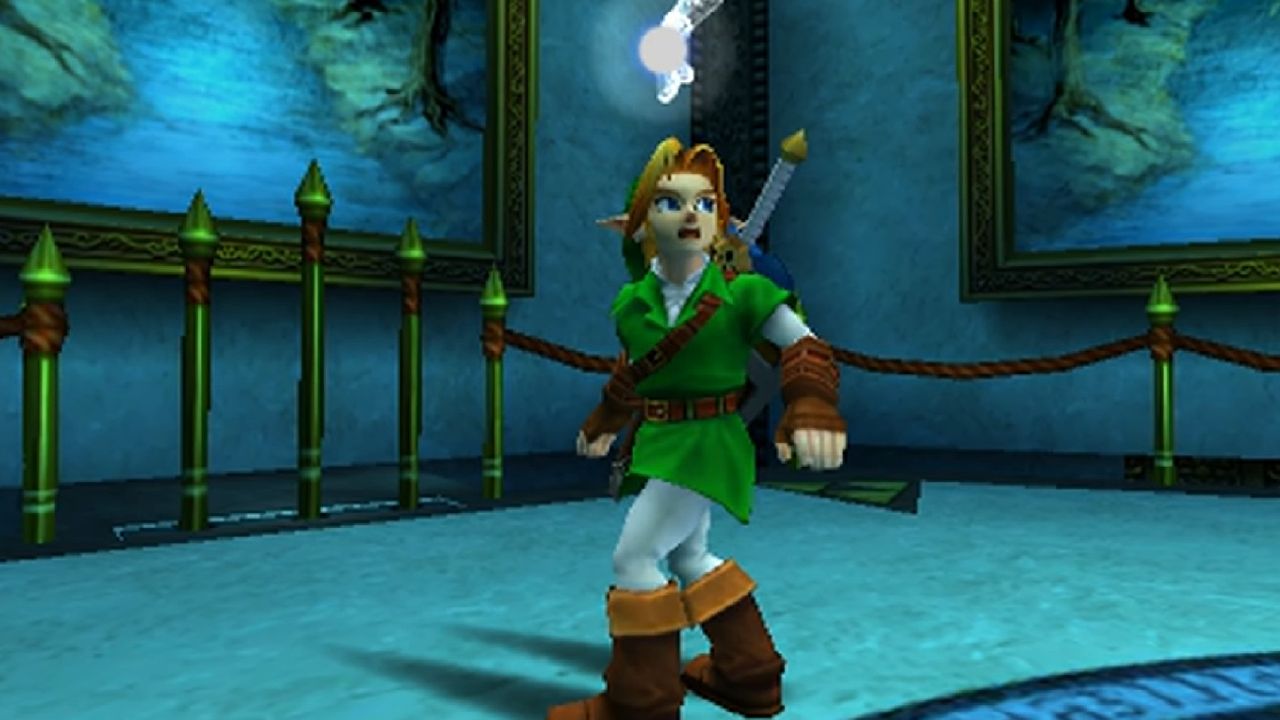
Breath of the Wild effectively did away with old-school Zelda dungeons, and while Tears of the Kingdom brought the idea back, it was without the traditional puzzle box design of the classic games. One of the most exciting parts about the upcoming Ocarina of Time remake is the opportunity to explore these challenges with modern graphics and visual flair, but ironically, it was during the production of the original Ocarina of Time that Shigeru Miyamoto decided traditional dungeons were boring in the first place.
"In every Zelda development, the dungeons take a huge amount of time to make," Miyamoto explained in a 1999 interview that was translated some years ago by Shmuplations. "I can't tell you how many times they end up having to be remade and revised, while the team is on the verge of tears. Did you know, in the original Legend of Zelda, at the beginning of the development it was just dungeons. There was no overworld map. That's a testament to the 'Dungeon Supremacy' philosophy we've always followed."
The Zelda games immediately following Ocarina of Time – Majora's Mask and The Wind Waker – would notably have fewer dungeons, featuring instead a much bigger focus on overworld exploration. Twilight Princess, I suppose, served as a return to that "dungeon supremacy" era in some respects, but modern entries have very much broken from that structure.
"With Ocarina of Time, for the first time we didn't spend as much time on the dungeons," Miyamoto explained in that interview, describing that decision as a very "'un-Zelda' thing to do." That's partly due to the fact that the developers had something of a fresh canvas to work with, no longer iterating on the ideas from A Link to the Past. "To the extent that we weren't constrained by earlier notions, it went fairly quickly," Miyamoto added.
"You know, we asked ourselves whether those mazes, where everything is always linked in a linear fashion, are actually still interesting to players," Miyamoto said. "Is it still fun to spend all that time plotting your way through them? And the conclusion we came to is no, it's not really that much fun. Instead of mapping your way through a maze, I think what's more important is a sense of dread, a sense of pressure, and of course an opportunity for finding secrets and solving puzzles – we should be pursuing an emotional immediacy, the sense that you are really there."
Miyamoto added, "There are still traditional mazes, like Gerudo's Fortress and the Forest Temple, but overall I don't think those are very appropriate to a 3D game."
I feel like that quote in particular goes a long way toward explaining why Nintendo has at times seemed reluctant to fully populate Zelda games with classic dungeons. Certainly, the idea of "mazes" that are "linked together in a linear fashion" has been effectively dead since Breath of the Wild, but it's wild to see that sentiment expressed just after the launch of Ocarina of Time, which was arguably the peak of the series' classic formula.
In my mind, the Ocarina of Time dungeons are the most memorable ones in the series. Admittedly, that might have something to do with the fact that I played the game to death at a very impressionable age, but the theme, the atmosphere, and the puzzles have always stuck with me more than anything else in the series.
Getting to see locations like Gerudo's Fortress and the Forest Temple from a new perspective is the whole reason why I'm excited for the remake. This style of Zelda game hasn't been around in years, and some primitive part of my gamer brain is dying to see old-school dungeon designs with modern bells and whistles. I hate to say that Miyamoto is wrong, but these dungeons are still plenty interesting to me.
These are the best Zelda games of all time.