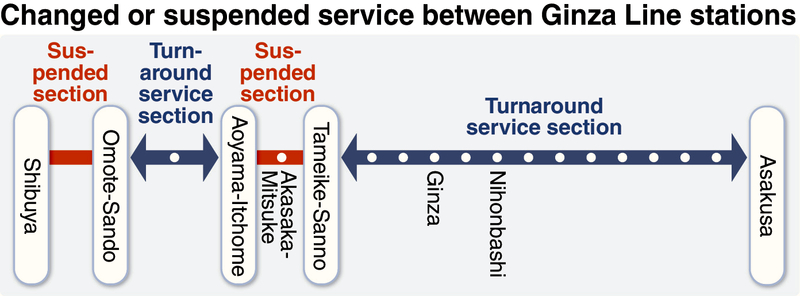
Train operation on Tokyo Metro's Ginza Line, connecting Asakusa and Shibuya stations, will be partially suspended from Saturday for six days until Thursday in two sections, one between Shibuya and Omote-Sando stations and the other between Aoyama-Itchome and Tameike-Sanno stations, due to construction to relocate Shibuya Station to a nearby site. This will be the longest train suspension for Tokyo Metro Co. for construction-related reasons and is part of an ongoing, large-scale redevelopment project in the Shibuya district. It is said that a project of this scale is a "once-in-a-hundred year" event that will drastically change the landscape of Shibuya district.
Shibuya Station, on the Ginza Line, was inaugurated in 1938. Among the 179 stations operated by Tokyo Metro, Ginza Station is the eighth largest in terms of the number of passengers seen daily with roughly 220,000 people per day in fiscal 2018.
The station has been plagued with severe congestion of passengers largely caused by the narrow platforms during rush hour, which is a result of the station being located on the third floor of Tokyu Department Store's Toyoko Store.
The new station is being constructed right above Meiji-dori avenue, or about 130 meters east of the current station. The construction project, which was started in 2009, has suspended train operation twice, a total of four days in 2016 and three days in 2018. The expected suspension is required in order to complete final-stage work such as completion of the new platform facilities and switching railroads. The width of the platforms at the new station will be enlarged to 12 meters.
During the six-day suspension, Tokyo Metro will provide turnaround services in two sections, one between Omote-Sando and Aoyama-Itchome stations, and the other between Tameike-Sanno and Asakusa stations as well as replacement train services including via the JR lines.
Subhead: Unraveling the Shibuya 'labyrinth'
In and around Shibuya Station, the redevelopment project, led by Tokyu Group joined by Shibuya Ward Office and East Japan Railway Co. (JR East), has been underway.
In the vicinity of Shibuya Station, starting with the completion of the Shibuya Hikarie in 2012, new landmark high-rises have been completed one after the other, including the Shibuya Stream and the Shibuya Fukuras. Last month, a roughly 230-meter tall building, the tallest in the Shibuya area, the Shibuya Scramble Square East Tower was opened. In fiscal 2023, another three complex facilities are slated to be completed southwest of Shibuya Station. The redevelopment project will continue to fiscal 2027, when Central and West Towers of Shibuya Scramble Square will be built on the site of Tokyu Department's Toyoko Store, which is scheduled to be closed and thereafter dismantled.
The complex flow of people around Shibuya station has been notoriously dubbed a "labyrinth." The train lines and National Highway Route 246 have been divided into parts and both the station and the railway companies have gone through multiple changes, causing further confusions among patrons of the station. The redevelopment project, however, is expected to improve the mobility issues with plans including the installation of sidewalk and the connection of facilities around the station
Subhead: Hachiko statue to be moved
Shibuya earned the nickname, "Bit Valley," resembling Silicon Valley in the 1990s, by attracting many IT start-up companies. However, when the IT bubble burst, the area's confined office spaces along with other factors contributed to these companies' relocating elsewhere. As the redevelopment project materialized, the district has been regaining its appeal, attracting companies like Google Japan G.K. and CyberAgent, Inc to the area.
The famous area in front of the station, Hachiko Square, will be expanded by about 60%, making use of the newly available space which will comes from the dismantlement of Tokyu Department Store's Toyoko Store. The symbolic statue of the faithful Akita dog, Hachiko, will also be relocated within the planned new site.
Caption
Courtesy of Tokyo Metro Co.
Train cars of Tokyo Metro's Ginza Line
Read more from The Japan News at https://japannews.yomiuri.co.jp/