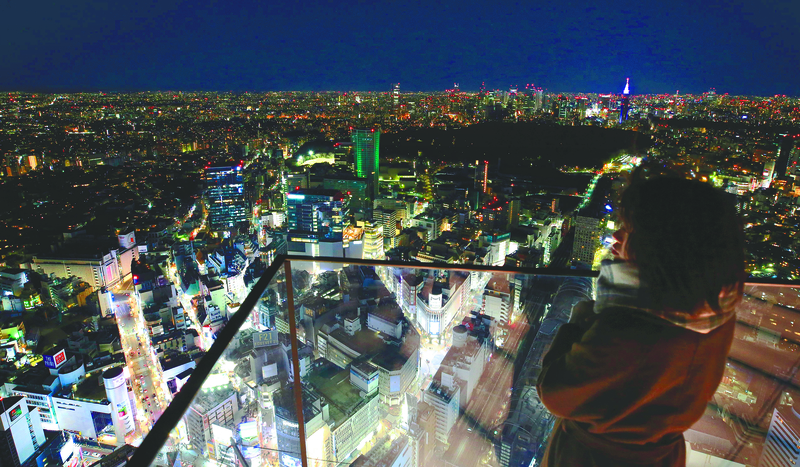
There is nothing to hinder my view of the night sky in Shibuya Ward, Tokyo, from the rooftop of a building 229 meters above the ground. It's truly a magnificent view.
Below, two of the things that best symbolize Shibuya -- the flashing lights of the scramble intersection and the neon-illuminated streets -- flash beneath me. The skyscrapers of Shinjuku glitter in the distance.
The east building of Shibuya Scramble Square opened for business in November 2019. Atop it is an observation deck overlooking the famous intersection called Shibuya Sky, which is surrounded by a glass barrier that stands just shy of average adult height.
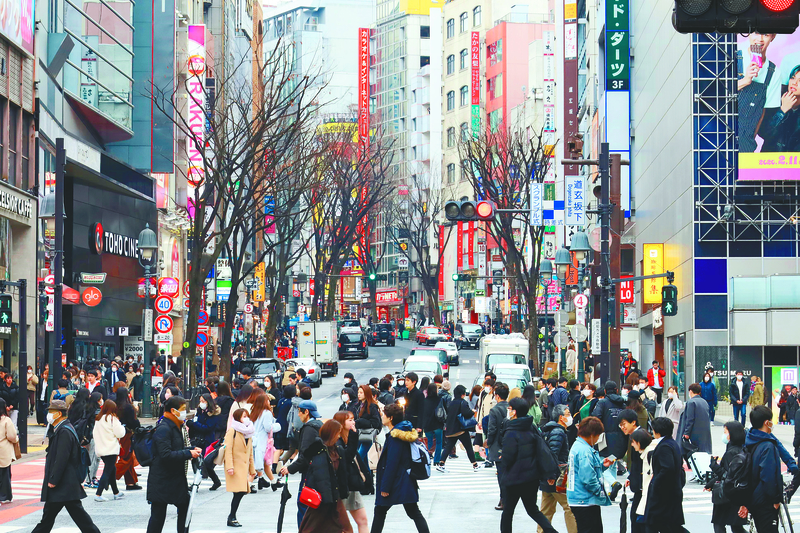
"The dazzling lights, the sounds of car engines, people briskly crossing the road. You can experience the scenery, sound and atmosphere of Shibuya," said 38-year-old manager Jun Shinya.
The observation deck offers a 360-degree panoramic view, a rarity among Tokyo's skyscrapers. "We went with clear glass, so those who are afraid of heights may feel a little scared," Shinya added.
I visited the rooftop during the daytime, but my feet were frozen in fear from the height.
The east building also houses commercial facilities and offices in its 54 stories -- 47 above ground and seven below. Large commercial facilities tend to steal customers away from local shopping streets, but Kenji Onishi, chairman of the shopping organizations' federation in Shibuya Ward, welcomes the new development. "People flow from commercial buildings to the shopping streets and they walk around all over the area," he said. "We can coexist and prosper together."
There are also many chic restaurants and clothing stores in the east building, and people in their 40s to 60s also visit frequently.
"From now on, it won't be just young people, but people of all ages, including foreign tourists, will visit and interact with each other. Shibuya will develop," said Onishi.
From the end of the Showa era to the Heisei era, Shibuya was the epicenter of youth culture: Fashion building Shibuya 109; "Ganguro" and "Yamamba" distinctive fashion for girls; the New Year's countdown; and Halloween costumes.
As part of the large-scale redevelopment project in front of Shibuya Station, Shibuya Hikarie opened in 2012. The central and west buildings of Shibuya Scramble Square will open in fiscal 2027, connecting many buildings, including the east building, to the station on the second floor. The project is overseen by Tokyu Group, East Japan Railway Co. (JR East) and Tokyo Metro.
The current large-scale redevelopments are said to be a once-in-a-century event. There is a hope from Tokyu, which initiated the development, that not only young people, but also a wide variety of people, will interact with each other and that a new culture will once again be born in Shibuya, as the name "scramble" suggests.
Kenji Ishii, a professor at Kokugakuin University's Faculty of Shinto Studies and author of books on Shibuya, holds somewhat skeptical views: "Shibuya has created unique cultures that came about naturally among the people who gathered there. There is no doubt that redevelopment will revitalize the area. However, I wonder if a wide range of generations and foreign tourists can be fused to create a new culture."
How will the large-scale redevelopment change Shibuya culture? Looking down on Shibuya 109, I pondered this for a while on the observation deck that opened in the dawn of the Reiwa era.
Read more from The Japan News at https://japannews.yomiuri.co.jp/